
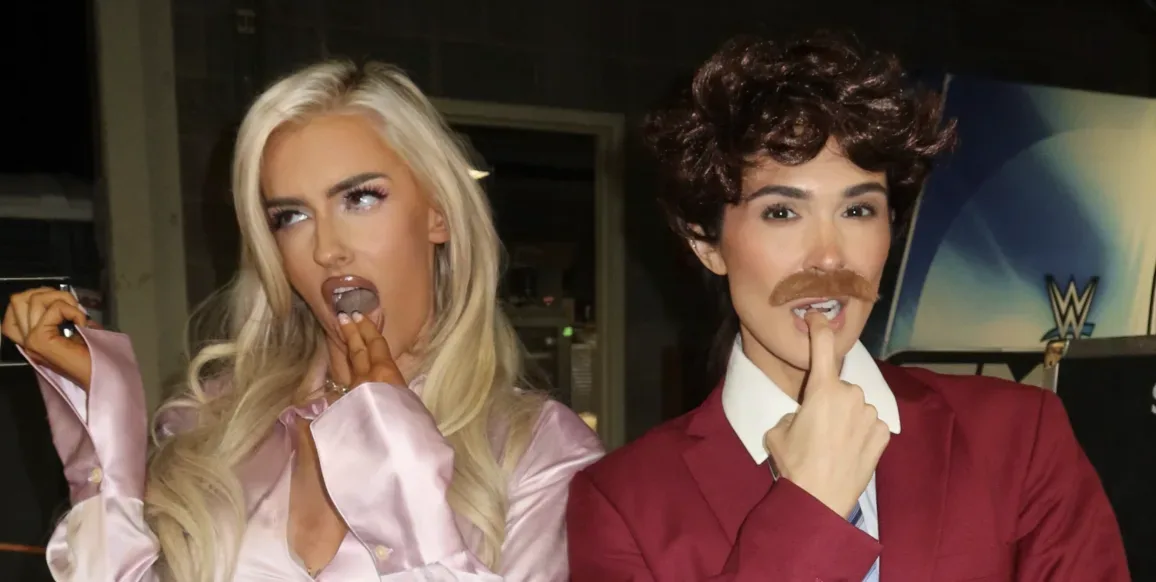
Halloween 2026 has once again given professional wrestling personalities an opportunity to step away from their usual on-screen presentations and embrace a different kind of character work. Across social media, wrestlers from multiple corners of the industry shared their seasonal celebrations, adding to a yearly tradition that routinely produces some of the most entertaining off-camera content of the fall.
Wrestling is an industry built around distinctive appearances, entrances, catchphrases and larger-than-life personalities. That makes Halloween an especially natural fit. While performers regularly appear in elaborate gear or carefully constructed television personas, the holiday offers a chance to celebrate outside the expectations of a weekly wrestling program. For one night, the usual boundaries between athlete, character, fan and pop-culture enthusiast can become far less rigid.
Saraya was among the wrestling names to take part in the Halloween conversation, sharing a post as the holiday arrived. Her inclusion reflects the broad reach of the annual celebration, which extends well beyond one promotion or one specific locker room. Halloween content routinely becomes a cross-promotional moment in wrestling, as performers and fans alike compare costumes, celebrate favorite films and characters, and enjoy a lighter side of an often intensely competitive business.
View the referenced post on X
View the referenced post on X
View the referenced post on X
A Tradition That Fits Professional Wrestling
Costumes are hardly unfamiliar territory for wrestlers. A wrestler’s attire can communicate an enormous amount before a bell ever rings. It can establish a competitor as dangerous, charismatic, unconventional, glamorous, rebellious or mysterious. Some of the most memorable presentations in wrestling history have depended as much on visual identity as anything said in a promo or done in a match.
For more background on this topic, read Court Bauer Details MLW’s Near-Deal With Paramount Before UFC Agreement.
Halloween differs from a standard entrance, however, because it often allows performers to share something more personal. A costume can point to a favorite movie, television series, comic-book character, musician, game or cultural touchstone. It can also be a group effort involving friends, partners, families or fellow wrestlers. Even when the post is brief, it gives audiences a glimpse at the interests and humor behind a familiar wrestling identity.
That is part of why Halloween has become a dependable social-media event for the wrestling world. The business is rooted in character, but performers are not confined to one role when the cameras for weekly programming are off. Holiday posts create space for a wrestler to be playful, inventive or intentionally unexpected without affecting an ongoing rivalry or championship picture.
For fans, that contrast is often the appeal. A performer who is presented as a villain on television may share a lighthearted costume at home. A wrestler known for a serious, intimidating demeanor may lean into comedy. Others may choose looks that connect directly to the genres and fandoms that overlap so heavily with wrestling audiences, including horror, fantasy, superheroes, animation and gaming.
Names From Around Wrestling Join the Conversation
The Halloween posts circulating this year include participation connected to names such as Anthony Bowens and Charlotte Flair, illustrating how quickly the celebration spreads throughout the broader wrestling community. It is not limited by company affiliation, brand placement or storyline alignment. During the holiday, wrestlers, managers, personalities and supporters can all occupy the same online conversation.
That shared aspect is meaningful in an industry where promotions are ordinarily competing for audience attention. Halloween does not erase those competitive lines, but it does create a moment where the focus can shift away from wins, losses, title pursuits and rivalries. The common subject is creativity rather than competition.
Charlotte Flair has long been one of the most recognizable figures in WWE, while Bowens has established himself as a prominent name in AEW. Their appearances in the wider Halloween discussion demonstrate the way social media can bring together performers whose regular professional paths do not cross. Fans are able to enjoy the posts on their own terms, without needing the moment to lead into a televised segment or a future match announcement.
The annual costume cycle also provides a reminder that wrestlers have diverse interests beyond the roles they portray in front of live crowds. A social post may be simple, but it can spark conversation among fans who recognize a reference or appreciate the effort behind a look. Those interactions have become an increasingly important part of how performers maintain a connection with their audiences between events.
The Value of Off-Screen Personality
Modern wrestling is not experienced only during a two- or three-hour television broadcast. Fans follow performers through interviews, convention appearances, video content and social platforms. Holiday moments have become part of that wider ecosystem, particularly because they offer content that is immediate and easy to share.
There is also a useful balance at play. Wrestling stories are frequently driven by conflict, whether that means a personal grudge, a championship chase, a betrayal or a difficult comeback. Halloween content is usually free of that pressure. It allows performers to participate in a communal event without needing to advance an angle. In many cases, the simplicity is precisely what makes the posts enjoyable.
That does not mean the holiday is disconnected from wrestling’s creative culture. On the contrary, the care wrestlers put into costumes can be seen as another expression of a profession that values visual detail and crowd reaction. A successful costume, like a successful entrance, has to land quickly. It should be recognizable, confident and true to the person wearing it, even if it is meant to be humorous or surprising.
Halloween also provides a different venue for camaraderie. Wrestlers spend substantial time traveling, training and working in high-pressure environments. Social celebrations around holidays can show the friendships and family connections that exist away from the spotlight of a wrestling card. For audiences accustomed to seeing people positioned as opponents, those moments can be a welcome change of pace.
A Growing Annual Social-Media Event
As Halloween posts continue to roll in, the collection of costumes is likely to remain one of the day’s more lighthearted wrestling conversations. The holiday’s appeal is broad enough to encompass established stars, newer talent, retired names, wrestling media personalities and fans. That variety is central to its staying power.
Not every costume post needs an elaborate explanation to connect. Sometimes the reaction comes from the visual itself. Other times, fans enjoy identifying a reference, noticing a group theme, or seeing an unexpected choice from someone whose wrestling persona is already so firmly defined. In an entertainment form built on audience participation, Halloween gives supporters another way to respond, share and celebrate alongside the performers they watch year-round.
The latest round of posts serves as a reminder that wrestling’s sense of spectacle does not begin and end at the entrance curtain. The industry’s performers are accustomed to transforming themselves for a crowd, but Halloween puts that creative instinct in a more casual setting. It is an opportunity to have fun with identity rather than defend it in the ring.
For Saraya, Charlotte Flair, Anthony Bowens and the many other wrestling personalities participating in the festivities, the day is another chance to engage with fans beyond their usual professional settings. As more Halloween content surfaces, the celebration will continue to offer a snapshot of the wrestling community at its most playful: connected by creativity, character and a shared enthusiasm for dressing up.

Darryl Polo
Darryl Polo is a passionate wrestling fan covering WWE, AEW, TNA and beyond. He loves great rivalries, breakout stars and the moments that keep fans talking long after the bell. How we work.