
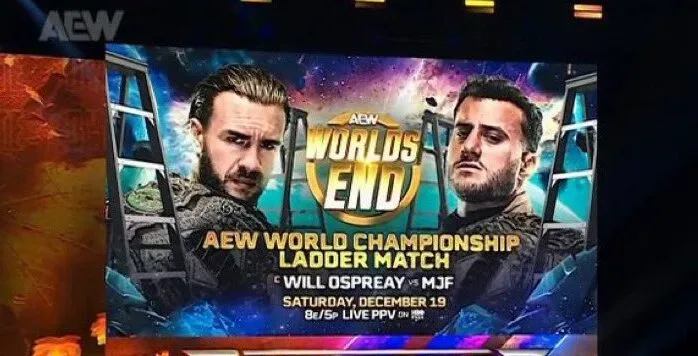
Will Ospreay and MJF will meet in a Title vs. Title ladder match at AEW Worlds End. AEW confirmed the bout on Dynamite, where Ospreay answered MJF’s challenge from the previous week with a stipulation of his own. MJF wanted the two to put their championships on the line, but he had no interest in settling the issue in a ladder match. He turned down the proposal in the ring, only for the official match graphic to appear on the screen behind him.
The announcement settled two questions at once: Ospreay is taking the match, and it won’t be contested under standard singles rules. The way AEW delivered the news made MJF’s reaction part of the reveal. He had returned to the ring with a microphone and a chance to press the challenge he’d already made. By the end of the segment, the match was set on terms he’d just rejected in front of the Dynamite crowd.
Ospreay answers MJF’s challenge from home
MJF laid the groundwork a week earlier on Dynamite when he challenged Ospreay to a Title vs. Title match at Worlds End. Putting both championships at stake was Friedman’s idea. When he returned for another in-ring promo this week, he learned that Ospreay had sent in a video message from home. Ospreay didn’t appear in the ring opposite him, but his response turned the segment into a negotiation over how the match would be fought.
View the referenced post on X
Ospreay’s counterproposal kept the championship stakes intact. He wasn’t looking for a match with only one title on the line, or for a non-title bout to settle the dispute. Instead, he suggested they make it a ladder match. It was a way to answer MJF without simply accepting the terms as presented: Friedman had picked what they would fight over, and Ospreay wanted a say in how they would fight for it.
For more background on this topic, read Jay White Sets the Continental Classic Pace as Mike Bailey and Jon Moxley Win on Dynamite.
MJF scoffed at the suggestion and dismissed it quickly. Had the exchange ended there, Ospreay’s message would have left a clear point of disagreement for the two to revisit before Worlds End. Instead, AEW put the graphic on the screen behind MJF while he was still in the ring. The ladder match was no longer a counteroffer waiting for his approval. It was the advertised match.
The graphic gets the last word on Dynamite
The timing gave the announcement its punch line. MJF was the one standing in the ring, with the microphone and the opportunity to tell the crowd what he thought of Ospreay’s idea. Ospreay’s part of the exchange had been recorded elsewhere. Yet it was the man on the video who got the stipulation he wanted, and the man with the live microphone whose answer was immediately undercut by the screen behind him.
That distinction matters because MJF wasn’t backing away from his own Title vs. Title challenge in the segment. His objection was to the ladder stipulation Ospreay attached to it. AEW’s graphic kept the match Friedman asked for and added precisely the condition he wanted to leave out. There was no drawn-out argument or handshake to mark an agreement. The graphic was the confirmation, and MJF’s refusal was still fresh when it appeared.
For Ospreay, getting the stipulation is a win in the build, not a result at Worlds End. He made a proposal and got it onto the card without making an in-ring appearance in the segment. For MJF, the reveal leaves him with a straightforward point to address the next time he talks about the match: he got the opponent and the championship stakes he wanted, but he didn’t get to decide the rules on his own.
What the ladder stipulation changes at Worlds End
The difference between a ladder match and a standard singles bout is more than the presence of a ladder at ringside. Under traditional ladder-match rules, a wrestler wins by climbing to retrieve what’s suspended above the ring rather than by scoring a pinfall or forcing a submission. A move that could ordinarily end a match might only buy enough time to start a climb. And a wrestler who has taken the worst of the exchange can still keep the match alive by stopping an opponent from reaching the prize.
That creates a different kind of timing problem for both men. Being first to the ladder doesn’t mean it’s the right moment to climb. Leaving an opponent down on the mat is useful only if that opponent stays down long enough to let the climb finish. The stipulation also gives the wrestler who is behind a goal short of turning the whole match around: interrupt one attempt, get both men back on the mat, and force the other to start again.
Ospreay’s choice of rules doesn’t make him immune to any of that. The same format that lets him win without pinning MJF also means that getting the better of Friedman in the ring won’t be enough on its own. MJF, meanwhile, doesn’t have to like the stipulation to take advantage of it. If he can create the last opening and make it to the top, it won’t matter that the ladder was Ospreay’s idea. That’s the competitive question the announcement adds to a match that already had championship stakes.
Both championships remain at stake
The Title vs. Title billing remains central to the Worlds End bout. This isn’t a ladder match added in place of the championship challenge; it’s the format AEW confirmed for that challenge. Neither wrestler goes into the match with only the prospect of winning something from the other. Each has a championship at stake, which is what made MJF’s initial proposal consequential before Ospreay added his condition.
There’s a clear division in how the match came together. MJF called for the meeting at Worlds End and proposed putting both titles on the line. Ospreay used his response to call for a ladder. AEW made the combination official on Dynamite, in the one moment when MJF was making it clear that he didn’t want both ideas to stand. At Worlds End, Friedman will get to pursue the championship prize he asked for, but he’ll have to climb for it.

Darryl Polo
Darryl Polo is a passionate wrestling fan covering WWE, AEW, TNA and beyond. He loves great rivalries, breakout stars and the moments that keep fans talking long after the bell. How we work.