
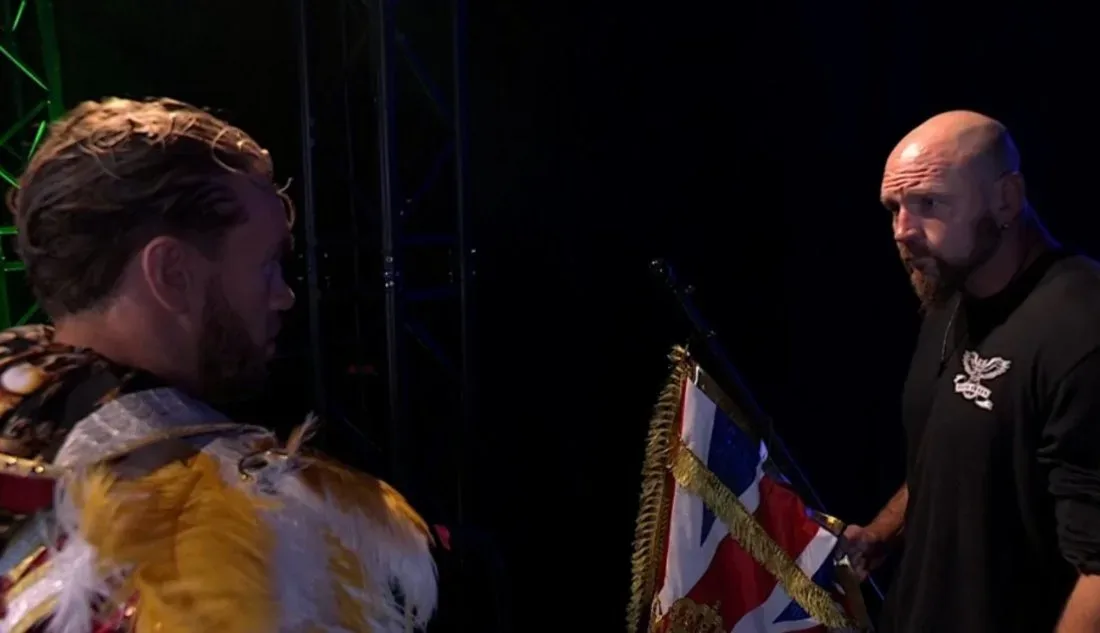
Will Ospreay’s AEW All In entrance at Wembley Stadium was designed as more than a standard walk to the ring. Before Ospreay emerged to his usual “Elevated” theme, AEW presented a video package narrated by his mother and followed him through a lengthy backstage walk that featured several of the rivals most associated with his career. The presentation was set to The Who’s “Baba O’Riley,” adding a distinctly British atmosphere to one of the company’s biggest annual events.
As memorable as the finished version became, Ospreay has revealed that “Baba O’Riley” was not the original song he hoped to use. Speaking on Insight with Chris Van Vliet, Ospreay said another track was initially under consideration, but AEW was unable to secure it because of licensing costs.
“There was a song that we wanted, but we just couldn’t get a license fee for it,” Ospreay said. “I won’t put it out there because maybe one of these days I will be able to track it down again. I’d like to leave that as a surprise.”
Ospreay did not identify the song he originally wanted. That decision leaves open the possibility that it could be used for a future entrance or major career moment if the licensing situation changes. For now, he has chosen to keep the title private rather than reveal an idea that he may still hope to revisit.
For more background on this topic, read Chris Jericho vs. Nick Wayne, Death Riders Trios Match Announced for September 16 AEW Dynamite.
The alternative came from AEW’s Mike Mansury, who suggested using The Who classic for the video and backstage sequence. While Ospreay initially had some uncertainty over whether the song was the right fit, he eventually felt the selection became perfect once it was paired with the package’s narration and imagery.
“But it was Mike Mansury that came up with the idea of The Who ‘Baba O’Riley,’” Ospreay said. “I’ll be honest with you, I have a connection with that song because there was a music video from the MV Zone. It was like a kind of little backyard wrestling music video group, and they did a Bryan Danielson tribute to that song, so I have a little bit of a connection to it.”
How “Baba O’Riley” Became the Right Choice
“Baba O’Riley” is among The Who’s most recognizable songs, and its use at Wembley carried an obvious local connection. The Who are British, while Ospreay’s appearance in London represented a homecoming setting on a grand scale. Yet Ospreay explained that the national connection alone did not immediately sell him on the idea.
He had a pre-existing association with the song through the MV Zone, a backyard wrestling music video group that created a Bryan Danielson tribute around it. That memory made the choice feel connected to wrestling long before AEW considered it for one of Ospreay’s own marquee moments.
Still, Ospreay said he was not completely convinced during the early stages. The unnamed song he had wanted was a personal favorite and generated a stronger immediate reaction from him. As he listened to “Baba O’Riley” while traveling with Al, he questioned whether it delivered the feeling he had envisioned for the entrance.
“I was just okay, I quite like the idea and The Who is British as well, so that’s kind of cool,” Ospreay said. “But I remember listening to it and on the travels that me and Al did, and I was just like, I don’t know if I feel it. The other song that I wanted got my juices flowing. It was my favorite song. I don’t know if I feel it.”
That hesitation changed when Ospreay heard the final voiceover and saw the clips prepared for the package. Rather than judging the music as an isolated choice, he saw how it worked as part of the full production: the words from his mother, the footage surrounding his journey, the backstage walk and the significance of the Wembley setting.
“It was only when I heard the voiceover and I saw the clips that were all around it,” Ospreay said. “I was like, this is perfect. This is it. Don’t change a thing.”
A Presentation Built Around Ospreay’s Journey
AEW All In at Wembley Stadium was naturally a major stage for Ospreay. The building and city gave the entrance an opportunity to frame him not simply as an AEW wrestler making his way to a match, but as a British performer returning to a venue that amplified the scale of the occasion.
The extended presentation reflected that idea. Ospreay did not immediately appear to his regular entrance music. The “Baba O’Riley” sequence first established a broader emotional tone, using the narration from his mother and the visual reminders of opponents who have played important roles in his career. Once that sequence concluded, Ospreay entered to “Elevated,” preserving the music that fans associate directly with him while allowing the earlier song to function as a prologue.
That distinction matters. “Baba O’Riley” was not a replacement for Ospreay’s established theme. It was part of a specific All In production concept. The song helped turn the walk into a retrospective, while “Elevated” remained the cue for Ospreay’s arrival.
Ospreay’s comments also underline how much creative presentation can depend on elements outside a wrestler’s personal preference. He had a song in mind, but music licensing prevented that choice from moving forward. AEW then found another option through Mansury’s suggestion, and the final result won Ospreay over because every part of the package complemented the others.
Licensed music has frequently been a complicated part of wrestling production. A song can be ideal creatively while still being unavailable because of cost or rights issues. Ospreay’s account is a clear example of a presentation changing in response to that reality. Rather than publicly naming the original selection and treating it as a missed opportunity, he has kept it in reserve and expressed hope that he may someday be able to pursue it again.
The Personal Weight of the Voiceover
The use of Ospreay’s mother as the voice of the video package gave the Wembley presentation an especially personal dimension. Ospreay also discussed the process of getting his mother involved in the voiceover during the interview, emphasizing the family element behind a moment built for one of wrestling’s largest audiences.
For Ospreay, the emotional impact apparently did not fully arrive until her words were combined with the completed footage and the music. His reaction suggests that the package succeeded because it did not rely on one ingredient. The song brought grandeur and familiarity, the visuals placed the entrance in the context of his rivalries, and the voiceover gave the sequence a more intimate foundation.
It is also notable that Ospreay’s personal connection to “Baba O’Riley” ran through another wrestler. His memory of seeing the song attached to a Bryan Danielson tribute gave it an association with wrestling fandom and creative tribute videos. In that respect, the song had a history for Ospreay before it was ever considered for Wembley.
Danielson is one of the defining names of his generation, and Ospreay’s recollection of a tribute video highlights the long-standing influence wrestling media and fan-made material can have on performers. A song that may not have been Ospreay’s first choice still carried a wrestling-specific memory, one tied to a performer he clearly remembered in connection with the track.
An Unnamed Song Still Waiting in the Wings
Ospreay has left the door open for the original song to be used someday. He did not say when he might try to acquire it again, nor did he indicate what type of appearance he would want it for. There is also no confirmation that AEW will revisit the licensing process. The only certainty is that Ospreay remains interested enough in the idea that he does not want to spoil it publicly.
That restraint makes sense given the kind of entrance he described. Major-event presentations are often remembered for surprises, and a carefully selected piece of music can be central to that reaction. By withholding the title, Ospreay preserves the possibility of giving fans a fresh reveal if the track ever becomes available.
For the All In Wembley entrance, however, Ospreay ultimately believes AEW made the correct call. His initial doubts disappeared once he experienced the complete package, and he offered an unequivocal endorsement of what the production team assembled.
“Baba O’Riley” may have begun as a second choice born from an unavailable license, but it became an essential part of a presentation that captured Ospreay’s history, his connection to Britain and the emotional importance of performing at Wembley Stadium. In Ospreay’s own view, once the music, narration and visuals came together, there was nothing left to change.

Darryl Polo
Darryl Polo is a passionate wrestling fan covering WWE, AEW, TNA and beyond. He loves great rivalries, breakout stars and the moments that keep fans talking long after the bell. How we work.