
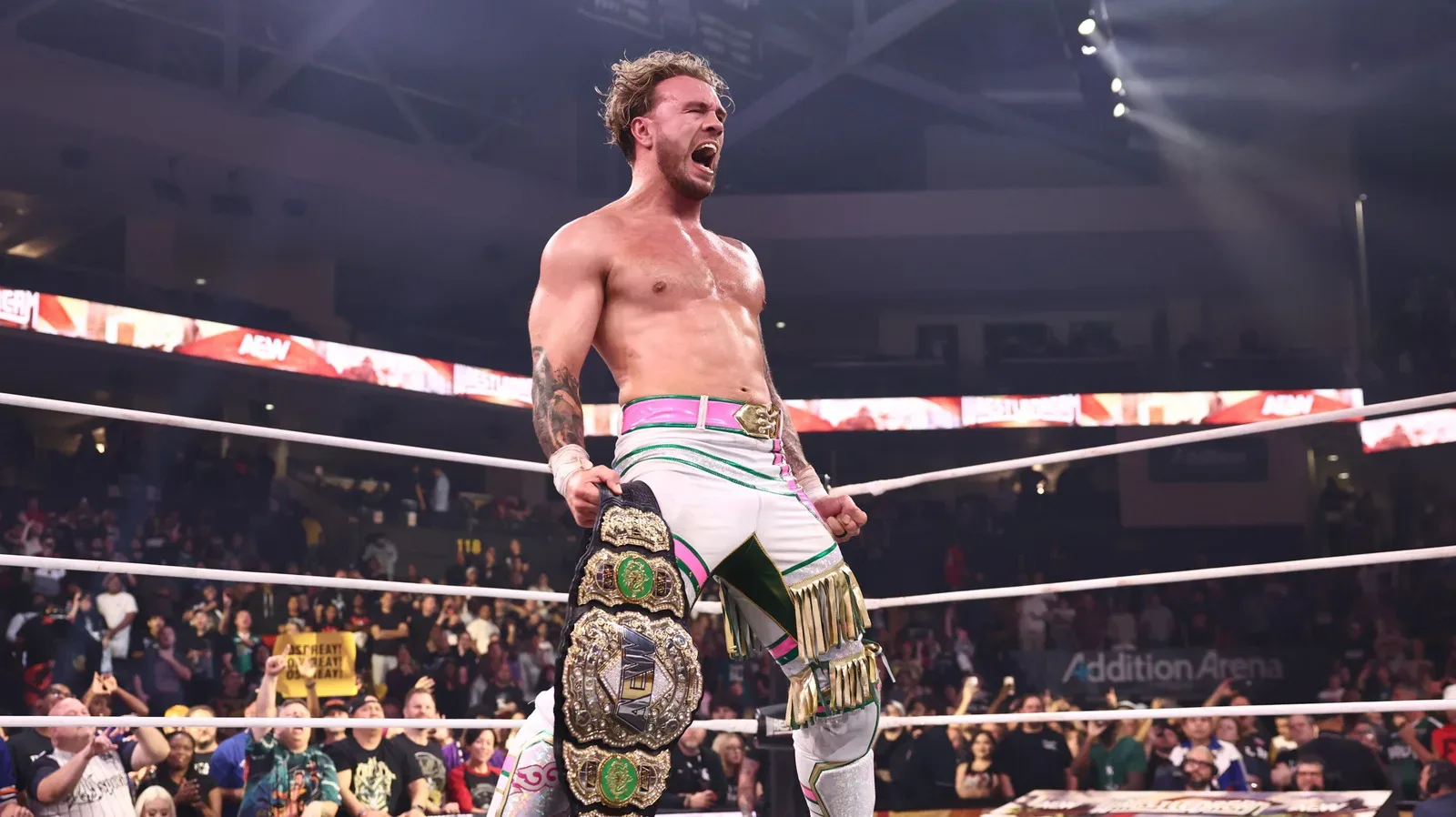
Will Ospreay’s rise to the AEW World Championship has been built on speed, athleticism, fearlessness and a willingness to make professional wrestling look different from match to match. The man known as “The Aerial Assassin” has long been associated with spectacular movement and high-risk offense, but Ospreay has offered a clear look at where that fascination began: watching WCW cruiserweights as a child and attempting to understand every detail of what they did.
Speaking ahead of his Clockwork Carnage match at AEW WrestleDream 2026, Ospreay discussed the early years of his wrestling fandom and the hands-on way he studied the performers who caught his attention. Rather than simply marveling at cruiserweight action, he recalled stopping and replaying moments so he could examine positioning, body movement and the mechanics behind the aerial sequences. That process fed directly into the experimentation that took place on a trampoline in his family’s back garden.
“My mom put a trampoline in my back garden and I used to watch the WCW cruiserweights,” Ospreay said. “I used to watch them practice their tricks. I would like pause, rewind, see where their arms were and how did they move their bodies? Then I’d go on the trampoline and try it.”
It is an especially fitting origin story for a wrestler whose offense has often felt rooted in equal parts athletic imagination and detailed preparation. Ospreay’s work has never been solely about throwing himself through the air. A major part of his appeal has been the precision behind it: the way he creates momentum, changes direction, finds a landing position and connects one movement to the next. His recollection of studying WCW’s cruiserweight division helps explain why his style developed with such an obvious focus on motion and technique.
For more background on this topic, read Mercedes Moné vs. Marina Shafir Set for AEW Full Gear 2026.
From a trampoline to a wrestling ring
Ospreay’s mother ultimately took a more permanent step to channel her son’s growing obsession with wrestling. As Ospreay explained, she had become concerned that he was getting into trouble at school and outside the home. Her answer was to create an environment that would keep him closer to home and give him somewhere to direct that energy.
“I got sick of it and my mom saw that I was getting into trouble at school, and on the outside, so she was going, ‘How do I keep him in my garden? How do I keep him safe in the house? Put a wrestling ring in his back garden.’”
That decision gave Ospreay a far more wrestling-specific space in which to continue developing. He also joked about what it must have been like for people living nearby, with the noise of bumps and practice sessions coming from the family garden. While the remark was made lightly, it underlines how seriously he was already taking his ambition long before he became an international star.
For many wrestlers, early fandom is remembered in terms of favorite names, championship matches or unforgettable television moments. Ospreay’s description stands apart because he framed it as a learning process. He was not only watching the cruiserweights for entertainment. He was trying to decode their actions and reproduce the physical principles behind them.
That kind of curiosity has been visible throughout his career. Ospreay has continually worked in a style that demands timing, awareness and a willingness to keep evolving. His matches have featured explosive aerial offense, rapid counters and elaborate sequences, but those elements work because they are supported by control and conditioning. The childhood habit of studying small technical details appears consistent with the wrestler he later became.
WCW’s cruiserweight legacy remains relevant
WCW’s cruiserweight division remains one of the most celebrated parts of the promotion’s history. It gave high-flying, internationally influenced wrestling a major platform in the United States and helped establish a presentation in which speed, innovation and technical excellence could headline television time. Its influence can be felt across modern wrestling, particularly in the work of performers whose styles blend aerial athleticism with increasingly complex ring movement.
Ospreay identifying that division as an early inspiration is therefore significant. His career has unfolded in an era where high-level athletic wrestling is more accessible to global audiences than ever, but the cruiserweights he watched helped establish an important template. They showed that spectacular action could be a central attraction rather than a novelty, and that smaller wrestlers could command attention through pace, creativity and execution.
AEW itself has frequently provided a stage for wrestlers whose approaches draw from a wide range of international and historical influences. Ospreay’s journey from studying WCW footage in his garden to standing as AEW World Champion is a striking example of that connection between generations. The visual language of cruiserweight wrestling—fast transitions, aerial attacks and daring movement—helped shape a performer who eventually reached one of the industry’s highest positions.
There is also a notable personal dimension to Ospreay’s reflection. The story is not simply about an aspiring wrestler imitating what he saw on television. It is about a mother recognizing that her son needed structure and a safer outlet, then finding an unconventional way to support something he cared about. The backyard ring became part of the foundation for a career that has since taken Ospreay to major events and championship-level success.
Adapting after neck surgery
Ospreay’s current position at the top of AEW has not come without serious challenges. He underwent neck surgery in September 2025, a procedure that kept him out of AEW competition for an extended period. Given the nature of his style and the strain that elite-level wrestling places on the body, the absence represented a major turning point.
Since returning, Ospreay has had to adjust aspects of his in-ring approach. That adaptation is important in the context of his comments about WCW cruiserweights and his early days on the trampoline. The same wrestler who built his identity around pushing physical boundaries has had to find ways to preserve his effectiveness while accounting for the reality of recovery and long-term health.
Changing a style does not mean abandoning what made it successful. In Ospreay’s case, the shift has not stopped him from reaching the defining accomplishment of his AEW run. At AEW All In London 2026, held at Wembley Stadium, Ospreay captured the AEW World Championship. Winning the title in that setting added a major chapter to his career and demonstrated that his revised approach could still carry him to the top of the company.
The championship victory also gave added meaning to the resilience behind his return. Ospreay had been away from the ring following surgery, then returned with the task of rebuilding momentum in an environment filled with high-level competition. Reaching the AEW World Championship after that setback showed that evolution can be just as valuable as the breathtaking attributes that initially defined a wrestler.
A successful WrestleDream defense
Ospreay entered AEW WrestleDream 2026 as champion and successfully retained his gold in the Clockwork Carnage match. The result ensured that his reign continued beyond the event while reinforcing the momentum he generated by winning the championship at All In London.
For Ospreay, WrestleDream provided another reminder of the balance he now has to maintain. His identity remains tied to the creativity and intensity that made him a standout long before he became AEW World Champion. At the same time, his path since neck surgery has made adaptation an unavoidable part of his professional story.
That tension may ultimately add another layer to his title reign. Ospreay is still the wrestler who watched WCW cruiserweights frame by frame, then climbed onto a trampoline to test what he had learned. He is still the performer whose name evokes aerial offense and extraordinary athleticism. But he is also now a champion navigating the demands of a changed body, a demanding schedule and the responsibility of representing AEW at its highest level.
His memories of the backyard ring and the WCW cruiserweights provide a useful lens through which to view that journey. Ospreay’s success has been driven by natural ability, but also by observation, repetition and a willingness to learn. Those traits matter even more after a major injury absence. The moves may evolve, the risks may be assessed differently and the style may continue to change, but the mindset that brought him from the garden to Wembley Stadium remains firmly in place.
In pictures

Darryl Polo
Darryl Polo is a passionate wrestling fan covering WWE, AEW, TNA and beyond. He loves great rivalries, breakout stars and the moments that keep fans talking long after the bell. How we work.