
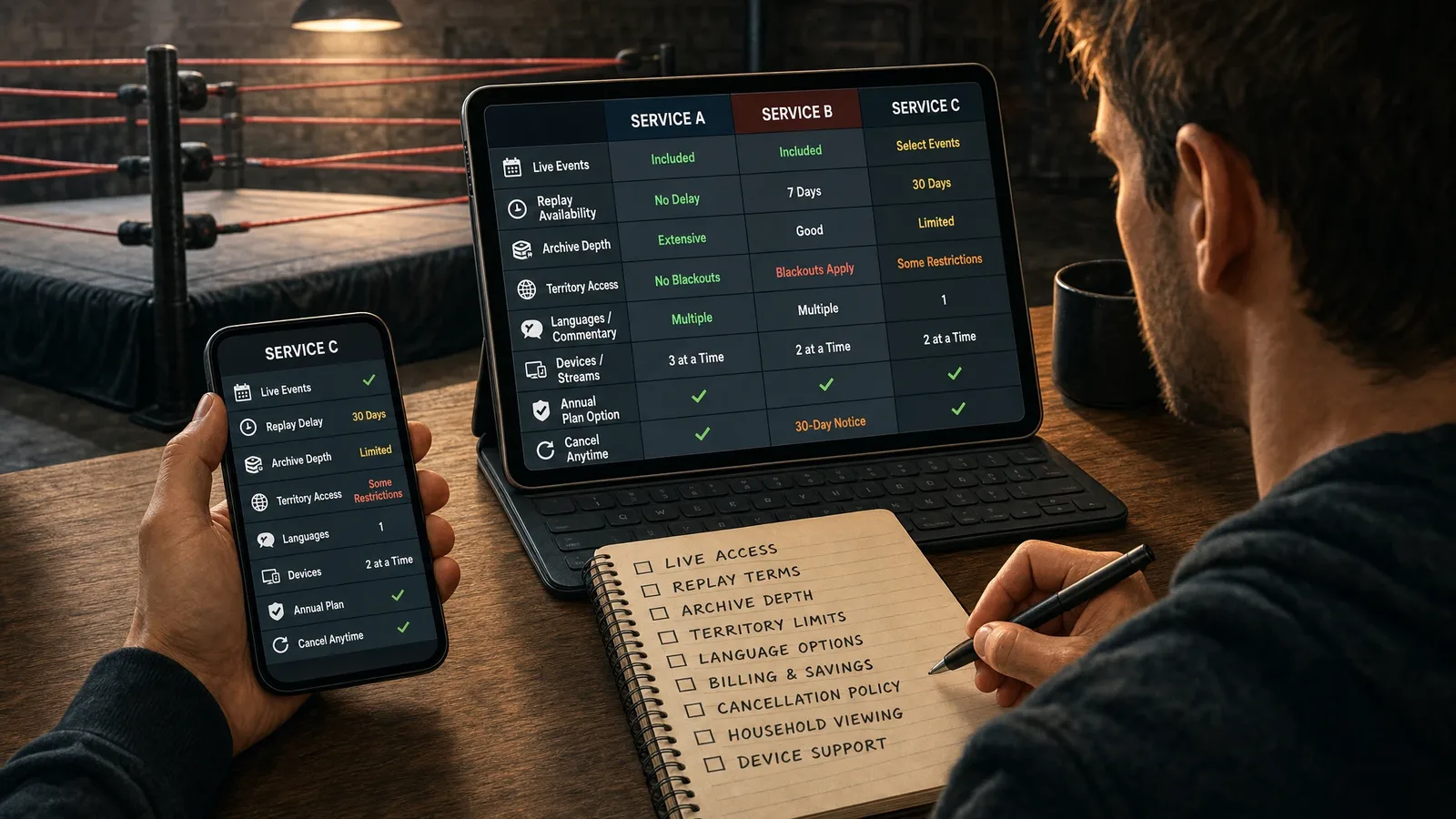
Start with the wrestling you actually plan to watch
A wrestling subscription can combine several very different kinds of viewing: current weekly programs, historical pay-per-views, live specials and digital-first material. Those categories should not be treated as one undifferentiated library. Before comparing plans, make a short watch list: Are weekly episodes the priority? Do live specials matter? Is the main goal older events, or are short-form and digital programs part of the appeal? A service may be a strong fit for one of those uses without being equally strong for all of them.
That watch list gives price a useful context. A lower-priced plan is not automatically better value if it omits the category a fan expects to watch most, while a larger package may include programming that will go unused. TNA’s support information, for example, separates monthly and annual tiers that share core-library and certain live-programming access, with the annual tier adding a specified group of live pay-per-views. The meaningful comparison is therefore the included viewing, not the label attached to the plan.
Separate live programming from event replay access
“Available with a subscription” needs a closer look. TNA says its monthly membership includes new iMPACT! episodes as a Thursday simulcast and Xplosion on Fridays. That is a useful example of the detail to seek: whether a regular program is live, simulcast, uploaded later or simply retained in the archive. Fans who want to follow a show as it happens should look for a specific access description rather than assuming that a current-series listing means live viewing.
Premium-event access also deserves a separate checklist. In its live-content FAQ, TNA lists eight live specials as included with subscriptions, while describing four live pay-per-views as items requiring an upgrade or separate purchase. A buyer can ask three direct questions for every event they care about: Is it included at this tier? Is it live or on demand? If it is not included, is it sold separately? An event calendar alone does not answer those questions.
A one-off purchase can have a different replay arrangement from a membership. TNA describes a one-time pay-per-view license that expires after a set 30-day period. That means “I bought the event” and “I will retain access indefinitely” are not interchangeable assumptions. When deciding between an event purchase and a subscription, note the replay window, whether the purchase is separate from member access, and whether the time available fits the way you tend to watch.
Read archive claims as descriptions, not guarantees
Archive depth is more than a promotional adjective. TNA describes its on-demand offering as a full content library with digital-first material, but its support page does not define every program or every historical event contained within that library. “Full library” is therefore a starting point for investigation, not proof that every production from a promotion’s history is present. A careful buyer should search for the particular eras, events or series they want before treating archive breadth as part of the plan’s value.
The same distinction applies to free offerings. AEW says a free MyAEW account provides a 24-hour WatchAEW FAST channel plus selected AEW and Ring of Honor content. That is not the same product as a paid on-demand subscription, even though the branding overlaps. When comparing a free account, a continuously programmed ad-supported channel and a paid library, identify which one delivers the specific show or replay on your list. Shared branding should not substitute for a comparison of access types.
Treat your location as part of the subscription terms
A subscription’s apparent value can change before a viewer chooses a device. TNA says prices and content availability may vary by location for both subscription tiers and one-time pay-per-view purchases. AEW describes paid MyAEW availability as reaching many international fans, wording that is not a universal availability promise. Check the offer presented for your own country or territory, including its event access and price, rather than relying on an announcement aimed at a different market.
WWE’s March 2021 Network-to-Peacock FAQ is a clear historical example of territorial rights changing the viewing destination. Peacock became the exclusive U.S. streaming home for WWE Network, while viewers outside the United States were directed to WWE Network or, where available, a local provider. The lesson is not that every promotion follows that arrangement; it is that a promotion’s name on a service does not establish identical access worldwide. Territory, local partner and platform can each determine where a fan watches.
A territory split can also alter the apps a viewer needs. WWE’s 2021 FAQ said U.S. viewers could no longer access WWE Network through WWE apps after the move and instead needed Peacock. When rights are licensed to another platform, the partner’s supported-device rules shape the practical viewing experience. Before paying, confirm both the service carrying the desired programming in your location and whether that service works on the screen you actually intend to use.
Compare billing cycles with the included access
Monthly and annual billing are not merely two ways to divide a cost. TNA’s tiers illustrate why: both include core-library and certain live-programming access, but the annual tier adds a specified group of live pay-per-views. Compare what each billing option includes during its term, then decide whether that added access belongs on your personal watch list. The useful question is not simply which cycle looks cheaper in isolation, but what programming is attached to the commitment being considered.
Recurring billing deserves its own check before checkout. TNA says subscriptions renew automatically on both monthly and annual cycles. Cancellation and renewal are related but different: a plan can be cancellable while still renewing unless the member acts before the next billing point. Record the renewal cycle, the next charge date and the process for turning off renewal. These details help a buyer decide whether a prepaid annual commitment or a shorter monthly cycle better matches their viewing habits.
Trials can make a practical difference when the uncertain part of the purchase is not the wrestling catalog but the experience of using it. TNA says it offers no free trial. A trial, where one is offered by another service, can be used to assess archive navigation, stream quality and compatibility with the intended device; its absence means a buyer should seek clear answers on those points before subscribing. It is also sensible to verify whether a stated trial applies in the viewer’s territory and through their chosen purchase route.
Know how cancellation, refunds and account deletion differ
The route used to subscribe can determine the route used to leave. For TNA web purchases, cancellation is handled in the account subscription section, while purchases made through Apple or Google Play must be cancelled through the corresponding store. That makes the checkout channel a consumer decision, not just a technical detail. Before subscribing, identify where billing will be managed and where cancellation instructions will appear, particularly if a household uses more than one app-store account.
Cancellation does not necessarily end access on the day it is requested. TNA says cancelled monthly subscriptions remain accessible until the end of the paid monthly period, and cancelled annual subscriptions remain accessible through the end of the paid annual period. It also says refunds for monthly and annual subscriptions are assessed on a resident-by-resident basis. A buyer should distinguish stopping a future invoice, retaining the remaining paid viewing period and receiving money back; they are separate outcomes.
Do not use account deletion as a substitute for cancellation. TNA states that deleting an account immediately removes content access and watch history but does not cancel an active subscription. In practical terms, a fan should first confirm that recurring billing has been stopped through the applicable subscription channel, then decide whether deleting the account is wanted. Keeping those actions separate avoids assuming that loss of login access has also ended an active payment obligation.
Test the screens, streams and network conditions that matter at home
Device compatibility is most useful when it is specific. TNA lists desktop browsers, iOS and Android mobile devices, Roku, Amazon-based devices, Samsung smart TVs, casting and AirPlay options. AEW lists MyAEW access through its website and connected-TV platforms including Android TV, Apple TV, Fire TV and Roku, while noting that more streaming options were still being developed. Check the exact television device, browser or mobile device in the household rather than concluding that a mobile app guarantees living-room access.
Household value can depend on simultaneous viewing limits. TNA permits multiple login sessions but only one video stream at a time. That distinction matters for people who expect two viewers to watch different events concurrently: being able to sign in on several devices does not necessarily mean that all of those devices can play video at once. Ask how many concurrent streams are allowed, then compare that limit with the household’s actual viewing patterns before treating one subscription as a shared solution.
A supported device cannot by itself promise a smooth stream. TNA says adaptive playback may reduce video quality when available bandwidth falls, and identifies network congestion and restricted networks as possible contributors to buffering or connection problems. This points to a balanced way to evaluate reliability: consider the service’s device support and playback behavior alongside the viewer’s own internet conditions. A fan who commonly watches on congested or restricted networks should treat that environment as part of the purchase decision.
Factor platform changes into a long-term commitment
Distribution arrangements can change while a fan is still thinking about an annual plan. AEW announced that AEWPlus on Triller was ending, that existing subscriptions would end by May 20, 2026, and that no new content would be added. AEW directed former AEWPlus users toward MyAEW for an AEWPlus-style Dynamite and Collision offering, while also discussing live pay-per-views previously purchasable on Triller. A replacement destination may preserve some access, but the new platform’s exact terms still need checking.
Account and billing migration are separate questions from where the content goes. WWE’s 2021 FAQ said prior U.S. WWE Network subscriptions would not automatically transfer to Peacock, and it described cancellation of existing Network accounts plus credits for unused prepaid balances, with processing dependent on payment method. Those were terms of that specific transition, not a universal policy. The broader buying question is durable: if a service changes, will credentials, billing, remaining prepaid time and device access move with it, or require new steps?
Explore more

Darryl Polo
Darryl Polo is a passionate wrestling fan covering WWE, AEW, TNA and beyond. He loves great rivalries, breakout stars and the moments that keep fans talking long after the bell. How we work.