
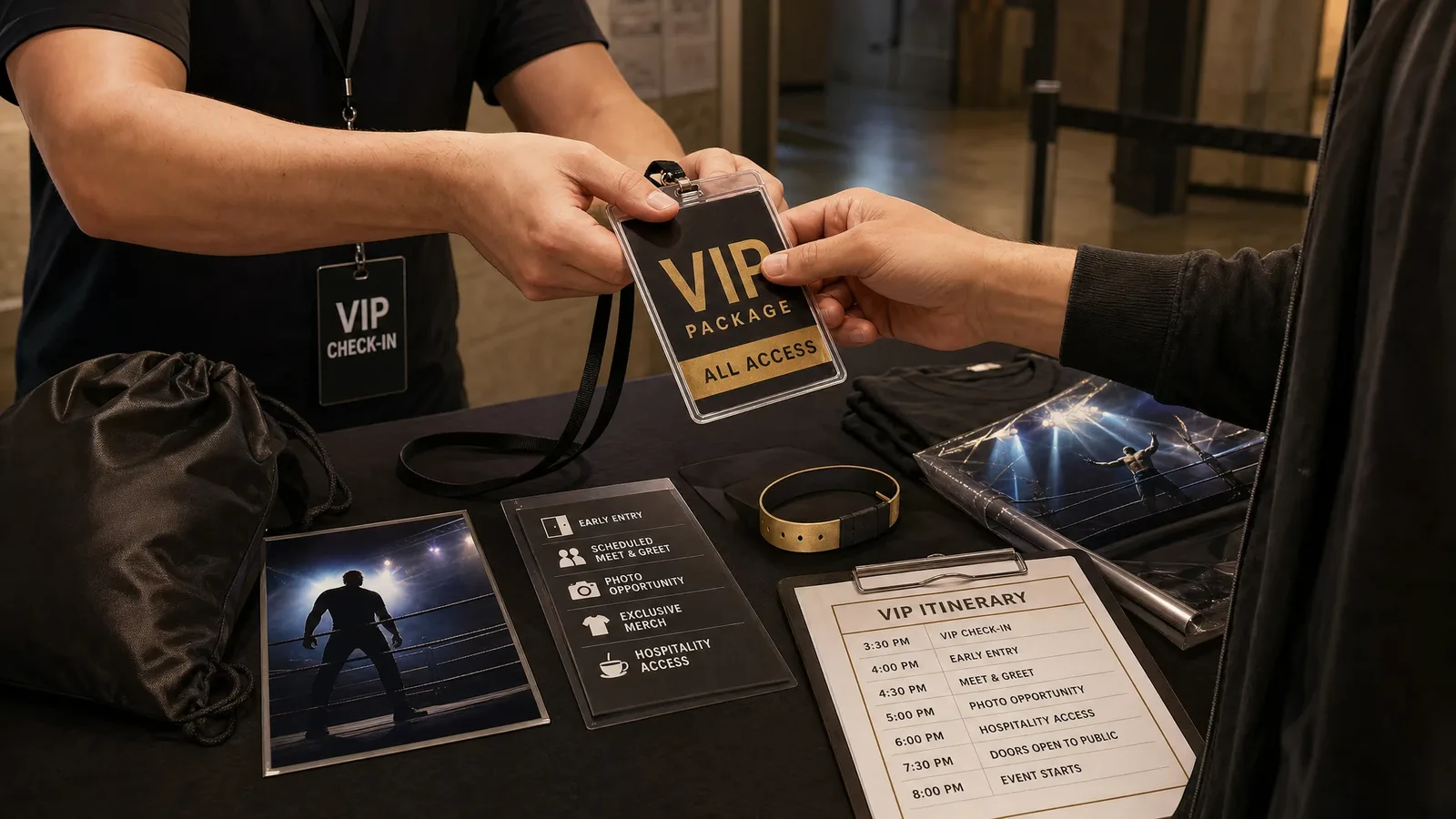
A VIP label is a bundle name, not a universal promise
“VIP” is best read as a label that needs to be unpacked, not as a fixed level of access. TNA’s featured Championship Belt Package combines several different things: a front-row event ticket, a backstage tour before doors open, a ringside photo opportunity, a post-show talent meeting, a replica belt and a video-board message. That combination is useful because it shows how many separate benefits can sit beneath one package name. Before comparing prices or tiers, make a list of every stated inclusion and ask which part matters most to your planned day.
Availability can be part of the offer’s value and its limitation. TNA describes its VIP experiences as available while supplies last, rather than as an upgrade every ticket holder can obtain. Its listed Championship Belt Package starts at $1,999 per person, with pricing varying by event. A starting price is therefore not a promotion-wide promise or a complete comparison tool. The meaningful comparison is between the exact inclusions, seat position, schedule and terms for the event being considered, not between two packages that happen to share the VIP label.
Start by separating admission from activities
First establish whether the offer gets you into the wrestling show itself. TNA expressly includes a front-row event ticket in its package, so both admission and premium seating are named benefits there. Other VIP-style products may instead be limited to a fan session or photo event. A buyer should be able to point to clear language covering the show ticket, if one is included, rather than assuming that a paid talent experience opens the arena doors or reserves a seat for the card.
A useful next distinction is seat tier versus exact assigned location. Historical WrestleMania 33 travel-package terms said section, row and seating location could change before final assignment because of production, layout, safety and seating-distribution needs. Those terms also provided a partial refund if ticket value went down after a seating change, while equal-value package modifications did not create a refund. The example does not establish a rule for current offers, but it demonstrates why buyers should look for both the promised seating category and the terms governing a later adjustment.
Map every benefit to a time on the event day
A package can include access across several parts of the day without making those parts interchangeable. TNA places its backstage tour before doors open but schedules its talent meeting after the show. Its ringside photo opportunity is separately listed from the post-show meeting. In practical terms, a fan should not read “meet-and-greet included” as proof that the meeting occurs before bell time, or read “early access” as permission to roam freely through the building. The stated schedule defines the experience more reliably than the package’s headline.
Arrival windows can matter as much as the printed start time. In WWE’s 2021 MGM Grand meet-and-greet example, doors opened 45 minutes before the session, fans were asked not to arrive more than an hour early, and those arriving more than 30 minutes after the session began were no longer guaranteed an interaction. These were event-specific instructions, not a standing timetable for all wrestling events. Still, they illustrate the questions worth asking: when does check-in open, what is the last safe arrival time, and what happens if travel or show timing makes you late?
Treat a photo opportunity and a meet-and-greet as separate benefits
A photo opportunity does not necessarily mean a fan may take unlimited pictures, choose the camera or use a phone. WWE’s MGM Grand rules provided one professional photo, one printed photo and one pre-signed 8x10 with each meet-and-greet ticket. Personal selfies were prohibited, and an on-site professional photographer handled the image. The lesson is straightforward: identify the promised output. Is it a professional photograph, a printed copy, a digital file, a personal-device selfie, an autograph item or some combination? The words “photo opportunity” alone do not answer those questions.
Delivery of the photograph can involve a step beyond the moment with talent. WWE instructed MGM Grand attendees to use a QR code to download the professional photo and to pick up a printed copy in a designated photo-print area. That arrangement makes a photo benefit a small process rather than a single encounter. Check how the image will be delivered, whether a printed copy is included, where it must be collected and whether the session timetable leaves enough time to complete those steps. Those details can be especially important when an event has multiple scheduled activities.
Autographs and physical interaction also require their own reading. WWE’s example prohibited personal items from being brought for signing and supplied a pre-signed 8x10 instead. It also barred handshakes, hugs, fist bumps and other physical contact. These limits show that an advertised meeting can be a structured, brief interaction with set health-and-safety boundaries. Fans who have a particular collectible, pose or greeting in mind should look for language that specifically permits it rather than treating a general meet-and-greet description as an open-ended entitlement.
Identify who receives access and who handles the credential
Companions should not be assumed to have the same access as the named purchaser. At WWE’s 2021 meet-and-greet, every attendee needed a ticket to enter the space, except someone accompanying a minor. Parents could accompany a child through the line, but they could not join the photograph or receive an autograph. The distinction is useful for families: entry, supervision and participation may be three different permissions. A purchase plan should account for each person’s role and the exact rule for adult companions before anyone arrives at the event.
The organizations involved may divide responsibilities. WWE’s MGM Grand example specified the fan experience while Ticketmaster delivered digital tickets by email after purchase. TNA, by contrast, uses an inquiry process for its VIP offer: a representative is meant to confirm availability and next steps within one business day, and no payment is required simply to inquire. These examples show two different pathways. One is ticket-platform checkout and credential delivery; the other begins with a package representative. Buyers should know which party is responsible for the experience details and which party provides the entry credential.
TNA identifies its VIP representative as the contact for availability and next steps, but its public page does not spell out detailed rules on refunds, transfers, accessibility or talent substitutions. That absence makes direct clarification important before payment, especially for a package with several timed components. Ask for the applicable event terms in writing and keep the answer with the order information. A sensible question is not merely “What is included?” but also “What happens if a listed part cannot be delivered, I need to transfer the package, or an accessibility need affects seating or participation?”
Account for building rules and accessibility separately
A VIP activity can still be subject to ordinary entry and security requirements. WWE’s MGM Grand instructions tied meet-and-greet entry to the event bag policy and prohibited noncompliant bags and items. That means the existence of a separate fan-event space did not erase building-style restrictions. Before bringing signs, memorabilia, bags or other items, compare the VIP instructions with the relevant entry policy. This is also another reason not to presume that a personal item can come into a signing line simply because a talent activity appears on the itinerary.
Accessibility language should be read for the particular event and package. WWE described its 2021 MGM Grand meet-and-greet as fully accessible, but that statement applies to that event rather than proving the same arrangement everywhere. In the historical WrestleMania 33 travel terms, guests needing accessible seating were told to request it with the order. If the described seating was unavailable in an accessible location, WWE said it would offer an alternative; accepting it could affect price, while declining it could lead to a full refund. Early, package-specific communication is the practical takeaway.
Travel bundles add lodging and administration questions
A travel package is materially broader than a standalone ticketed photo session. WWE’s historical WrestleMania 33 terms combined tickets with hotel accommodation, scheduled fan sessions, collectibles, administrative rules and a designated group contact. Yet included hotel accommodation did not mean every travel detail was covered: airfare, hotel parking, ground transportation, food and drinks were excluded unless the package description expressly included them. For any bundled offer, separate the core package from the costs of getting to the city, moving around it and eating during the trip.
Even an included hotel can come with conditions that affect a group’s planning. The WrestleMania 33 terms said guests in the same package shared a standard room, with room-sharing and bed-assignment constraints. They also made the named main traveler the primary contact for booking, hotel and change information. These historic terms are not current policy, but they highlight practical points to verify in a current travel offer: who controls the reservation, how many people share the room, how beds are assigned, and whether every traveler receives the information they need directly.
Read cancellation, transfer and talent language before paying
Refund and transfer terms should be treated as part of the product, not as afterthoughts. WWE’s WrestleMania 33 terms required full payment at purchase and said confirmed payments were non-refundable. Transfers were permitted only when a new main traveler agreed in writing to the terms and the original main traveler made the required transfer request. Those historical provisions do not dictate a current event’s policy, but they show why resale assumptions can be risky. Obtain the current package’s written terms on cancellation, transfer, name changes and payment timing before committing funds.
Finally, separate a promised format from a promised performer or an unchangeable itinerary. WrestleMania 33’s Performance Package terms said participating Superstar identities would not be available in advance. The same terms allowed WWE to cancel the package for a full refund, while reserving the right to modify portions through substitutions of equal value. A careful buyer can use that distinction to assess the offer: is the essential purchase a particular person, a particular session type, a preferred seat or a broader weekend bundle? The written remedy for a change may depend on that answer.
Explore more

Darryl Polo
Darryl Polo is a passionate wrestling fan covering WWE, AEW, TNA and beyond. He loves great rivalries, breakout stars and the moments that keep fans talking long after the bell. How we work.