
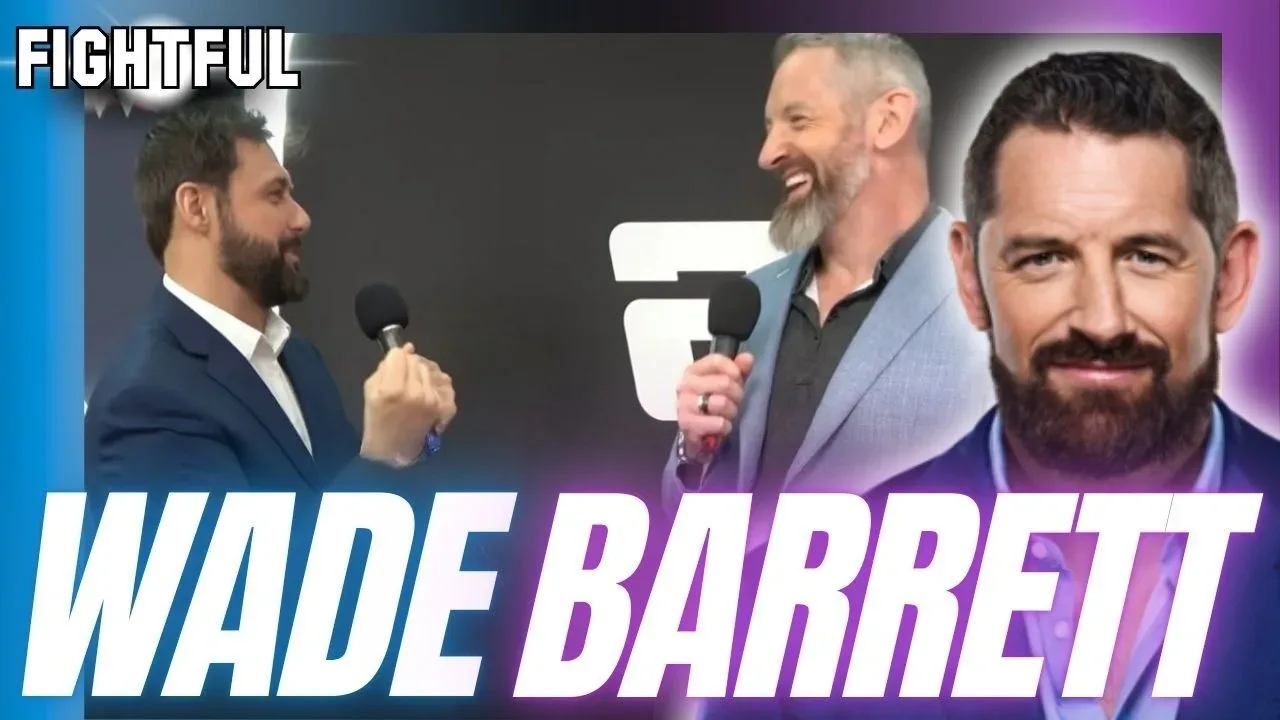
Wade Barrett’s voice is now part of WWE 2K26, but his arrival in the game’s commentary booth was not a simple case of recording a few sessions and being added to the roster.
The WWE commentator has revealed that he completed approximately 125 hours of voice-over work for the game, a process that began roughly a year before WWE 2K26 was released worldwide on March 13. Barrett joins Michael Cole, Booker T, and Corey Graves as part of the title’s commentary lineup, giving players another recognizable voice from WWE programming as they work through matches across the game’s various modes.
WWE 2K26 features CM Punk on its cover, while the game’s presentation continues to place a major emphasis on making in-ring action feel connected to WWE television. Commentary is a significant part of that presentation, particularly in a yearly sports-entertainment game that needs to account for a large roster, different match stipulations, signature moves, entrances, rivalries, championship situations, and the countless combinations created by players.
For Barrett, being selected was an exciting development, but it also meant beginning nearly from scratch.
For more background on this topic, read Jim Johnston Recalls the Sushi Bar Meeting That Launched His WWE Music Career.
“So it was pretty intense. Obviously I was thrilled to be named as one of the commentators in there. This is a process that started about 12 months ago,” Barrett said. “I had to sit and do a ton of voice over and thankfully they sent a load of tech and equipment to my house to do it from my house rather than go to a studio every time.”
That home setup allowed Barrett to take on the workload without repeatedly traveling to a recording facility. Still, the volume of material was substantial. WWE video games require commentary that can fit naturally around a broad selection of scenarios, from an ordinary one-on-one bout to a high-stakes premium live event environment. The game must also be able to deliver lines around specific wrestlers, maneuvers, momentum changes, and outcomes without making those transitions feel noticeably mechanical during play.
Barrett said the full recording total reached 125 hours. He also pointed out that his task differed from that of Corey Graves, whose voice has been featured in WWE games for many years. An established commentator can have usable material already in the game’s audio library if past lines still apply to current WWE Superstars and familiar situations. Barrett did not have that benefit when his work on WWE 2K26 began.
“In total I did a total of 125 hours of voice over for this game,” Barrett said. “A huge part of that, if you compare me to Corey, who has probably been in the game for the last eight or nine years, they have a huge well of lines from previous years that will still apply this year. It might apply to say a Brock Lesnar or a Drew McIntyre or something like that. For me, we had zero. So we had to start at the bottom and work our way up.”
Building a commentary library from the ground up
Barrett’s explanation illustrates why the addition of a new commentator can take considerably longer than fans may expect. The voice recording itself is only one stage in the process. The game also needs a deep catalog of dialogue that can be triggered in the appropriate circumstances, whether a wrestler is executing a signature attack, targeting an opponent, surviving a near fall, competing for a title, or battling in one of the game’s many match formats.
Even when a line is broadly applicable, it has to be assigned and implemented in a way that makes sense in the moment. A call designed for a particular move or a particular WWE Superstar cannot be dropped randomly into a match. It must be activated under the right conditions and blend with the rest of the commentary team’s responses. That becomes even more complicated in a title where players can select different wrestlers, alter match rules, and create situations that would not necessarily occur on weekly television.
Barrett said he enjoyed the experience despite the scale of the assignment. He had already heard some of his completed commentary in the released game and was pleased with the final result.
“But it was a lot of fun, it was a great experience,” Barrett said. “I just heard some of it today on the game, and I’m very happy with the results.”
His involvement represents another extension of Barrett’s current role in WWE. After returning to the company in 2020 as a commentator, Barrett has become a regular presence across major WWE broadcasts. His work has included WrestleMania and Royal Rumble events, giving him a profile that goes well beyond routine weekly television commentary.
That visibility was one factor Barrett considered when discussing why he may have been added to the video game series at this point rather than earlier. He did not present it as a matter of a simple delay or omission. Instead, he emphasized the size of the technical undertaking needed to put a commentator into a modern WWE game in a meaningful way.
Barrett sees a much larger production challenge behind the scenes
Barrett suggested that WWE 2K26’s developers reached the point where his place on WWE broadcasts made it necessary to begin the lengthy integration process. From there, however, the challenge extended far beyond a performer reading lines into a microphone.
“I think the reason it’s taken several years to get there is because of how big of an undertaking it is,” Barrett said. “So the fact that they said, ‘You know what? He’s such a significant part of the broadcast these days, and he’s been on WrestleMania and Royal Rumbles and all this stuff, we really need to bring him in now and start this process.’”
As Barrett sees it, recording the dialogue was a massive commitment for him, but the development team faced an even more complicated job when it came time to make the audio function inside the game. Commentary needs to react quickly enough to feel connected to the action while also avoiding repetitions that can distract players during lengthy sessions.
Barrett, who said he is not especially technical, expressed appreciation for the work required to transform recorded audio into commentary that lands at the exact moment a move takes place. That is especially relevant in a WWE game, where timing is critical. Calls need to match not only a move’s execution but also the broader match context, including whether an offensive sequence is building toward a finish, whether a wrestler escapes danger, or whether the contest is shifting dramatically.
“It’s a huge process for me recording the lines, but it’s an even bigger process for the 2K guys fitting those lines into the game and programming it in,” Barrett said. “I’m not a techie guy, but I can’t even imagine how you make that work from what I recorded, ‘Yeah, put this in the game,’ where it hits in the exact right time someone does this move. It’s pretty insane.”
The comments offer a useful look at the scale behind an element players may take for granted. Commentary is often heard continuously during a match, but the work behind it involves a large number of recordings and detailed programming decisions. Barrett’s 125 hours underscore the amount of material needed just to establish a new voice within that system.
For WWE 2K26 players, Barrett’s debut adds further continuity between the game and the current WWE broadcast product. His voice has become familiar to viewers through his regular commentary work, and the new title now brings that presence into the virtual presentation alongside Cole, Booker T, and Graves.
Barrett’s reaction also makes clear that the opportunity carried personal significance. He was thrilled to be included, enjoyed the demanding recording process, and came away satisfied after hearing the finished work in the game. While players may only hear individual calls during a match, those moments are the result of a year-long process and more than a hundred hours of recording from one of WWE’s established broadcast voices.

Darryl Polo
Darryl Polo is a passionate wrestling fan covering WWE, AEW, TNA and beyond. He loves great rivalries, breakout stars and the moments that keep fans talking long after the bell. How we work.