
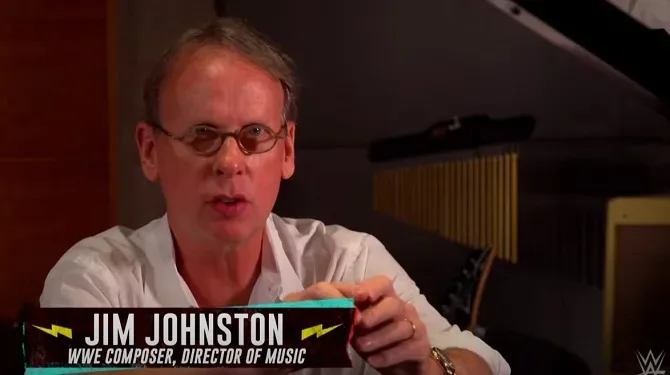
Jim Johnston’s body of work remains closely tied to the sound and identity of WWE, but his long association with the company began with a far smaller assignment than an arena entrance theme. The composer recently looked back on the unlikely meeting that opened the door to his WWE career, explaining that a conversation at a Japanese restaurant led to an opportunity to create music for Vince McMahon.
Johnston began working with WWE in 1985 and remained associated with the company for 32 years. During that tenure, he created a vast number of pieces for the promotion, including music used in promotional material, video packages, television presentation and, eventually, entrance themes. His work became a major part of how WWE presented performers, helping establish musical identities that fans could immediately connect with particular characters.
Speaking on Ropes N Riffs, Johnston said the process started in the early stages of his composing career, when a regular at a local Japanese restaurant remembered that he wrote music.
“I met a guy at a sushi bar, and this was back in the days when there were no sushi bars here, so it was just a Japanese restaurant… It was like going to your local bar where you saw the same six to ten people every time you went.”
For more background on this topic, read Nattie Details the Ongoing Evolution of Her WWE Character.
Johnston recalled that the acquaintance approached him with a problem: he needed music for a video presentation but did not know how to handle the audio side of the project. Johnston admitted that, despite being early in his career, he projected more confidence than he actually felt.
“One night he comes in and says, ‘Didn’t you say you write music? I have to put together a video for my boss and I know how to put together the visual, but I have no clue how to put together music.’ This was really early on in my career, so I basically half-assed lied and said, ‘Absolutely, I know how to do that.’”
The person who approached Johnston was an art director for Vince McMahon. At the time, McMahon had recently purchased the company from his father, and Johnston said there was no established music component in place for the assignment. The initial request was not for a televised wrestling program or for a superstar’s walk to the ring. Instead, it was music for a presentation intended for a cable television conference.
That modest project proved significant. Johnston composed the music, played it for McMahon, and received a positive response. From there, the scope of the work began to expand.
“He was the art director for Vince [McMahon] at the time, and Vince had just bought the company from his dad. There was no music—and this was just music for a cable TV conference, not even for TV. So I composed something, played it for Vince, and Vince liked it. At that point, Vince was off to the races, so his first question was, ‘What else do you do?’”
Johnston stressed that his earliest contributions were not immediately centered on the entrance music that later became his best-known work. He first handled what he described as more peripheral creative material, including music connected to promos and video packages. Those assignments allowed him to become part of WWE’s larger presentation while the company continued to grow its national profile.
“So we just kept doing different things, though at first it was all peripheral stuff like promos and packages rather than entrance themes.”
A Career That Helped Shape WWE Presentation
The story is a reminder that Johnston’s WWE run did not begin with a grand plan to build a library of wrestling themes. It started with a single piece of music for a business presentation, followed by McMahon’s interest in finding out what else the composer could bring to the company. Over time, Johnston became one of the defining creative figures behind WWE’s audio presentation.
Entrance music has long been one of the most immediate tools available in professional wrestling. Before a wrestler speaks, wrestles, or even appears on camera, a theme can establish energy, mood and expectation. A few seconds of sound can signal power, danger, humor, celebration or an approaching fight. For major WWE performers, that music also becomes part of the connection between a character and the audience.
Johnston’s decades with WWE covered an era in which the promotion’s themes were often constructed as extensions of the personalities on screen. The music was not simply background audio between segments. It was part of the presentation, designed to help make an arrival feel distinct and to give the crowd an immediate cue to react.
That role also extended beyond entrances. Promos and video packages require a different approach, as the music must support a narrative without overwhelming the voices, images or emotion of the segment. Johnston’s account of beginning with those projects illustrates how music could serve multiple purposes within WWE production: selling an upcoming match, underlining a rivalry, giving an event a larger atmosphere or helping package a performer for the audience.
The Continuing Debate Over Wrestling Themes
Johnston’s reflections arrive amid continued discussion among wrestling fans about modern entrance music and the challenge of making themes immediately recognizable. One of the most common complaints surrounding current wrestling presentation is that too many songs can blend together or fail to communicate enough about the performer before they appear.
The comparison to earlier generations is often rooted in how memorable certain themes became for fans. A recognizable opening sound can produce an instant crowd response, while a song with a clear character-driven identity can make a wrestler’s entrance feel bigger before the match has even started. That does not mean every successful theme has to follow the same formula, but it does highlight the importance of a distinct musical hook and a strong relationship between the song and the person using it.
Johnston’s career is central to those conversations because of the sheer length of his WWE tenure and the range of material he produced. He worked through changing television formats, shifting musical trends and different creative eras, while contributing to WWE’s effort to make its programming feel polished and recognizable.
His explanation of the beginning of that run also shows how quickly a creative relationship can develop when a piece of work fits a company’s needs. Johnston was asked to solve an audio problem for a presentation. McMahon liked what he heard, asked what else Johnston could do, and the assignment became the foundation for a career that lasted more than three decades.
Johnston Would Still Like to Write Themes
In a separate interview, Johnston said he would like to create entrance music again. However, he also indicated that he does not expect WWE to ask him to return. That position adds a note of uncertainty to any discussion about a potential reunion between the composer and the company where he spent 32 years.
WWE moved in a different direction after Johnston’s time with the promotion, with CFO$ taking over the role of creating much of the company’s entrance music. Johnston’s desire to write more themes makes clear that his interest in the craft remains, even if he does not believe another WWE opportunity is likely.
For now, Johnston’s latest comments offer a look at the unusually humble origin of one of WWE’s most consequential behind-the-scenes creative careers. There was no initial assignment to compose an iconic entrance song, no established music department waiting for him and no indication that the first project would lead to decades of work. There was simply a conversation at a restaurant, a request for help with a video, and a young composer willing to say yes.
That decision led Johnston to a meeting with Vince McMahon, then to a series of promotional and package assignments, and ultimately to a place in WWE history. His work helped demonstrate why entrance music matters in wrestling: when the sound, the performer and the moment align, a theme does far more than introduce somebody walking toward the ring. It becomes part of the character’s identity and part of the audience’s memory.

Darryl Polo
Darryl Polo is a passionate wrestling fan covering WWE, AEW, TNA and beyond. He loves great rivalries, breakout stars and the moments that keep fans talking long after the bell. How we work.