
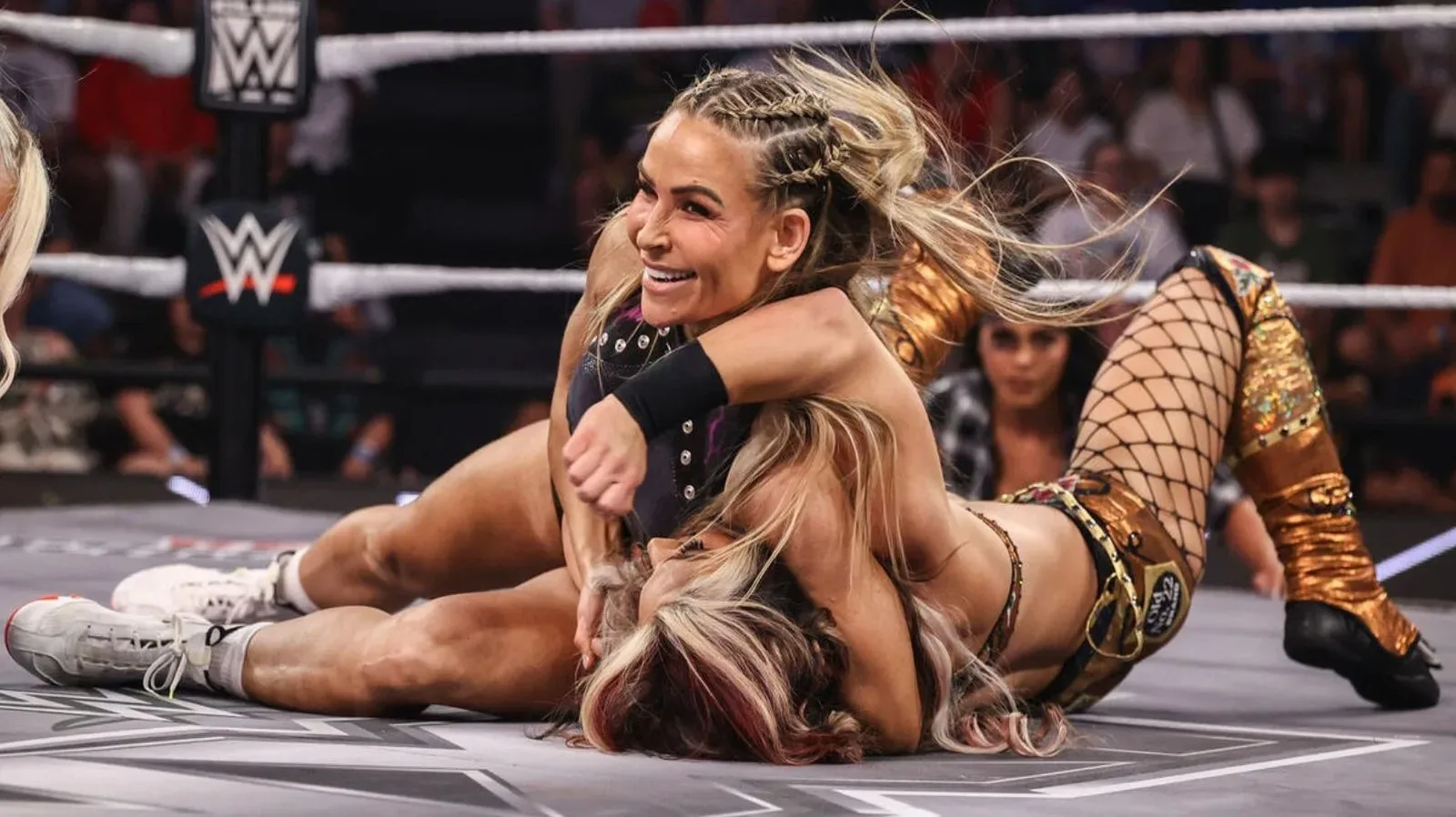
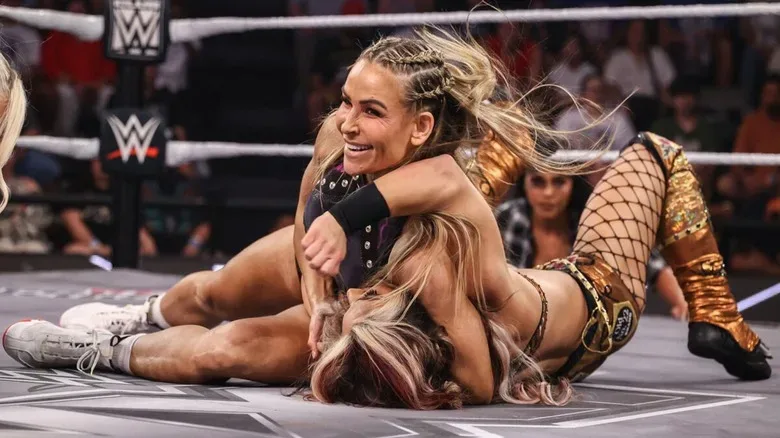
Natalya’s latest WWE evolution has not been framed as a departure from her wrestling history so much as a more direct expression of it. Working as Nattie, the longtime WWE veteran has leaned into a grittier presentation that draws from the training environment that shaped her long before she arrived in the company.
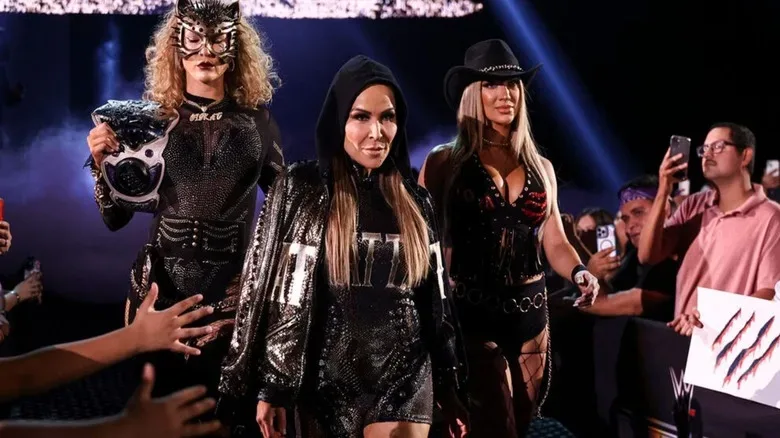
The character first appeared in Bloodsport before Nattie brought it into WWE at the 2026 Royal Rumble. Since then, the former women’s champion has appeared in WWE NXT and briefly worked with Maxxine Dupri on the main roster. While that work gave fans an early look at the adjusted persona, Nattie has made clear that she considers the character a work in progress rather than a finished product.
For a performer who has spent nearly two decades on WWE television as Natalya, the transition has required more than a new ring name or a different wardrobe. It has meant finding a way to explain what changed, why it changed, and what elements of her long-established identity remain central to the presentation.
A New Layer to an Established WWE Career
Nattie described having only about six weeks of main-roster character work to establish the direction, including vignettes with Dupri in December that she viewed very positively. The timing then became more complicated as WWE shifted its attention toward WrestleMania season, when major stories and lineups were already in motion.
For more background on this topic, read John Cena Explains Why Mason Rook’s Storytelling Stood Out Long Before NXT Debut.
She understood that she would not be part of WrestleMania plans, but the pause in momentum still created a natural question: how could she continue building the character while not actively advancing it in a prominent main-roster program?
That question has informed the work she has done in NXT. Rather than abandoning the idea when the main roster calendar moved in a different direction, Nattie has used opportunities across WWE programming to add definition to the persona. The goal is not simply to present a tougher version of Natalya. It is to give the audience a clearer sense of the experiences that formed her and why those experiences matter now.
Character reinvention can be particularly challenging for a wrestler with Natalya’s tenure. She signed a WWE developmental contract in 2007 and has been one of the company’s most durable women’s division figures ever since. Audiences have seen her in championship programs, tag teams, family-centered stories, mentorship roles, and singles feuds across several eras of WWE.
That history brings recognition, but it can also make change more difficult. Fans already have a strong understanding of who Natalya is supposed to be. Nattie’s task is therefore not to erase that familiarity, but to redirect it toward a more intense and stripped-down portrayal.
Forged in Stu Hart’s Dungeon
The foundation of the Nattie character is her background in the Hart family’s wrestling tradition. Natalya was trained in the Dungeon associated with her grandfather, Stu Hart, before beginning her in-ring career with Stampede Wrestling in 2003. That connection is not merely a piece of biographical trivia for the current presentation. It is the core of what she wants the audience to recognize.
Nattie has stressed that the persona comes from what she did at the beginning of her career. In that sense, the character is intended to be a derivative of the wrestler shaped by the Dungeon environment: disciplined, resilient, technically grounded, and willing to endure the difficult work required to continue competing at a high level.
The distinction matters because Nattie does not see the change as an attempt to imitate an MMA-based gimmick. She specifically noted that she is not trying to follow the template associated with Ronda Rousey, despite expressing respect for Rousey’s accomplishments in both UFC and WWE. The Nattie persona is instead tied to pro wrestling lineage and the demanding training culture of the Hart family.
That framing gives WWE a potentially meaningful avenue for the character. Natalya has always had legitimate ties to one of wrestling’s most influential families, but Nattie places more emphasis on the hardship and credibility behind that legacy. It is less about invoking a famous surname and more about emphasizing the work that preceded her WWE career.
It also fits the setting of NXT, where the company often places a premium on wrestlers demonstrating their identity in the ring. Nattie’s experience gives her a different kind of credibility than most developing talent, but the character’s focus on training and toughness can make her a useful presence in that environment. She is not presenting herself as someone living off a past reputation; she is presenting herself as someone who continues to test that reputation every time she competes.
The Meaning Behind “Low Key Legend”
One phrase associated with Nattie’s current outlook is “low key legend.” It reflects an unusual balance between recognizing a substantial body of work and refusing to demand recognition for it. Nattie’s view is that fans and peers can decide how to categorize her legacy, while she stays focused on the day-to-day responsibility of performing.
There is considerable evidence behind the sentiment. Nattie said she has wrestled close to 2,000 matches and holds seven Guinness World Records. Those are significant markers in any wrestling career, particularly in WWE’s modern women’s division, where she has been a consistent presence through major changes in television exposure, match opportunities, and roster depth.
Yet the character is not built around celebrating those accomplishments in a self-congratulatory way. Instead, it is built around refusing to be satisfied by them. Nattie’s philosophy is that the obligation to prove herself does not disappear because of longevity, statistics, accolades, or family heritage.
She illustrated that mindset through a conversation with Bubba Dudley, who asked why she still felt the need to keep paying her dues. Nattie’s response was simple: the rent is always due. For her, that means the process of earning one’s place never truly ends as long as she remains an active wrestler.
That attitude is especially relevant to the current character. A reinvention late in a career can sometimes be viewed as a final attempt to find a new role. Nattie’s comments suggest she sees it differently. She is not stepping back into a nostalgia act or relying on a résumé to carry the presentation. She is trying to develop another dimension of her work and show that she is still willing to adapt.
Rey Mysterio as a Model for Longevity
Nattie also pointed to Rey Mysterio as an example of the standard she wants to follow. She called the WWE Hall of Famer the greatest wrestler in the world, emphasizing his ability to remain humble and continue putting in the work despite everything he has achieved.
Mysterio’s career offers an apt comparison in one important respect: longevity in WWE only works when it is paired with evolution. His identity has remained recognizable for decades, but he has adjusted to new opponents, new styles, changing audiences, and different roles on the roster. Nattie appears to be pursuing a similar principle. The elements that made Natalya recognizable have not vanished, but they are being rearranged through a more forceful presentation.
For WWE, the next step is consistency. Nattie has established the conceptual basis for the character, but sustained television time and meaningful rivalries will determine how strongly it connects. Her earlier work with Dupri and her NXT appearances have offered starting points, though the character still has room to be explored on both Raw and SmackDown.
There is also a practical benefit to giving the presentation time to breathe. Natalya’s reputation as a reliable in-ring performer is already secure. If Nattie continues to gain definition through promos, vignettes, matches, and rivalries, the character can offer a fresh framing for an athlete whose WWE career has covered an extraordinary amount of ground.
For now, Nattie is not treating her accomplishments as a finish line. The Dungeon-trained veteran is treating them as proof of what she has endured, while continuing to pursue the work still ahead. That is the central message of the character: legacy has value, but in Nattie’s view, it only matters if she is still prepared to earn it.
In pictures

Darryl Polo
Darryl Polo is a passionate wrestling fan covering WWE, AEW, TNA and beyond. He loves great rivalries, breakout stars and the moments that keep fans talking long after the bell. How we work.