
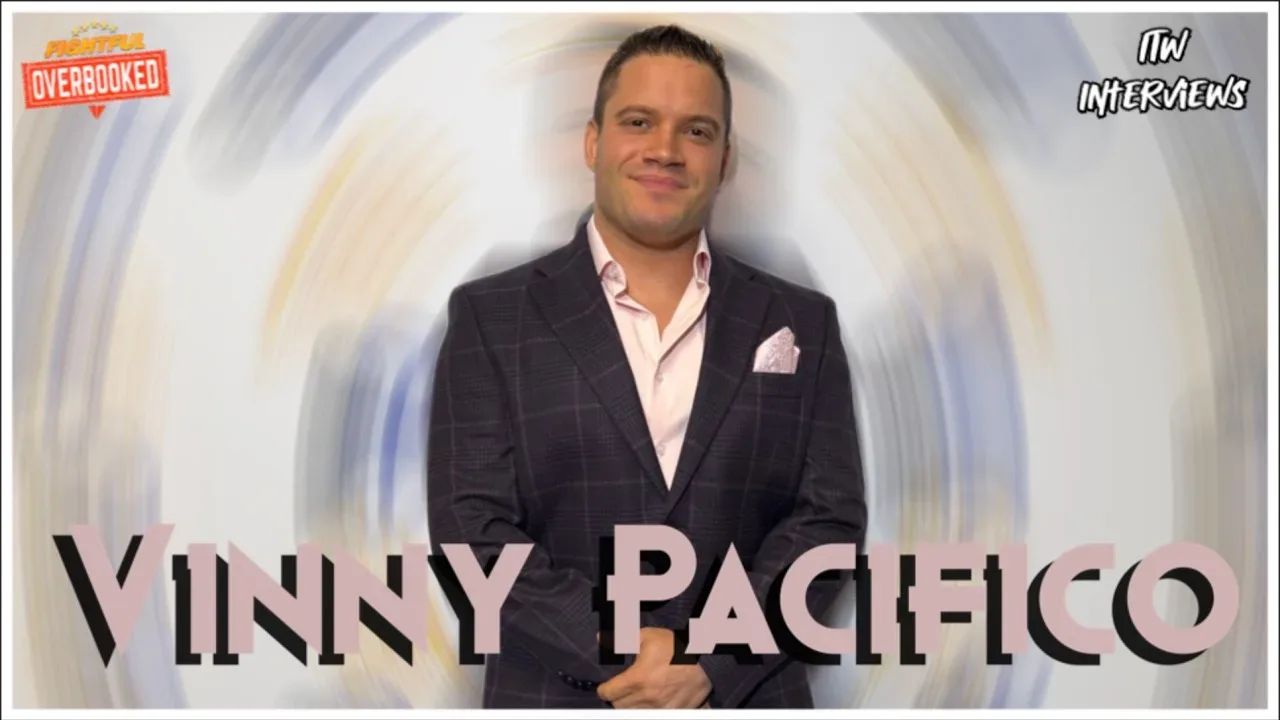
Vinny Pacifico is continuing to build his life around two demanding professions: professional wrestling and acting. The workload has required him to spend long stretches away from home, move quickly between sets and wrestling venues, and carefully organize the limited windows available in his schedule. For Pacifico, however, the answer has not been choosing one pursuit over the other. It has been learning how to make both fit.
Pacifico discussed the challenge of balancing his wrestling calendar with his acting opportunities during a recent interview. He described planning as the most important skill he has developed while managing both sides of his career. The schedules can be intense, but the way film and television work is often structured has helped create a workable rhythm alongside wrestling bookings.
“Luckily for me,” Pacifico said, “a lot of my filming for movies or TV” has taken place during the week, while wrestling work is “mostly weekends.” That distinction has allowed him to approach each commitment strategically rather than treating acting and wrestling as competing paths.
Weekday Sets, Weekend Wrestling
The basic scheduling split is straightforward in theory. Productions frequently film on weekdays, while independent wrestling events commonly take place on Fridays, Saturdays, and Sundays. In practice, though, making that arrangement work still means coordinating travel, production call times, appearances, and personal responsibilities with little room for error.
For more background on this topic, read Hyperactive Reveal John Cena’s DX Comparison Inspired Their EVE Multiverse Rumble Look.
Pacifico said he has had to map out his availability so that he can take on acting work and continue wrestling whenever possible. His example from the film The Hours That Keep Us illustrates the pace required to do that. The project features Paige VanZant and Mickey Gall, and Pacifico filmed his material in Massachusetts during August.
His production schedule ran from Tuesday through Friday. Rather than using the weekend to recover from the work week, Pacifico then wrestled on Saturday. He also recalled attending a premiere connected to another film being made by the same group before flying out to wrestle the following day. The sequence is a concise snapshot of the logistical demands behind maintaining momentum in both careers.
There is no suggestion from Pacifico that the process is effortless. On the contrary, he emphasized that it comes down to finding a way to make individual opportunities work as they arrive. A film shoot may have a fixed production window; a wrestling booking may be set months in advance or provide a key chance to perform in front of a new audience. Keeping both commitments means being prepared to travel immediately after one job ends and before the next one begins.
For performers working outside a single full-time wrestling organization, that kind of flexibility can be particularly important. Independent wrestling depends heavily on travel, promoter relationships, and staying visible across different markets. Acting adds another layer, with auditions, filming days, premieres, and the unpredictability of production schedules. Pacifico is navigating those realities by treating planning as an essential part of the job rather than an afterthought.
A Full Schedule Comes With a Personal Cost
While Pacifico is grateful that his wrestling and acting calendars can complement each other, he was equally candid about the downside of staying busy. He said the expanded workload means he is home far less often.
“It’s way busier because I’m not home really at all anymore,” Pacifico said.
That reality has taken on added importance in recent weeks. Pacifico shared that his grandmother has not been doing well and that he has been trying to spend more time with her and help in whatever ways he can. After returning home from filming, he has used time between professional commitments to focus on responsibilities there.
The comments add a human dimension to the practical discussion of flights, shooting days, and wrestling dates. A tightly arranged schedule is not simply a matter of getting from one venue to another. It also affects the time available for family and the ability to be present when loved ones need support.
Pacifico reflected on how much of his earlier life was consumed by wrestling and training. He said that from the age of 14 through around 20, he missed a great deal because he was rarely home. Wrestling and training were his central focus during those years. After meeting his wife at age 20, he began spending more time around home, though travel for wrestling remained a significant part of his life.
Now, with acting added to the equation, the demands have increased again. Pacifico did not frame that as a complaint about having opportunities. Instead, he acknowledged the difficult balance that comes with pursuing work he values while also recognizing the importance of his family relationships.
“It’s not easy to not be home,” he said.
Learning to Be Strategic
Pacifico’s solution is not a dramatic secret or a perfect formula. It is preparation. He said becoming “really strategic with the planning” is what he has gotten good at as his career has become more complex.
That approach means looking ahead at production blocks and wrestling dates, identifying possible conflicts early, and using the weekday-weekend divide whenever it is available. It also means accepting that some weeks will require him to be in constant motion. The ability to make a Tuesday-through-Friday shoot fit before a Saturday wrestling appearance is valuable only if the travel and timing are managed carefully enough to make the transition possible.
There is also an endurance element to the arrangement. Wrestling is physically demanding, and a film set can involve long days, repeated takes, and extended waits between scenes. Moving from several days of filming directly into a wrestling event requires both professional discipline and a willingness to keep working while other people might be taking time off.
Pacifico nevertheless made clear that he considers the opportunity worthwhile. He said being able to wrestle, act, and keep both parts of his professional life active “has been great.” The phrasing matters because it captures the dual nature of his schedule: the workload is heavier, the time at home is reduced, but the chance to keep advancing in two fields is meaningful to him.
For Pacifico, success in the current stage of his career is not defined by avoiding a packed calendar. It is defined by managing that calendar in a way that leaves room for wrestling, acting, and the people closest to him. That requires constant adjustment, particularly when family needs become more urgent.
Wrestling Remains Part of the Plan
Pacifico’s acting work has not changed his commitment to professional wrestling. His comments consistently positioned wrestling as an ongoing priority alongside his work in movies and television. The example involving The Hours That Keep Us was not presented as a break from wrestling, but as a case of arranging a film project around an immediate in-ring appearance.
That distinction is important. Pacifico is not describing a transition away from wrestling; he is describing a career model built around continuing to do both. Weekday filming can lead into weekend matches, and the travel associated with one profession must be considered alongside the obligations of the other.
He has also spoken about his interest in wrestling in Europe again, another indication that his ambitions in the ring remain active even as acting creates new professional opportunities. International wrestling travel would add another consideration to an already detailed calendar, but Pacifico’s remarks suggest that he sees scheduling as the tool that makes continued expansion possible.
The balancing act will likely remain demanding. Productions can require concentrated blocks of time, wrestling opportunities can emerge across different regions, and personal circumstances can rightly change priorities without warning. Pacifico’s recent comments show that he understands those pressures clearly.
Rather than minimizing the strain, he outlined it plainly: more work means more travel; more travel means less time at home; and keeping everything moving requires deliberate organization. But he also expressed appreciation for being able to pursue both acting and wrestling at the same time.
Pacifico’s approach is rooted in making the most of the schedule he has. When filming falls during the week and wrestling is available on the weekend, he is prepared to do both. When he gets home, he is trying to make that time count for his family. It is an exacting routine, but one he has learned to navigate through experience, flexibility, and an increasingly strategic approach to planning.

Darryl Polo
Darryl Polo is a passionate wrestling fan covering WWE, AEW, TNA and beyond. He loves great rivalries, breakout stars and the moments that keep fans talking long after the bell. How we work.