
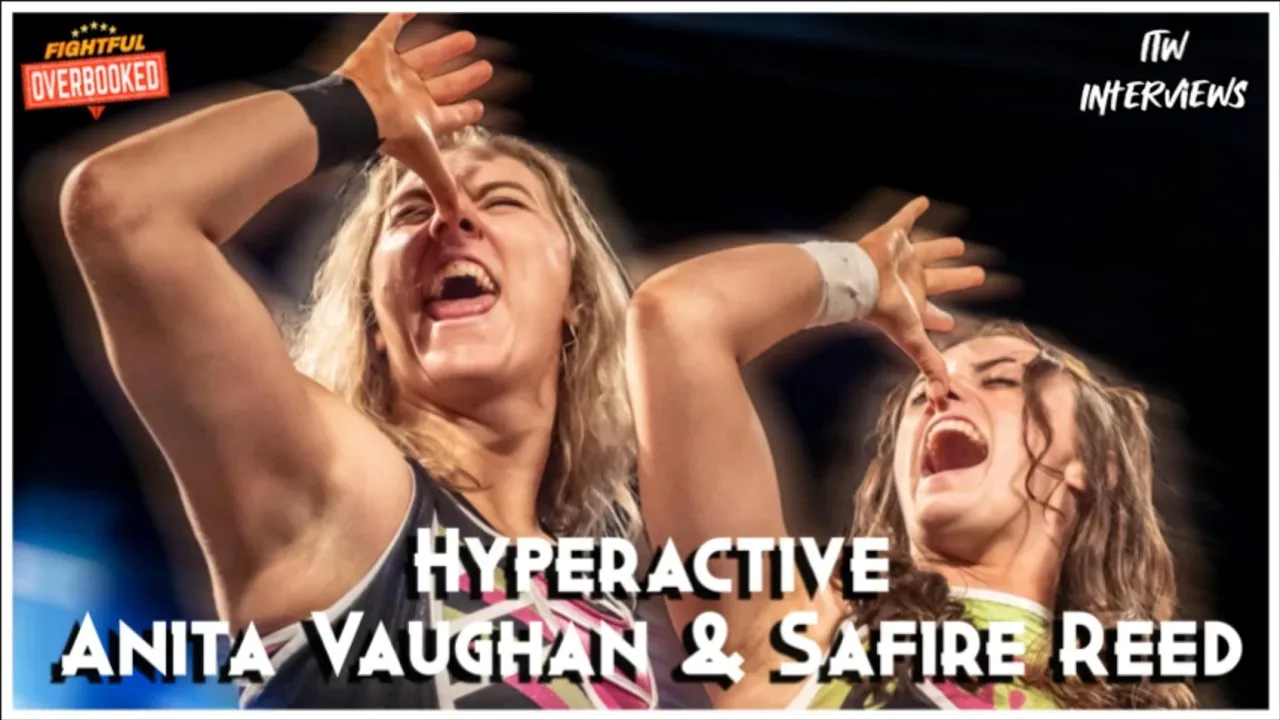
Hyperactive’s D-Generation X-inspired presentation in an EVE Multiverse Rumble was not simply a spur-of-the-moment tribute. Safire Reed and Anita Vaughan have revealed that the idea grew from feedback delivered by John Cena during Bayley’s Lodestone camp, where Cena told the emerging tag team that they reminded him of DX.
For Reed and Vaughan, the comparison carried particular weight. DX remains one of WWE’s most recognizable and influential acts, with Triple H and Shawn Michaels defining the group’s early identity through their rebellious attitude, crowd connection and singular chemistry. When Hyperactive later had an opportunity to lean into a Multiverse Rumble concept in EVE, the Cena comment gave them a clear direction for their characters.
Vaughan explained that the pair went forward as Triple H and Shawn Michaels, respectively, drawing a direct line between the on-screen homage and the experience they had at Lodestone. The moment came after Hyperactive wrestled a tag team match in front of Cena and received detailed feedback from him afterward.
“It was great. We got to do a tag team match in front of him. After we got feedback from him as well, which is like, we talked about it before, but just like how incredible that was that it was like, he was so close to retirement and he still came out and spent like such a generous amount of time giving such detailed feedback,” Vaughan said.
For more background on this topic, read MLW Signs Terry ‘The Flip’ Sequoyah, Debut Timeline Tied to Injury Recovery.
The importance of the session, in Vaughan’s telling, went beyond having a famous name watch their work. Cena’s willingness to spend time evaluating performers and offering specific advice made the exchange especially meaningful for wrestlers still establishing themselves. That is the kind of access independent talent rarely gets, even at a time when more training camps and developmental initiatives are creating opportunities for wrestlers to be seen by established names.
Then came the line that stuck with Hyperactive.
“One of the things he said, he was like, you guys remind me of DX. I was like, that kind of a comment just sticks with you. You’re like, John Cena said that. That’s really crazy. Thank you, Mr. Cena. Thank you. So I think that’s where the idea came like, hey, for this Multiverse Rumble, it should be DX. That would be really cool. So that’s how we ended up going as Triple H and Shawn Michaels respectively.”
A Defining Comparison for an Emerging Team
There is a difference between a broad compliment and a comparison that gives performers a creative reference point. In this case, Cena connecting Hyperactive with DX gave Reed and Vaughan a notable point of validation while also offering an instantly understandable framework for their Multiverse Rumble presentation.
DX’s legacy is rooted in more than ring gear or entrance mannerisms. At its best, the act was built on the confidence of performers who knew how to provoke a reaction, play off one another and make audiences feel included in the joke. That made the comparison a substantial one for a team such as Hyperactive, whose identity depends on the shared energy between its two members.
Reed and Vaughan did not claim that Cena intended to offer a blueprint for their careers, nor did they present the remark as anything more than feedback from a respected veteran. But the fact that it became the catalyst for a specific EVE appearance illustrates how a short observation from an experienced wrestler can stay with talent long after a camp ends.
For independent wrestlers, opportunities to perform before major names often provide more than critique of an individual match. They can sharpen a team’s understanding of its presentation, help clarify the traits that register with viewers and give performers confidence that their instincts are connecting. Hyperactive’s decision to turn Cena’s DX comparison into an on-screen concept is an example of that process in action.
Lodestone’s Role in the Story
Bayley has held several Lodestone camps for independent women’s wrestlers, creating a setting focused on development and feedback. Hyperactive have been connected to the initiative from the beginning, as Reed and Vaughan attended the first Lodestone camp.
Cena was also among the attendees at the camp, where he spoke with talent, watched matches and offered his thoughts. The setting placed Hyperactive in front of one of wrestling’s most accomplished modern stars at a particularly significant point in his career. Vaughan noted that Cena was close to retirement, yet still made time to give extensive feedback to wrestlers working to advance their own careers.
That generosity is central to why the moment resonated with the duo. The value was not merely that Cena saw them wrestle. It was that he engaged with what they were doing and identified something in their team dynamic that reminded him of a legendary pairing.
For Cena, whose WWE career has included a long history of working with rising talent and helping newer performers find their footing in high-pressure situations, the Lodestone appearance represented another chance to share experience with wrestlers outside his usual environment. For Hyperactive, it produced a memory that became part of their creative history.
The Lodestone camps also underline the growing significance of spaces designed to support women on the independent scene. Training, match feedback and conversations with established wrestlers can all be difficult to access consistently, particularly for performers developing their profiles across multiple promotions. By bringing talent together in that setting, camps such as Lodestone can create moments that have an impact beyond the day’s matches.
Why the Multiverse Rumble Was the Right Stage
A Multiverse Rumble naturally offers wrestlers room to take chances with presentation. The format invites surprise entrants, alternate concepts and references that might not fit as neatly into a standard tag team bout. For Hyperactive, portraying Triple H and Shawn Michaels allowed them to acknowledge Cena’s comparison in a playful, visible way.
The choice also respected the basic point behind the comment. Reed and Vaughan were not simply selecting a famous act for recognition. They were drawing on the specific team Cena named after seeing them perform together. That gave the tribute an organic connection to their own path rather than making it a disconnected costume decision.
Vaughan’s explanation makes clear that the duo saw the idea as a way to honor an extraordinary interaction. Being told by Cena that they evoked DX was surreal enough; getting the chance to transform that statement into a themed appearance made the experience even more memorable.
There is an added layer to the decision because DX has endured across generations of fans. Triple H and Michaels are among the most prominent figures in WWE history, and the group’s imagery remains immediately recognizable. Reimagining that image as part of an EVE Multiverse Rumble gave Hyperactive an opportunity to tap into a familiar visual language while putting their own spin on it.
Momentum and an Unfinished EVE Chapter
Elsewhere in their discussion, Hyperactive addressed the postponement of their EVE match against The Brawling Birds. No further details about a new date or the reason for the postponement were provided in this discussion.
The postponement means that the team’s EVE story with The Brawling Birds remains unresolved. In wrestling, a delayed match can interrupt momentum, but it can also leave audiences waiting for a confrontation that still needs to happen. Hyperactive’s continued visibility, including the DX-inspired Multiverse Rumble appearance, ensures that the team’s personality remains part of the conversation while that bout is on hold.
For Reed and Vaughan, though, the most enduring takeaway from the Lodestone camp may be simpler than any individual booking. A respected figure saw their work, gave them serious feedback and offered a comparison that made them think differently about what they could present as a unit.
Hyperactive’s choice to become Triple H and Shawn Michaels for the EVE Multiverse Rumble was therefore rooted in more than nostalgia. It was the result of a meaningful piece of encouragement from John Cena, a team recognizing the value of its chemistry, and an opportunity to turn a memorable comment into a creative moment in the ring.

Darryl Polo
Darryl Polo is a passionate wrestling fan covering WWE, AEW, TNA and beyond. He loves great rivalries, breakout stars and the moments that keep fans talking long after the bell. How we work.