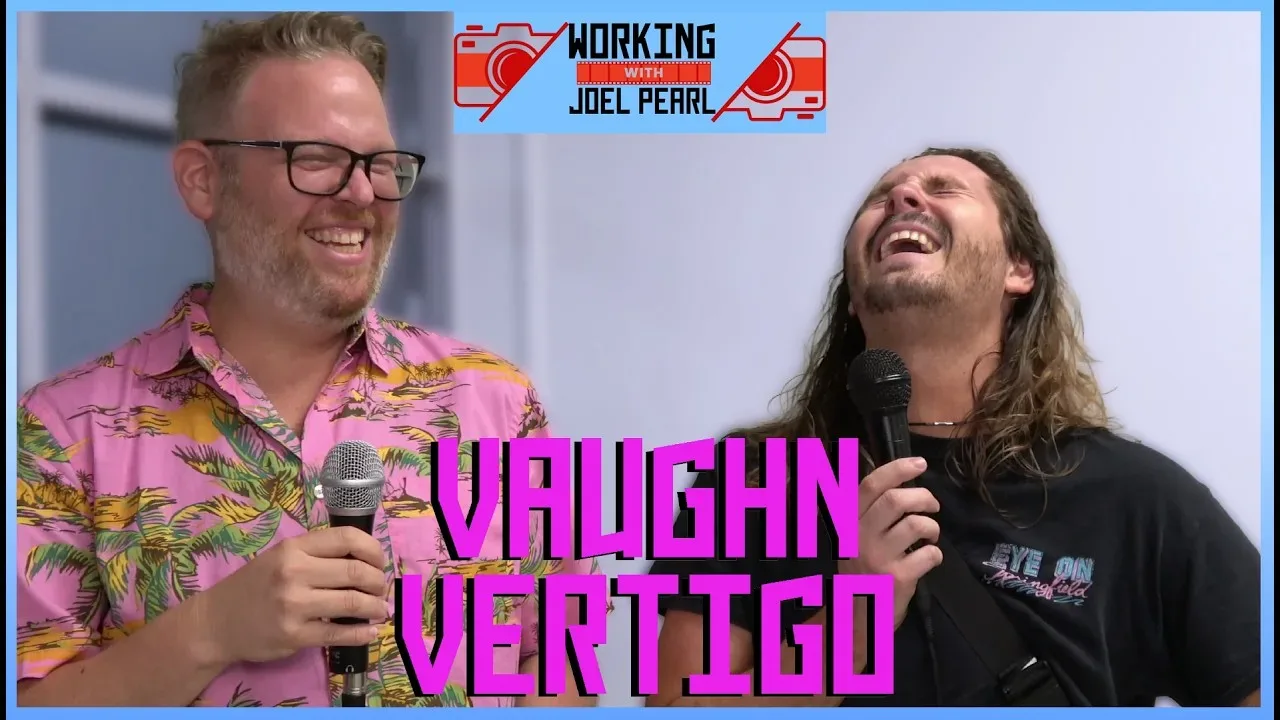
Vaughn Vertigo has described his time working with AEW as a series of unpredictable opportunities, ranging from pre-show matches to being placed directly in the path of Christian Cage’s Killswitch.
As Vertigo’s profile has continued to rise on the independent wrestling circuit, he has taken on more work with larger promotions, including AEW and ROH. Those appearances have given him chances to work around prominent talent and to take part in moments that can substantially expand the visibility of an emerging wrestler. For Vertigo, the experience has also carried a uniquely surreal quality: one minute he is a professional preparing for an assignment, and the next he is standing in a hallway among performers he grew up watching.
Speaking about those AEW opportunities, Vertigo emphasized that every appearance can bring a different assignment. The uncertainty is part of what makes the environment exciting, whether he is competing in a match, appearing as part of a segment, or being selected to help execute a memorable television angle.
“I mean, they’re all very cool experiences. You kinda get imposter syndrome where you’re just standing in the hallway like, there’s Chris Jericho, there’s Edge, there’s Christian, there’s MJF. All these people walk by and you’re like, ‘No, you’re here for a reason.’”
For more background on this topic, read Gringo Loco and Amber Nicole Welcome Daughter Aria Nicole Santo.
That sense of imposter syndrome is familiar to many wrestlers moving from the independent landscape into nationally televised environments. The job may call for an extra, security role, enhancement appearance, pre-show bout, or another supporting position, but the setting remains significant. Major television productions move quickly, and wrestlers brought in for those roles must be prepared to contribute effectively with limited notice.
Vertigo’s AEW work has already placed him across from recognizable names. He cited working the AEW pre-show in Winnipeg against Evil Uno and wrestling the Gunn Club in Detroit as examples of how varied the assignments can be. He has also shared the ring with Christian Cage and Ace Austin. Rather than viewing that lack of certainty as a drawback, Vertigo said it has made the experience enjoyable.
“Then, you get put in a spot where you take a Killswitch from Christian. These things pop up and sometimes you’re doing the AEW pre-show in Winnipeg against Evil Uno or you’re wrestling the Gunn Club in Detroit. You don’t know what to expect when you show up and it’s always a fun time for the most part, and the catering is great.”
From the Unprettier to the Killswitch
The spot with Christian carried a personal layer for Vertigo that extended beyond the immediate AEW segment. Christian’s finishing move has been known by different names throughout his career, most notably the Unprettier and the Killswitch. Vertigo put together a social-media reel connecting two eras of his life: footage of himself as a child taking the Unprettier on a trampoline and footage of himself years later taking the Killswitch while appearing as a security guard in AEW.
The comparison captured an aspect of professional wrestling that resonates with fans and performers alike. A move that was once part of backyard-style childhood play became a real on-camera bump in a major wrestling promotion. It is an especially fitting story for a wrestler who is still building his career while receiving opportunities to work close to some of the names that shaped his fandom.
“It probably did because I turned it into a reel of me as a kid on the trampoline taking the Unprettier. I showed that, then me as a security guard taking a Killswitch.”
The visual is straightforward, but it speaks to the long route that can exist between becoming a fan and earning a place in the professional business. Vertigo was not merely revisiting a childhood memory; he was documenting a real milestone. The later clip came in an AEW setting, with Christian delivering one of the moves most associated with his career.
For wrestlers doing supplementary television work, a brief segment can matter considerably. It can provide valuable experience with television production, timing, positioning, physicality, and the expectations of a nationally visible company. It may also create a clip that helps define how fans first encounter a performer. Vertigo’s reel did just that by framing the Killswitch as both an AEW moment and a continuation of an early connection to wrestling.
The Conversation That Led to the Spot
Vertigo also shared the story of how he came to be involved in the Killswitch spot. The segment took place in London, and before the action unfolded, Vertigo introduced himself to Christian by mentioning a training connection.
Vertigo was trained by Rob Fuego. He told Christian that Fuego had come up with Christian under Rob Hutchinson, establishing an overlap in their wrestling backgrounds. Christian’s response was unexpected and has remained funny to Vertigo in retrospect.
“That was in London. A funny story about how I got picked for it. I got to say to Christian, I was like, ‘Hey, I’m trained by Rob Fuego, who came up with you under Rob Hutchinson.’ He said to me, ‘Oh, maybe we’ll use somebody else for this’, which I still think is hilarious.”
The exchange is a reminder that wrestlers often bring a dry sense of humor to moments that may appear intimidating from the outside. For Vertigo, the comment did not prevent him from becoming part of the segment. Instead, it became a memorable detail attached to an already unusual opportunity: talking to Christian Cage about a shared training lineage and then taking Christian’s signature move in front of an AEW audience.
Vertigo also recalled another humorous part of the same sequence involving Edge. In the segment, a security guard whipped Edge off and delivered a line before being met with a spear. Vertigo questioned the logic of security guards delivering dialogue in such moments, but clearly enjoyed the absurdity of it.
“If you watch that segment back, Edge asks — there’s a security guard that whips Edge off and throws a line, then Edge gives the spear. I still think that’s hilarious. I don’t know why security guards throw lines, but it’s funny.”
Making the Most of Unpredictable Opportunities
Vertigo’s comments offer a look at the reality of wrestlers who are earning opportunities beyond the independent circuit. Not every appearance arrives with extensive buildup or a clearly defined path. A wrestler can enter the building without knowing whether the night will involve a match, a security role, a short segment, or another assignment entirely. The ability to adapt is important, as is the confidence to recognize that being present is itself an opportunity.
That is why Vertigo’s remarks about imposter syndrome stand out. Sharing a backstage area with Chris Jericho, Christian Cage, MJF, and other established stars can be overwhelming. Yet Vertigo’s own response to that feeling is simple: remember that he is there for a reason. That outlook is valuable for any performer trying to turn an initial appearance into more consistent work.
His experiences also illustrate the range of roles that can contribute to a wrestler’s growth. A pre-show contest with Evil Uno in Winnipeg offers one type of challenge. A match involving the Gunn Club in Detroit offers another. A security-guard role that culminates with a Killswitch from Christian presents a completely different kind of television responsibility. None of those scenarios are identical, but all require readiness and professionalism.
For Vertigo, AEW has provided a setting where those possibilities continue to emerge. His positive assessment was not limited to a single match or segment; he described the company’s assignments as consistently enjoyable, even when he has no idea what to expect upon arrival. That openness to the unexpected has helped produce a memorable highlight in the form of the Killswitch spot and the childhood-to-professional-wrestling reel that followed.
As Vertigo continues to expand his work in AEW, ROH, and the independent scene, the London moment with Christian Cage will stand as an especially distinctive chapter. It combined a personal training connection, an amusing backstage exchange, a major on-screen bump, and a direct link to the kind of wrestling fandom that began years earlier on a trampoline. In an industry built on moments, Vertigo found one that was both professionally meaningful and genuinely funny.
Darryl Polo
Darryl Polo is a passionate wrestling fan covering WWE, AEW, TNA and beyond. He loves great rivalries, breakout stars and the moments that keep fans talking long after the bell. How we work.