
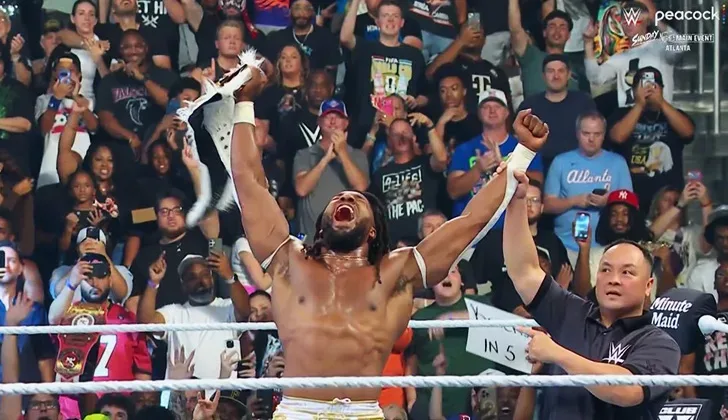
Trick Williams has consistently carried himself as a performer with major-star ambitions, but he has been equally open about the work required to reach that point. Following his WWE Sunday Night’s Main Event victory over Baron Corbin to regain the WWE United States Championship, Williams reflected on the journey that brought him into wrestling, including the significant adjustment from Division I football and the lessons provided by two WWE Hall of Famers, Booker T and Shawn Michaels.
Williams’ rise has been fueled by athletic ability, confidence, and an increasingly polished understanding of how to connect with an audience. Still, he explained that his sports background did not make every part of professional wrestling instinctive. In fact, one of the foundational elements of wrestling ran directly against the physical habits he developed on the football field.
From avoiding the ground to learning how to hit it
As a football player, Williams was conditioned to remain upright. Success on offense can be measured through gaining yards, making catches, breaking tackles, and staying on one’s feet through contact. Wrestling training demands a dramatically different physical vocabulary. Before a performer can master a signature move, a character, or a high-pressure match, they have to learn how to fall safely and convincingly.
“The first thing you learn becoming a WWE superstar is how to fall, how to hit the ground, how to flip, how to cartwheel, how to do all these different things,” Williams said.
For more background on this topic, read Sol Ruca Eyes WrestleMania Entrance Performed by The Skeletones.
That was not an automatic transition for someone coming from football. Williams described rolling, bumping, and repeatedly taking impact as unnatural at first. He summarized the difference with a simple comparison: in football, “the ground is lava,” because staying off it is a priority by any means necessary. In WWE, learning to hit the mat correctly is an unavoidable and essential starting point.
The point is especially relevant to Williams’ development because it underlines the distinction between being a gifted athlete and becoming a complete wrestler. Athleticism can open doors, but it does not replace the training needed to protect oneself and an opponent, work within the rhythm of a match, and make every movement look believable to viewers. Williams said the process became one of taking things gradually, adding skills and learning more of the craft each day.
That progression goes beyond bumps and movement. Williams said a WWE Superstar must also determine how to portray themselves as a character, what moves fit their presentation, and how every aspect of the performance connects. His comments reflect the full scope of the job: wrestling is physical, but it is also visual, emotional, and dependent on an audience understanding exactly who a performer is.
Booker T’s focus on presentation and star power
Booker T has been an important mentor for Williams, and the guidance Williams described centers on an element that can be easy to overlook amid the athletic demands of the ring: making every moment read clearly for the camera.
Williams pointed to the example of applying a headlock. The hold itself may be basic, but Booker T’s instruction is about how the hold is framed. Williams said Booker emphasizes positioning the move in a way that lets the cameras capture the visual detail, including a wrestler’s bicep pressed against an opponent’s forehead and the physical intensity visible in the shot.
“Booker T… emphasizes always looking good for the camera,” Williams said. “If you going to put somebody in a headlock, make sure you lock in that headlock so your bicep is pressed up against their forehead and all the cameras can see the veins and everything in your bicep.”
That advice is not merely about posing. It speaks to how wrestlers translate physical action into television. A hold has to look effective, the camera needs a compelling image, and the performer needs to project a larger-than-life presence even in a relatively simple sequence. Williams said Booker’s broader message is to place an emphasis on being cool and, more importantly, being a star.
For Williams, Booker T’s role has added personal weight because he was already one of the wrestlers Williams admired before entering the industry. Booker’s career includes five reigns as WCW World Heavyweight Champion, a record Williams referenced while explaining why the Hall of Famer represented the kind of greatness he hoped to approach.
Williams also named The Rock and Stone Cold Steve Austin alongside Booker T as performers whose impact helped define what he wanted wrestling to feel like. He was drawn to their authenticity, their aura, and the way audiences responded to them. In Williams’ view, those stars created something that felt special because they approached their roles as extensions of themselves rather than as something artificial.
“They was very authentic to themselves, and the people responded like that,” Williams said.
Williams acknowledged the familiar warning that people should not meet their heroes, but said his experience with Booker T has been the opposite. Rather than diminishing his admiration, the mentorship has given Williams direct access to knowledge from a wrestler whose style, charisma, and accomplishments helped inspire his own career choice.
Shawn Michaels’ standard: make the crowd react
While Booker T’s coaching has stressed visual presentation and star presence, Williams described Shawn Michaels’ teaching in terms of the ultimate purpose of a wrestling match: eliciting a major reaction from the crowd.
Michaels’ influence on developmental talent has been substantial, and Williams said the Hall of Famer consistently emphasizes putting on “the best match, period.” In Williams’ explanation, that standard is measured less by outside concerns and more by whether fans are chanting, yelling, and fully engaged in what is happening in the ring.
“Make sure the people are chanting, make sure the people are yelling, making noise,” Williams said. “That’s the most important part about the business.”
It is a straightforward philosophy, but one that can be applied at every level of a performer’s development. Matches require execution, timing, storytelling, character consistency, and the ability to work with an opponent. Those tools matter because they can produce the desired emotional result. If the audience is invested enough to react loudly, the match is accomplishing its central objective.
Williams said some people become caught up in the wrong things, while Michaels’ lesson keeps the focus on the audience going “crazy.” It is a valuable perspective for a wrestler whose presentation has always relied heavily on crowd energy. Williams’ charisma is amplified when fans respond to his catchphrases, entrances, and momentum shifts, but the same principle applies when he is building drama bell to bell.
A championship result and a continuing evolution
Williams’ win over Baron Corbin at WWE Sunday Night’s Main Event gave those lessons an immediate championship backdrop. By defeating Corbin, Williams regained the WWE United States Title, adding another major result to his ongoing evolution as a WWE star.
The victory is also a reminder that career growth in wrestling does not end once a performer reaches the championship level. Williams spoke about continuing to learn new moves, new skills, and the finer details of his character. The input from Booker T and Michaels addresses two of the most important pieces of becoming a sustained top-level act: looking like a star in every frame and giving people a reason to react when the bell rings.
Williams’ football background may have given him the competitive foundation and athletic tools to pursue a WWE career, but his own comments make clear that he has had to rebuild aspects of his physical approach from the ground up. He had to learn to fall after years of trying not to. He had to understand how to make a simple hold look powerful for the camera. And he had to keep the crowd’s emotional investment at the center of a match.
With the United States Championship back in his possession, Williams now has another platform to apply those lessons. The advice is rooted in the experience of two Hall of Famers with different strengths, but the message is aligned: present yourself like a star, perform for the audience, and make every opportunity matter.

Darryl Polo
Darryl Polo is a passionate wrestling fan covering WWE, AEW, TNA and beyond. He loves great rivalries, breakout stars and the moments that keep fans talking long after the bell. How we work.