
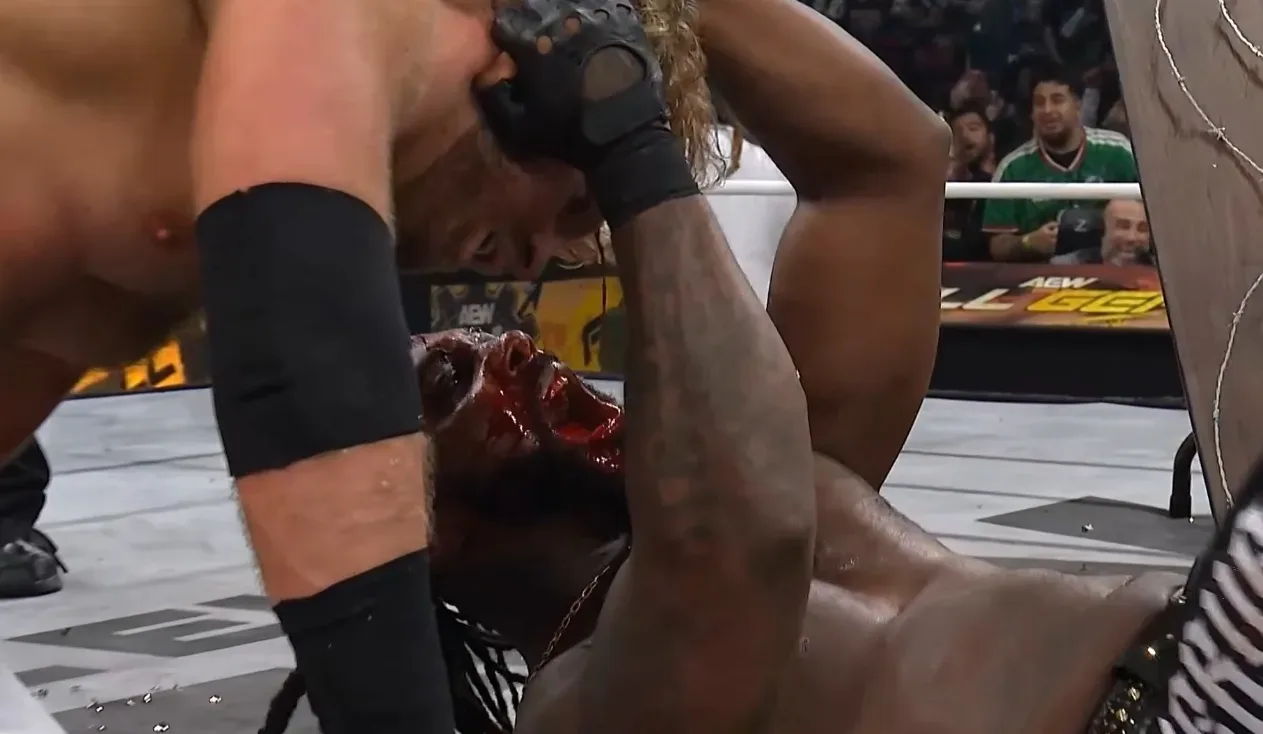
AEW Full Gear delivered the kind of extreme violence that was certain to create conversation, and Tony Schiavone has given his candid assessment of one of the show’s most unsettling images: Swerve Strickland drinking Hangman Page’s blood.
Speaking on What Happened When, Schiavone was asked about the online discussion surrounding the violence featured at Full Gear, including a Texas Death match that involved staple guns, skewers, and the bloody moment between Strickland and Page. The longtime announcer made clear that he had not followed the reaction closely, but he did not deny that the visual was difficult to watch.
“Yeah, that was pretty gross, I have to admit,” Schiavone said.
The moment came as part of the continued, deeply personal conflict between Strickland and Page. Their rivalry has repeatedly gone far beyond conventional competitive animosity, with both men seeking to get inside the other’s head through increasingly violent and symbolic actions. Strickland drinking Page’s blood at Full Gear was not presented in isolation; it intentionally echoed Page drinking Strickland’s blood during their Full Gear 2023 encounter.
For more background on this topic, read Mara Sadè Embraces Worldwide Momentum Following TNA Departure.
That history is important to the reaction. AEW did not frame Strickland’s action as random shock value detached from the story. Instead, it was a callback to one of the rivalry’s most infamous prior moments, turning Page’s own past behavior back on him. Even with that context, Schiavone acknowledged that the image itself was extreme.
Schiavone Says Full Gear Violence Was ‘Fucking Nuts’
Full Gear featured two major matches built around chaos and brutality: the Texas Death match and Anarchy in the Arena. The show used weapons, blood, and escalating physical punishment to convey the intensity of the issues being settled in the ring.
When Conrad Thompson asked Schiavone about the chatter surrounding the violence, the AEW broadcaster said he had not seen it and was focused more on the spectacle unfolding in front of him than on social-media commentary afterward.
“I didn’t see any of the chatter because, as you know, I don’t give a shit,” Schiavone said. “I just thought it was fucking nuts. Two men are standing up there, each have a staple gun and are stapling each other.”
Schiavone’s response speaks to the central divide that tends to emerge whenever AEW presents a particularly graphic match. Some viewers embrace the promotion’s willingness to use violent stipulations and push emotional feuds into uncomfortable territory. Others question whether certain images go too far, particularly when blood, weapons, and scenes designed to provoke disgust become a focal point of the presentation.
For Schiavone, disagreement is simply part of putting on a wrestling show that aims to make people feel something. He said that there will always be elements that some fans dislike, while also observing that controversial material naturally travels farther online.
“You’re always going to do something that people don’t like,” Schiavone said. “People love to amplify the controversial; that’s what being on social media is all about. I haven’t heard any of it. You just have to move on.”
A Full Gear Callback in the Page-Strickland Story
The blood-drinking spot carried added weight because of the long-running connection between Page, Strickland, and the Full Gear event itself. At Full Gear 2023, Page drank Strickland’s blood in a moment that became one of the defining visuals of their feud. When Strickland responded with the same act years later, it functioned as a deliberate reversal.
Such callbacks can be effective because they reward viewers who have followed a rivalry closely. Page and Strickland’s history has been marked by grudges, personal escalation, and efforts to prove psychological dominance as much as in-ring superiority. In that environment, the Full Gear scene was meant to communicate that neither competitor had forgotten what happened before.
It also demonstrates why reactions to the moment can vary dramatically. For viewers invested in the story, the reversal may be read as a pointed piece of revenge and continuity. For viewers encountering the scene without the same historical context, the act can understandably register first as a graphic and disturbing visual.
Schiavone’s description of it as “pretty gross” recognizes that second response without dismissing the storytelling purpose behind it. In wrestling, especially under Texas Death rules, performers and producers often use heightened physicality to show that a conflict has moved past normal rules or restraint. The desired effect is not always comfort. Sometimes it is revulsion, disbelief, or a sense that the people involved have reached a place where ordinary competition is no longer enough.
Strickland and New Level Leave With the Trios Titles
The Texas Death match did not just provide a dramatic chapter in the Page-Strickland rivalry. It also had championship implications.
Strickland teamed with New Level, consisting of Kofi and Austin Creed, against Page and Brodido, the team of Bandido and Brody King. By the end of the violent contest, Strickland and New Level were victorious and captured the Trios Titles.
The outcome ensured that Full Gear’s most talked-about violence had a significant competitive consequence. Strickland, Kofi, and Creed did not merely survive a chaotic stipulation match; they emerged with AEW’s trios championship gold. The victory gives their alliance immediate credibility while leaving Page, Bandido, and King to absorb a brutal defeat.
For Page and Strickland in particular, the result adds another layer to a rivalry already defined by escalation. A Texas Death setting is designed to strip away the neat boundaries of a standard match, and the addition of the Trios Titles made every gruesome turn matter beyond personal pride. The champions now carry the rewards of that fight, while their opponents are left with both physical damage and the frustration of losing the titles.
AEW’s Balancing Act With Extreme Matches
AEW has long featured a range of styles, from technical wrestling and high-flying action to hardcore stipulations and faction wars. Full Gear’s Texas Death and Anarchy in the Arena matches highlighted the more chaotic end of that spectrum. Staples, skewers, forks, fire, and heavy bleeding created a night built around the sense that rivalries had become uncontrollable.
There is an inherent balancing act in that approach. Excessive violence can alienate viewers who prefer a more restrained presentation, but it can also make major blood feuds feel distinct when the violence is tied to a story with genuine stakes. The strongest version of an extreme match is not defined solely by the weapon used or the amount of blood shown. It is defined by whether the violence clarifies character, advances a feud, and makes the final result feel consequential.
The Page-Strickland callback had those narrative foundations. Page’s past action at Full Gear 2023 gave Strickland’s response a clear meaning. The Trios Titles gave the match a tangible reward. And the intensity of the teams involved established why a standard encounter would not have been enough to settle the issue at hand.
Still, Schiavone’s reaction is a reminder that even wrestling figures accustomed to spectacle can find particular moments unpleasant. Calling the spot “pretty gross” does not mean he failed to understand its intended purpose. It means the scene accomplished a visceral effect strong enough to stand out amid an already wild night.
Controversy Will Continue to Follow Full Gear’s Most Violent Moments
Debate over violence in professional wrestling is unlikely to disappear, especially as clips and screenshots circulate rapidly online without full match context. Graphic moments can become the immediate headline, while the rivalry, championship stakes, and prior callbacks that led to them can be lost in the discussion.
Schiavone’s outlook is that criticism and controversy are unavoidable. Not every fan will enjoy the same material, and AEW cannot expect universally positive reactions when it presents imagery intended to be jarring. His point, however, is that the promotion and performers ultimately have to continue forward rather than become consumed by every wave of online response.
At Full Gear, Strickland and New Level left with the Trios Titles after defeating Page and Brodido in Texas Death. The road to that result included one of the event’s most divisive moments, a blood-soaked reversal that recalled the history between Strickland and Page. Whether viewers saw it as effective long-term storytelling, excessive violence, or both, it accomplished one undeniable goal: it made sure the conflict was impossible to ignore.

Darryl Polo
Darryl Polo is a passionate wrestling fan covering WWE, AEW, TNA and beyond. He loves great rivalries, breakout stars and the moments that keep fans talking long after the bell. How we work.