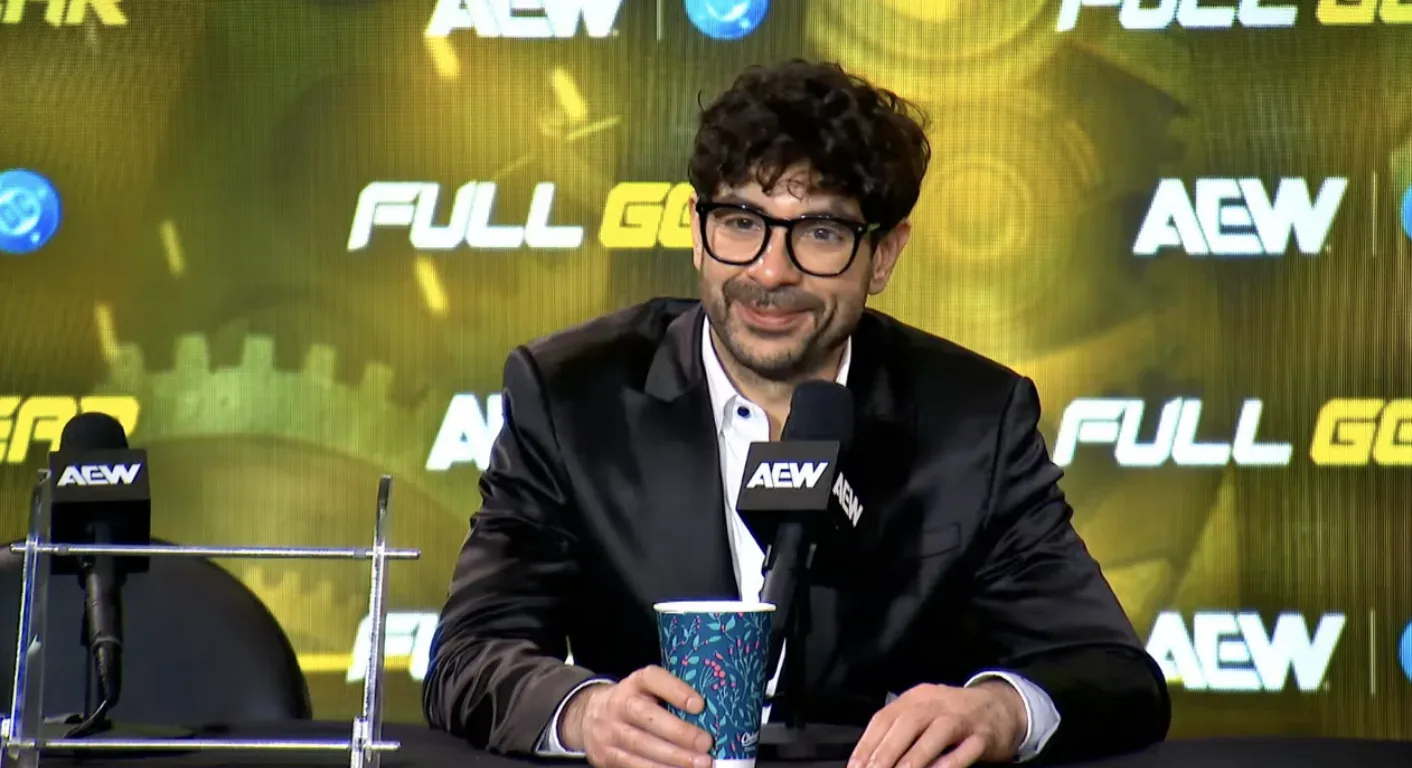
Tony Khan says AEW has identified a useful pay-per-view conversion tool in the rare occasions when a match starts during the Buy In or Tailgate Brawl pre-show and carries over onto the main card.
The concept was used at AEW All In, where the Casino Trios Royale began before the pay-per-view proper and continued into the opening moments of the main broadcast. That structure created an immediate spotlight for The New Level, whose debut unfolded as the event officially moved into its paid portion.
During the media call for AEW All Out, Khan was asked about the business impact of allowing a pre-show match to “bleed” into the pay-per-view. He answered directly that AEW has experienced an increase in purchases when it has used the approach.
“Big time. We have. That’s why it’s worked. I haven’t done it that much.”
For more background on this topic, read Tony Khan Confirms AEW Worlds End Will Return in 2026.
Khan did not attach a specific number or percentage to that increase. Still, his comments make clear that AEW considers the strategy more than a creative wrinkle. In the company’s view, it can give viewers who are watching the free television portion of a show a reason to continue with the match by purchasing the pay-per-view.
FTR vs. JetSpeed Set the Template
Khan identified FTR vs. JetSpeed as the first time he used the format. That match, he said, demonstrated the intended effect particularly well because fans could watch it on TNT and then decide they wanted to see its conclusion.
“The first time I did it was FTR vs. JetSpeed, it worked fantastically well. There was clearly an uptick, people were watching that match on TV and they were on TNT and they said, ‘Oh, I want to keep watching that match, I’m gonna buy this pay-per-view.’ That worked really well.”
That example outlines the logic behind the presentation. A conventional pre-show match is designed to warm up the audience, offer additional bouts, and give viewers an accessible lead-in before the paid event begins. Once a match is fully contained within that window, however, the audience has no immediate reason to make a purchase simply to see its ending. A contest that remains unresolved as the main card begins changes that equation.
For viewers already invested in the action, a continuing match offers a clear and immediate hook. Rather than promoting a later attraction in abstract terms, the show asks fans to act during a moment they are already watching. Khan’s recollection of the FTR and JetSpeed match suggests AEW saw viewers respond to that live urgency.
It is also a format that depends heavily on the match and the timing. Khan emphasized that AEW has not employed it frequently. That restraint is significant because a tactic designed to create a one-time sense of momentum can lose effectiveness if fans come to expect every pre-show bout to run past the pay-per-view start time.
All In Used the Format for a Different Kind of Moment
The Casino Trios Royale at All In showed how the same structure can serve a broader creative purpose. Battle royal-style matches naturally support an extended runtime, surprise entrances, shifting alliances, and late developments. Having the contest continue into the main card allowed AEW to preserve that momentum while putting The New Level’s arrival in front of the pay-per-view audience from the outset.
In that setting, the pre-show-to-main-card transition was not solely about keeping a standard match going a few additional minutes. The structure made the first moments of the pay-per-view feel connected to what fans had just watched for free, while also giving the company a notable development to present after the event officially began.
That distinction matters. A continuation needs to feel organic to the match rather than artificially extended simply to hold back an ending. A Casino Trios Royale is well suited to the format because it has an open-ended rhythm and can accommodate an arrival or major shift without stopping the show’s momentum. A more tightly plotted singles or tag match requires a stronger reason to remain unfinished as the clock reaches the pay-per-view start.
AEW’s use of the device therefore appears selective in two ways: it is not deployed on every event, and it is not necessarily deployed for the same creative objective every time. The FTR vs. JetSpeed example was framed by Khan primarily as a purchase-conversion success. The All In example combined that commercial function with the debut of The New Level.
A Live Television Advantage
Khan’s reference to TNT also underlines why the approach can be effective in a live environment. A free televised pre-show reaches an audience that has already chosen to spend time with the event. Those viewers may be interested in AEW’s product but undecided on whether to buy a full pay-per-view. The continuation creates a decision point while their attention is focused on an active match.
That differs from a traditional promotional message, where a commentator might list the main-event matches or remind viewers of the start time. Those announcements can be valuable, but they ask prospective buyers to make a decision based on what is coming later. The carryover approach instead ties the purchase proposition to something already in progress.
For a promotion, the challenge is balancing that incentive with the experience of existing customers. Fans who have already purchased the show need to feel that the main card begins with meaningful action rather than a delay before the advertised attractions. Starting the pay-per-view with the final stretch of a match can address that concern when it provides a fast-moving opening and a clear sense that the event has begun immediately.
There is also a presentation benefit to avoiding a hard reset between the pre-show and the pay-per-view. Rather than ending one program, running a lengthy transition package, and beginning another with a separate entrance sequence, the action can continue without interruption. At All In, the Casino Trios Royale functioned as that bridge.
None of that guarantees the technique will work in every market or for every event. Khan did not suggest it was a universal solution, nor did he offer figures that would establish how large an increase has occurred across individual shows. His point was narrower: AEW has seen a noticeable positive response when it has used the format, and the FTR vs. JetSpeed match was the first instance that convinced him of its value.
Why AEW Is Not Making It Routine
Khan’s most important caveat may be that he does not intend to use the tactic constantly. The scarcity of the approach is part of what gives it value. If audiences know the pre-show is likely to contain a full match from bell to bell, they can enjoy that programming without feeling they are missing a conclusion. If they know a continuation is possible but uncommon, an unresolved bout carries greater suspense.
Overuse could also create frustration among viewers who tune into the free portion expecting a complete match. The format asks fans to decide whether their interest in the specific contest is strong enough to purchase the event. That choice works best when the unfinished action feels like a special circumstance rather than a recurring barrier.
From a creative standpoint, selective use also protects the importance of the pay-per-view opener. AEW can choose a match that has enough energy to launch the main card, whether that means a highly competitive tag contest like FTR vs. JetSpeed or a multi-team spectacle such as the Casino Trios Royale. The decision should enhance the event’s rhythm, not merely delay a finish.
Khan’s comments provide an unusual look at how AEW evaluates the boundary between its free programming and its premium live events. The company’s pre-shows can serve several functions at once: they offer additional wrestling, build anticipation, provide a television lead-in, and, on select occasions, become part of the pay-per-view story itself.
For now, Khan’s position is straightforward. AEW has seen an uptick in buys when a pre-show match carries into the main event presentation, but the company believes the device is most effective when saved for the right match and the right moment. All In supplied one of those moments through the Casino Trios Royale and The New Level’s debut, while FTR vs. JetSpeed remains the example Khan cited as proving the idea could work commercially.
In pictures
Darryl Polo
Darryl Polo is a passionate wrestling fan covering WWE, AEW, TNA and beyond. He loves great rivalries, breakout stars and the moments that keep fans talking long after the bell. How we work.