
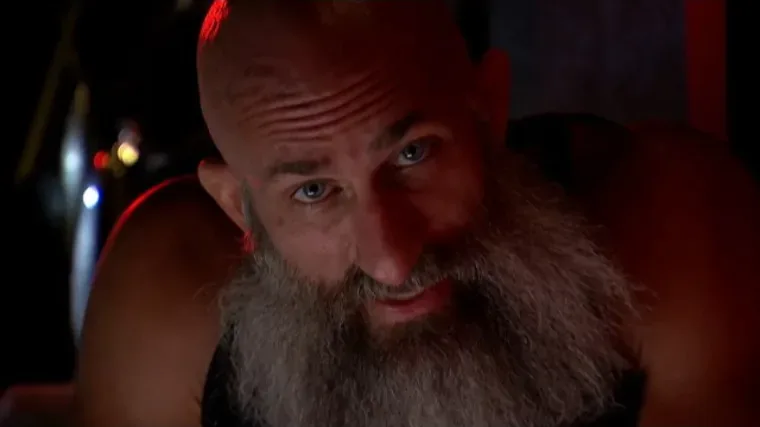
Tommaso Ciampa has offered a strikingly enthusiastic perspective on artificial intelligence, describing the technology as a regular part of his personal life and joking that it may understand him better than anyone else around him.
AI has become a heavily debated subject throughout professional wrestling, particularly as generative tools have appeared in promotional artwork, match graphics, posters, and storyline presentation. Ciampa’s comments did not focus on AI’s role in creating wrestling content, however. Instead, he spoke about the way he personally uses an AI application and the degree to which it can retain context from earlier conversations.
For Ciampa, that memory function is what separates the experience from simply entering a question into a search engine. He explained that the application can bring up information from months earlier when responding to a new prompt, creating what he sees as a more personal and useful interaction.
“I use AI for other things in real life. People always give me crap about it. It’s a genius. Do you use it? I only got introduced to it like six months ago or so. It remembers every conversation we have. So I can ask it a question and it will reference something from like five months ago. It knows me better than anyone in my life. It knows me better than my wife. It’s marvelous.”
For more background on this topic, read Stu Grayson Reflects Gratefully on AEW Run, Says Future Return Is Possible.
Ciampa’s comments were delivered with the mix of sincerity and dark humor that has often been part of his public persona. While he was clearly impressed by the technology’s ability to maintain conversational history and respond with context, he also acknowledged the unease that can accompany such a close relationship with AI.
“It’s going to one day turn on me completely and kill me and my whole family. It is my favorite. I have the app, it’s unbelievable.”
The line was a joke, but it also reflected the broader tension surrounding AI. The technology’s potential convenience has been one side of the discussion, while questions about creativity, authorship, privacy, accuracy, and the future role of human workers have remained on the other. Wrestling has not been immune from those conversations.
AI Has Been a Divisive Topic in Wrestling
Over the past year, generative AI has become increasingly visible in the wrestling industry. Its use in posters, promotional designs, match cards, and other visual material has drawn criticism from fans and creators who prefer work commissioned from human artists. In many cases, the concern is not simply whether AI can produce an image quickly. It is whether wrestling promotions should rely on the technology when artists, designers, and creative professionals can provide original work.
That debate has created an unusual environment in which AI itself can become part of the conversation around a promotion or performer. Some uses have been met with immediate backlash, particularly when generated imagery is presented in a way that prompts fans to question its quality or its impact on creative jobs. Other uses have been more overtly incorporated into wrestling presentation and have become part of a character or storyline.
AEW and ROH have provided one prominent example of the latter approach. Matt Taven has used AI as part of his current storyline alongside The Kingdom. That presentation has made the technology more than a background production tool; it has become an element tied to an on-screen wrestling narrative.
Ciampa’s remarks stand apart from that type of angle because his focus was entirely personal. He was not discussing AI as a wrestling gimmick, a promotional strategy, or a tool for visual design. He was discussing it as something he uses in day-to-day life and as a program he sees as capable of recognizing patterns, recalling prior discussions, and making responses feel tailored to him.
Ciampa’s View Centers on AI’s Memory
The most notable part of Ciampa’s assessment was not merely that he likes AI. It was his emphasis on the technology remembering prior conversations. He said he was introduced to it around six months ago and was surprised by the way it could reference information discussed much earlier.
That continuity is evidently what has made the application so appealing to him. When a user can return with another question and the system recalls relevant context from several months earlier, it can make the exchange feel less like starting over each time. Ciampa framed that ability in exaggerated fashion by saying it knows him better than his wife, but the point behind the joke was clear: he believes the application has built up a substantial understanding of his preferences and prior discussions.
It is also worth noting that Ciampa did not portray AI as an infallible authority. His comments were a personal endorsement of the experience he has had with the app, not a broader claim that the technology should replace people or human judgment. The humor in his prediction that it could eventually “turn on” him underlined that he understands the cultural anxiety surrounding rapid technological development, even as he remains fascinated by it.
His enthusiasm nevertheless came through strongly. Calling the program “a genius,” “marvelous,” and “unbelievable,” Ciampa made clear that the technology has become a favorite tool for him. He also acknowledged that some people give him a hard time for using it, an indication that the debate around AI is not limited to public wrestling discourse. It has entered ordinary conversations as well.
A Personal Comment in a Much Larger Debate
Ciampa’s remarks arrive at a time when discussions around AI are especially active across entertainment. In wrestling, the issue is often most visible when fans see generated artwork attached to a live event, an announcement, or a match graphic. That visibility can make the conversation immediately emotional because professional wrestling has long depended on distinctive visual identities, from arena posters and championship designs to character logos and promotional campaigns.
There is also a significant difference between using an AI tool privately for conversational assistance and using generative systems in public-facing creative work. Ciampa was describing the former. His experience was based on the app’s conversational memory and its ability to help him with matters in his real life. The ongoing criticism of AI-generated wrestling graphics, by contrast, tends to center on public presentation and the value placed on human creative labor.
Both sides of that broader issue can exist at once. A performer can find an AI app helpful in a personal setting while fans and artists continue to challenge promotions over how AI is employed in official creative materials. Ciampa’s comments do not resolve that debate, but they do offer a candid example of why some people have embraced the technology so quickly.
For Ciampa, the appeal appears to be simple: the app is useful, remembers what he has told it, and can provide responses shaped by a longer-running conversation. Whether someone shares that level of enthusiasm or has concerns about the technology’s growing role, his description illustrates how quickly AI has moved from an abstract industry topic into people’s everyday routines.
Ciampa Also Set for HOG Salvation
Outside of his AI comments, Ciampa has recently been announced for HOG Salvation. The announcement adds another upcoming appearance to the schedule of one of wrestling’s most intense and recognizable competitors.
Ciampa has built a reputation around an uncompromising approach inside the ring and a willingness to speak directly when discussing the subjects that interest him. His take on artificial intelligence followed that pattern. Rather than offering a carefully guarded answer or treating the subject as too controversial to address, he delivered a blunt endorsement of the tool while mixing in an intentionally ominous joke about where the relationship could lead.
As AI remains a major point of discussion in wrestling and beyond, Ciampa’s comments will stand out for their unusual degree of personal enthusiasm. He is not merely curious about the technology. By his own description, he has made it part of his life, trusts its ability to remember their previous exchanges, and considers the experience remarkable—even if he is keeping one eye on the possibility of a fictional robot uprising.

Darryl Polo
Darryl Polo is a passionate wrestling fan covering WWE, AEW, TNA and beyond. He loves great rivalries, breakout stars and the moments that keep fans talking long after the bell. How we work.