
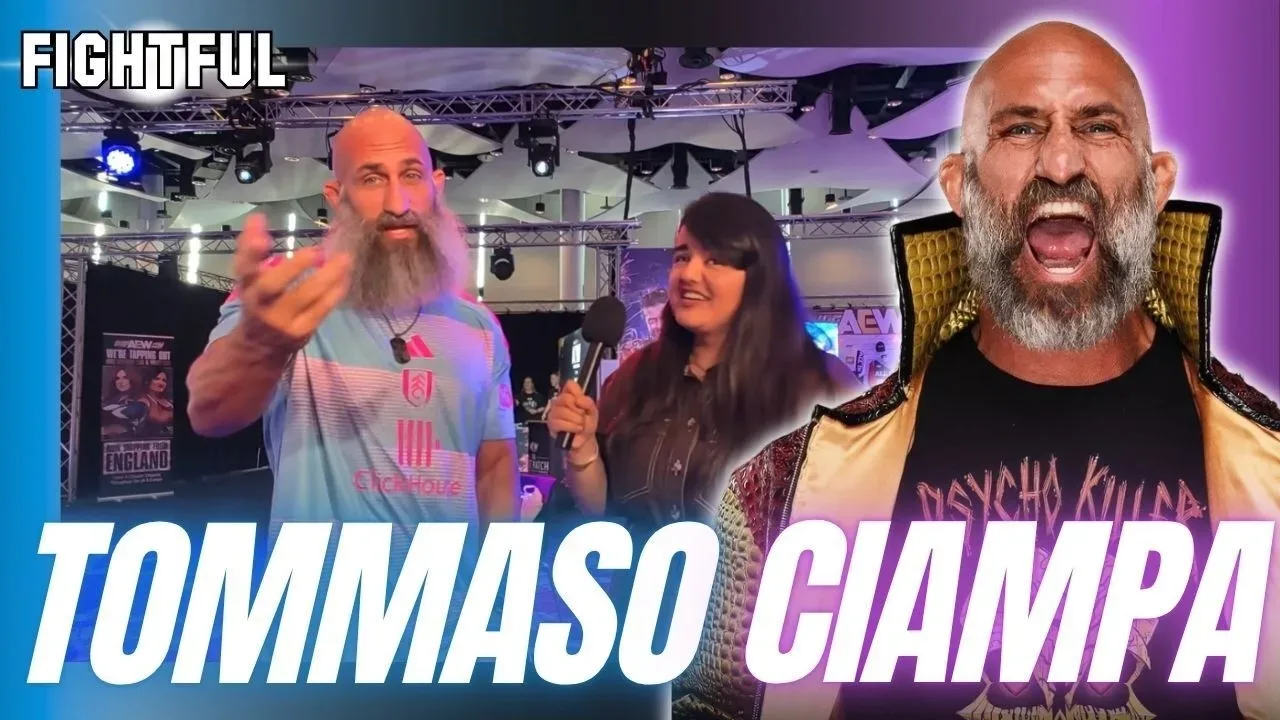
Tommaso Ciampa’s latest reflection is not about a championship, a rivalry, or the intensity that has long defined his in-ring career. Instead, the WWE veteran opened up about a personal family memory: watching The Lion King with his daughter Willow and realizing she had finally connected with a movie that meant so much to him as a child.
For Ciampa, the opening sequence of the animated classic had always carried major nostalgic value. He recalled how strongly it affected him when he was young, calling it “the greatest thing ever” from his own childhood. Like many parents, he eventually tried to share that feeling with his child, only to find that the timing was not right on his first few attempts.
“I remember trying it with Willow a couple of times, thinking this is going to be the thing, and she was too young,” Ciampa said.
The breakthrough came unexpectedly during a day when Ciampa’s wife, Jessie, was feeling ill. With Ciampa and Willow spending time together, he decided to put the film on, initially believing he would simply watch it himself. Rather than trying to force a shared viewing experience, he settled into the movie without expecting it to become a major family memory.
For more background on this topic, read Sol Ruca Eyes a Secondary Finisher While Refining the Story Behind the Sol Snatcher.
That was the moment Willow responded.
Ciampa said his daughter became engaged with the animals on screen, making noises along with them and reacting enthusiastically to what she was seeing. What had previously been a movie she was too young to fully appreciate suddenly became an experience they were enjoying together.
“I’ll just put this thing on for me. I’ll just watch it,” Ciampa recalled thinking. “And don’t you think that was the time she lost her mind? Every animal, she was doing the noises with them.”
The significance of the moment was not lost on Ciampa. He said he made a conscious decision not to reach for his phone or record Willow’s reactions. Instead, he wanted to remain present and take in the experience as it happened.
“I just remember sitting there and didn’t take the phone out, didn’t video it,” Ciampa said. “Like, I want to be in this moment.”
That choice became part of why the memory has stayed with him. Ciampa described the brief stretch of time as “five minutes of blissfulness,” recognizing that he was experiencing a familiar milestone for parents: seeing a child discover something that once shaped their own early years.
“Holy crap, I’m doing that thing where you’re living your childhood with your child,” Ciampa said. “Oh, my God. To this day, I can remember exactly where we were, location. Unbelievable.”
A Different Kind of Connection
Ciampa’s comments offer a glimpse away from the public-facing side of a WWE performer’s life. Wrestling audiences are accustomed to seeing him in a highly competitive environment, where identity is often shaped by physicality, championships, alliances, and conflict. His recollection of an ordinary afternoon at home presents a markedly different setting, centered on a parent sharing a meaningful piece of his own past with his daughter.
The story also highlights why certain childhood favorites endure across generations. A film can hold a specific emotional place for someone because of when and how they first encountered it. Yet a new layer is added when that person later gets to watch someone close to them experience it for the first time. The original memories remain, but they are joined by new ones.
For Ciampa, the important detail was not simply that Willow watched the movie. It was the spontaneous nature of her response. Earlier efforts had not worked because she was still too young. On this occasion, without the pressure of trying to manufacture a milestone, she was ready to engage with it on her own terms.
That timing was what made the experience resonate. Ciampa had expected to revisit something from his childhood by himself. He instead got to see his daughter react to it with excitement, turning a quiet household moment into one he can still vividly picture.
Choosing the Moment Over the Recording
One of the clearest parts of Ciampa’s recollection was his decision not to document it through a phone. In an era when memorable family moments are often captured immediately, Ciampa said he chose to stay fully in the room and watch Willow’s reaction instead.
There is no suggestion that recording a family moment is inherently wrong; Ciampa’s point was personal to this particular experience. He recognized in real time that he wanted to preserve the occasion through his own attention rather than interrupt it by trying to capture a video. The result was a memory he said remains remarkably clear years later, including the exact location where they were sitting.
That detail gives the story much of its emotional weight. The moment was not planned as a celebration or built around a special event. It grew out of a simple decision to put on a movie while spending time with his daughter. Ciampa’s memory of it remains powerful precisely because it was small, unexpected, and genuine.
Ciampa’s Perspective Beyond the Ring
Ciampa has built a reputation through the intensity of his professional wrestling work. Whether competing as part of WWE’s main roster or across the major stages that have defined his career, he has often been associated with a focused, confrontational style and a deep investment in every story he tells inside the ring.
His comments about Willow reveal another form of investment: the care that comes with being present for family experiences that cannot be replicated. A wrestling match can be replayed, revisited, and discussed by fans. A fleeting reaction from a child during a movie may never be recorded at all. Ciampa’s story makes clear that he values the latter kind of memory just as strongly.
The phrase he used — “living your childhood with your child” — captures the balance at the heart of the story. It was not about trying to recreate his past exactly. Willow was having her own response, complete with animal noises and excitement that belonged entirely to her. Ciampa was simply able to witness that response through the lens of someone who had loved the same film as a kid.
That distinction matters. The film was familiar to Ciampa, but Willow’s experience was new. Their shared viewing did not replace his childhood memory of the opening of The Lion King; it gave that old memory a new meaning.
An Unforgettable Family Memory
Ciampa’s account ultimately lands because it is so relatable. The circumstances were not elaborate. Jessie was sick, Ciampa was spending time at home with Willow, and a familiar movie happened to be the right choice at the right time. Yet that ordinary sequence produced a moment he still describes with amazement.
For a performer whose work regularly unfolds in front of large crowds and television cameras, the most lasting scene in this story had no audience beyond father and daughter. There was no need for a phone, no need for a recording, and no need to turn it into anything bigger than it was.
It was simply Ciampa, Willow, and a childhood favorite finding new life in their home. And for Ciampa, that brief shared experience became unforgettable.

Darryl Polo
Darryl Polo is a passionate wrestling fan covering WWE, AEW, TNA and beyond. He loves great rivalries, breakout stars and the moments that keep fans talking long after the bell. How we work.