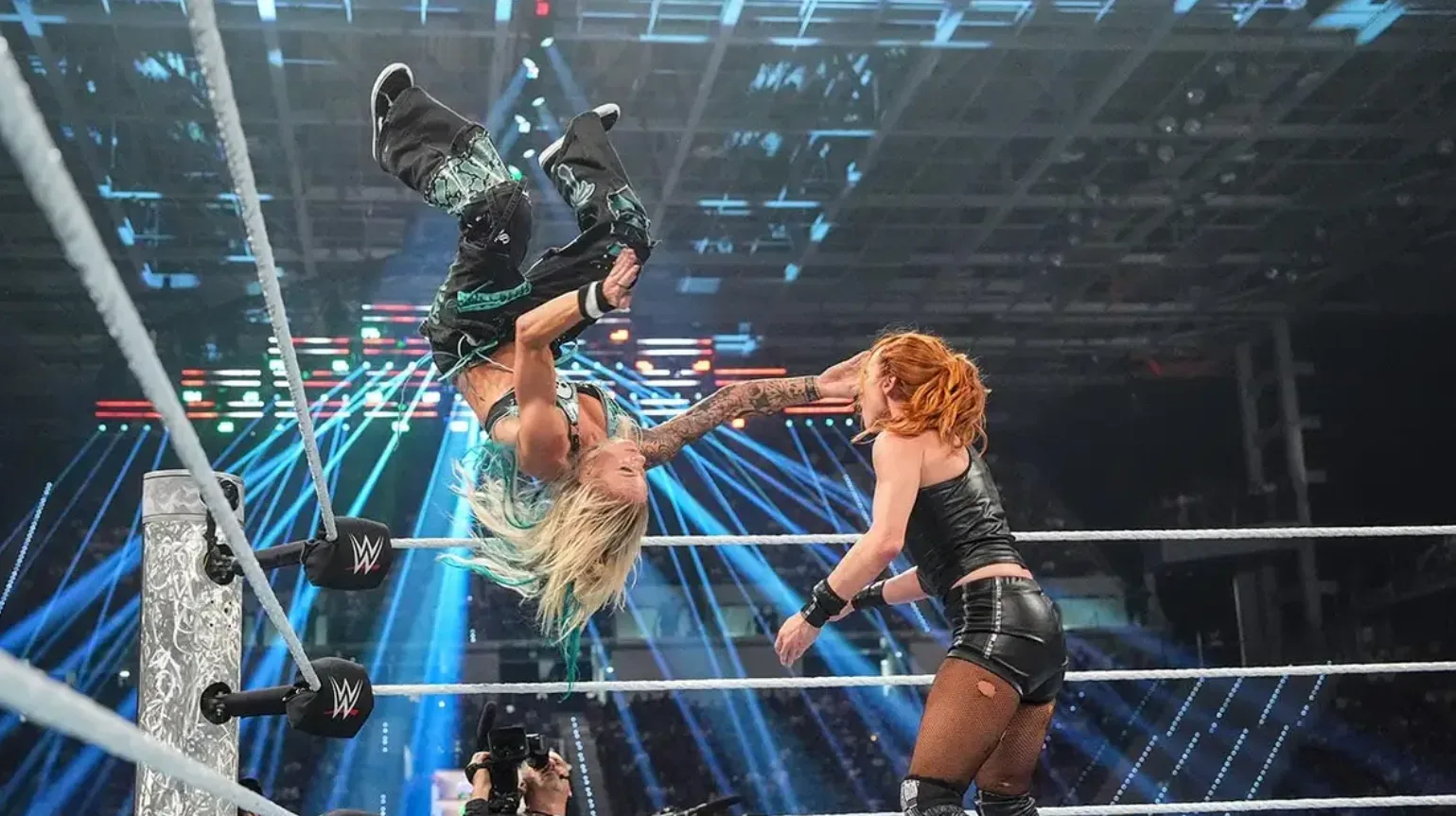
Sol Ruca knows the Sol Snatcher is one of the most immediately recognizable moves in WWE. The athletic, sudden finishing maneuver has become a major piece of her identity, capable of changing a match in an instant and drawing a reaction whenever it appears to be within reach.
That level of recognition is an advantage, particularly for a performer whose explosive in-ring style has helped her stand out. It can also create a unique storytelling question. When a wrestler has a signature finish that fans strongly associate with victory, audiences may be conditioned to wait for that one move rather than fully buying into every other pin attempt along the way.
Ruca addressed that subject during an appearance on HUGE POP!, explaining that it is something she has considered. Her answer showed that she does not see the issue as one that can be solved only by adding more moves. Instead, she sees it as part of the broader craft of selling, character work, and convincing the audience that a match could end before her best-known finisher is ever delivered.
“I’ve definitely had that thought before,” Ruca said. “However, I feel like it’s all about everything else that you do in the ring and with the emotion that you’re putting behind it because, yes, sometimes the fans might not bite on a falsie that I do with someone because they know it’s not my finish.”
For more background on this topic, read Rob Wells, Trailer Park Boys’ Ricky, Set for IPW Legacy Appearance in Ontario.
For Ruca, the answer lies in how a wrestler presents a near fall. A pin attempt cannot simply be a transition on the way to the expected conclusion. The urgency in the cover, the reaction after a kickout, and the visible frustration or disbelief can all communicate that the wrestler believed the match was over. Those details give the audience an emotional reason to question what they think they already know.
“If you put the emotion behind it, if you’re pinning the person, like, this is it, and then they kick out and your face changes, I feel like that’s how they buy into it,” Ruca continued. “It doesn’t always have to be my finish in my mind and that’s kind of what I’m working towards more, is working on those character bits and those facial expressions so that people aren’t just watching and waiting for the finish.”
Making the Journey Matter
Ruca’s comments speak to a fundamental challenge in modern wrestling. Fans are more familiar than ever with a performer’s move set, tendencies, and finishing sequence. That familiarity can make a signature move more valuable, but it also raises the standard for the rest of the match. A wrestler must make the audience believe that a strike, a counter, a power move, or a sudden cradle might produce a legitimate ending.
The Sol Snatcher remains a considerable asset in that respect because it is visually distinct and can emerge from unexpected positions. It carries the kind of highlight-reel quality that makes it feel decisive. Still, Ruca’s focus on facial expressions and character moments suggests she wants to ensure the move enhances her matches rather than becoming the only moment viewers anticipate.
That is especially significant as her opportunities continue to grow on WWE programming. Ruca won a qualifying match on the September 7 edition of Monday Night Raw, securing her place in the 2026 Women’s Money in the Bank Ladder Match. A ladder match presents a radically different kind of environment from a conventional singles bout, with multiple opponents, rapidly changing alliances, and a prize that can be claimed without a pinfall or submission.
In that setting, Ruca’s athleticism and ability to create a sudden highlight could be particularly important. At the same time, the match will demand the same kind of emotional investment she described. Ladder matches are driven by urgency: competitors have to sell the desperation of reaching the briefcase, the physical consequences of falling from height, and the frustration of seeing another wrestler stop them inches from the prize.
A Possible New Way to Win
While Ruca believes greater emotional commitment can make existing false finishes more effective, she is also considering a practical addition to her arsenal. She confirmed that she has thought about introducing a secondary finisher.
“Yeah, I definitely have,” Ruca said when asked whether she had considered another finishing move. “I think if I were to have a secondary finish, it probably has to be something that’s not high-flying, maybe a submission, or more of a power move.”
The reasoning is clear. The Sol Snatcher already occupies the high-flying portion of Ruca’s presentation. Attempting to add another move from a similar category could dilute what makes the original finish special, particularly when Ruca herself believes it would be difficult to surpass its impact at this stage.
“I do think that my finish — I don’t know if I could top that, at least not right now unless I can think of something else,” she said. “But, for now, I think that is gonna be my sole finish for a little bit.”
A submission or power-based match-ender would give Ruca a contrasting option. It could also offer a credible answer when the Sol Snatcher is unavailable. Opponents may seek to avoid positions that allow her to launch into the move, while certain match situations may not allow the space or momentum required for it. A different finish would provide another believable path to victory without requiring the Sol Snatcher to lose its aura.
There is also a storytelling benefit to keeping the signature move protected while adding a second conclusion. If an opponent survives a major Sol Snatcher attempt or effectively neutralizes it, Ruca having another method of winning can make her a more difficult wrestler to prepare for. Conversely, a developing secondary finish can create new match dynamics as audiences learn when it is dangerous and how an opponent might escape it.
The Balance Between Protection and Evolution
Ruca was careful not to suggest that an immediate change is coming. Her remarks instead frame a secondary finisher as an idea she is actively considering while the Sol Snatcher remains her primary and, for now, sole decisive move. That distinction matters. WWE performers often evolve their offense as they gain experience, face new opponents, and move into higher-profile situations, but the strongest additions tend to complement an established identity rather than replace it without reason.
The Sol Snatcher is already closely tied to Ruca’s name and visual identity. It gives viewers a clear moment to anticipate and provides WWE with a move that is easy to recognize in highlights. Preserving that connection while developing a grounded submission or forceful power finish could broaden her match structure without sacrificing the feature that has made her so distinctive.
Ruca’s emphasis on performance details may be the more immediate takeaway. She is not dismissing the concern that fans can wait for a wrestler’s expected finish. She is acknowledging it and identifying the areas she wants to improve: the conviction behind a cover, the response to a kickout, and the character-driven moments that turn a sequence of moves into a contest with emotional stakes.
That approach will be tested in the Women’s Money in the Bank Ladder Match. Ruca has already qualified for one of WWE’s most consequential annual opportunities, and the briefcase provides its holder with a potential championship match at the time of their choosing. Winning it can alter a wrestler’s trajectory overnight.
Whether Ruca ultimately unveils a submission, a power move, or another alternative remains unknown. For the moment, she is committed to making the Sol Snatcher feel like a destination without allowing it to become the only reason viewers invest in the road to that destination. If she can make every close call feel credible while retaining the explosive payoff of her signature move, Ruca’s evolving game could become even more difficult for the rest of WWE’s women’s division to solve.

Darryl Polo
Darryl Polo is a passionate wrestling fan covering WWE, AEW, TNA and beyond. He loves great rivalries, breakout stars and the moments that keep fans talking long after the bell. How we work.