
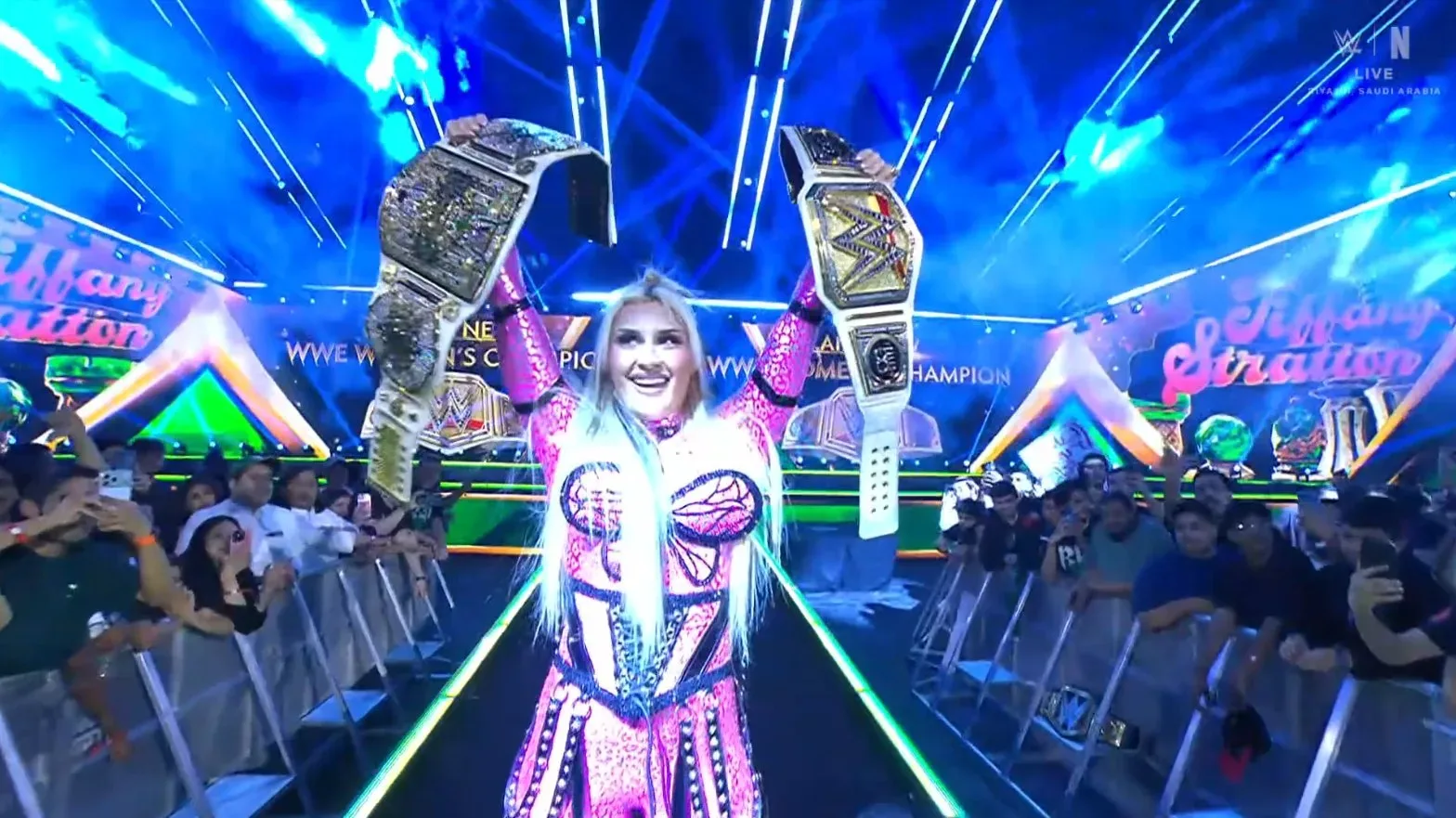
Tiffany Stratton has made no secret of where she believes her strongest work lies. After a period positioned as a babyface, Stratton returned to her more familiar villainous form at WWE Crown Jewel, turning on Chelsea Green and cashing in her Money in the Bank contract to capture the WWE Women’s Championship.
The championship victory put a definitive stamp on Stratton’s shift in direction. While she has demonstrated she can work in different roles on WWE programming, Stratton said her heel persona is not a character she has had to force. Instead, she views it as an extension of a side of her personality that she has been able to translate into wrestling.
Speaking with Dave LeGreca on Busted Open, Stratton discussed why so much of professional wrestling came together quickly for her and why playing the antagonist has felt especially natural.
“I was just around pro wrestling 24/7, and I’m a hands-on learner,” Stratton said. “I can watch people do things and kind of do it myself, especially when it came to in-ring stuff. All that stuff came quickly to me.”
For more background on this topic, read Roman Reigns Salutes The Rock on 30th Anniversary of WWE Debut.
Stratton’s assessment reflects a key part of the appeal she has developed during her WWE run. Her presentation has often been built around confidence, athleticism and an unapologetically superior attitude. Those elements can work in either a fan-favorite or villain role, but her comments make clear that she feels most comfortable when she is allowed to lean fully into the arrogance and sharp edge that have defined much of her on-screen identity.
Rather than approaching that role as an act detached from her real instincts, Stratton said she wanted her work to have an authentic foundation.
“I didn’t want to go out there and play a character,” Stratton said. “I know I can be quite the bitch. I always knew I’m better as a heel. I’m definitely a heel. I know how to be a bitch and cuss people out.”
That blunt self-evaluation has been reflected in Stratton’s recent actions. At Crown Jewel, her turn on Green created the opening for her Money in the Bank cash-in and WWE Women’s Championship win. The moment did more than give Stratton a title; it established that any goodwill or partnership with Green had been secondary to Stratton’s own ambition.
On the following Friday’s WWE SmackDown, Stratton continued to drive that point home. She delivered a cutting message to Green, telling her that she would be stuck in catering going forward. It was the kind of dismissive insult designed to reinforce the new champion’s belief that she has moved beyond the people around her and now occupies a different level within WWE’s women’s division.
Stratton’s confidence is central to the character
For wrestlers who thrive as heels, the most effective performances often come from finding a believable version of themselves and turning the volume up. Stratton’s comments suggest that is precisely how she sees her own process. She is not presenting her antagonist role as a collection of rehearsed mannerisms. She is drawing from an attitude she recognizes in herself and adapting it to the demands of WWE television.
Stratton also pointed to her upbringing when explaining how she found that voice.
“I was the girl who always talked bad to her dad growing up,” Stratton said. “I leaned into that. I really tried to find a way to make it authentic. I naturally found ways to be my bitchy self, and it’s worked.”
In wrestling, authenticity does not necessarily mean a performer is identical to the character seen on screen. It means the performer understands the emotions, motivations and reactions that make the role believable. Stratton’s remarks indicate that her confidence, confrontational delivery and willingness to demean an opponent are tools she feels she can use without losing herself in a role that does not fit.
That approach has particular value now that she is WWE Women’s Champion. A title reign places a performer under a brighter spotlight, and a heel champion needs a clear worldview. Stratton’s worldview is already apparent: she sees herself as better than the competition, expects recognition for that superiority and has little patience for anyone who questions her place at the top.
The Crown Jewel betrayal gave that outlook consequences. Green was not simply an obstacle in Stratton’s path; she was the person Stratton chose to discard on the way to taking the championship. By following that decision with her SmackDown insult, Stratton made it clear that the turn was not an isolated moment of opportunism. It was a statement of who she intends to be as champion.
A return to a proven WWE role
Stratton has spent the majority of her WWE career working as a heel, making the latest change less of a reinvention than a return to a role in which she has expressed the most confidence. Her comments do not dismiss the value of her babyface time. Wrestling performers benefit from learning how audiences respond to different versions of their presentation, and any period spent in a different role can add range.
Still, Stratton’s own view is straightforward: the heel side is where she believes she is better. That matters because conviction is a major part of professional wrestling performance. Fans can recognize when a wrestler is comfortable controlling a segment, insulting a rival or carrying themselves as though the ring belongs exclusively to them. Stratton’s words show that she does not see those tasks as a burden. She sees them as strengths.
Her reference to being a hands-on learner also offers insight into how quickly she has adapted to the business. Stratton said that watching others and then applying what she observed helped the in-ring side come quickly. In a performance-based industry, that ability to learn by observation can be especially valuable. It can help a wrestler develop timing, body language, reactions and the smaller details that separate simply performing moves from building a complete match and character.
That learning process has now brought Stratton to the top of the women’s division with the Money in the Bank briefcase successfully converted into championship gold. The cash-in remains one of WWE’s most consequential devices because it gives its holder the ability to alter the title picture at any moment. Stratton used that opportunity after turning on Green, choosing a route that matched the ruthless personality she says she has always understood best.
Chelsea Green has been given a direct target
The immediate fallout also leaves Green with a clear grievance. Stratton’s betrayal cost Green trust and helped launch Stratton’s championship reign, while the SmackDown comments added public humiliation to the situation. Whether Green responds verbally, physically or through a pursuit of the title, Stratton has already supplied her former ally with a deeply personal reason to seek payback.
For Stratton, that possibility is unlikely to cause much concern if her comments are any indication. Her character is built around the belief that she is equipped to handle anyone who steps forward. The more opponents object to her methods, the more opportunities she has to frame their frustration as jealousy or proof that they cannot match her.
That dynamic can be especially effective for a champion. A villainous titleholder does not need to seek approval. She needs to protect her position, antagonize the challengers around her and ensure the audience has a reason to want to see someone finally stop her. Stratton’s recent actions have provided the foundation for exactly that type of reign.
There is also little ambiguity in how she wants to be perceived. Stratton did not hedge when asked about the role that suits her. She identified herself as a heel, explained that the attitude comes naturally and emphasized that authenticity has been her guiding principle. The result has been a WWE persona rooted in self-assurance and confrontation rather than a carefully manufactured personality far removed from her own instincts.
As WWE Women’s Champion, Stratton now has the chance to push that approach even further. Her Crown Jewel cash-in has changed the championship landscape, her split from Green has created immediate tension, and her own comments leave no doubt about the attitude she plans to bring to the role. Tiffany Stratton believes she is at her best when she is unapologetically difficult, and she now has the title to go with that belief.

Darryl Polo
Darryl Polo is a passionate wrestling fan covering WWE, AEW, TNA and beyond. He loves great rivalries, breakout stars and the moments that keep fans talking long after the bell. How we work.