
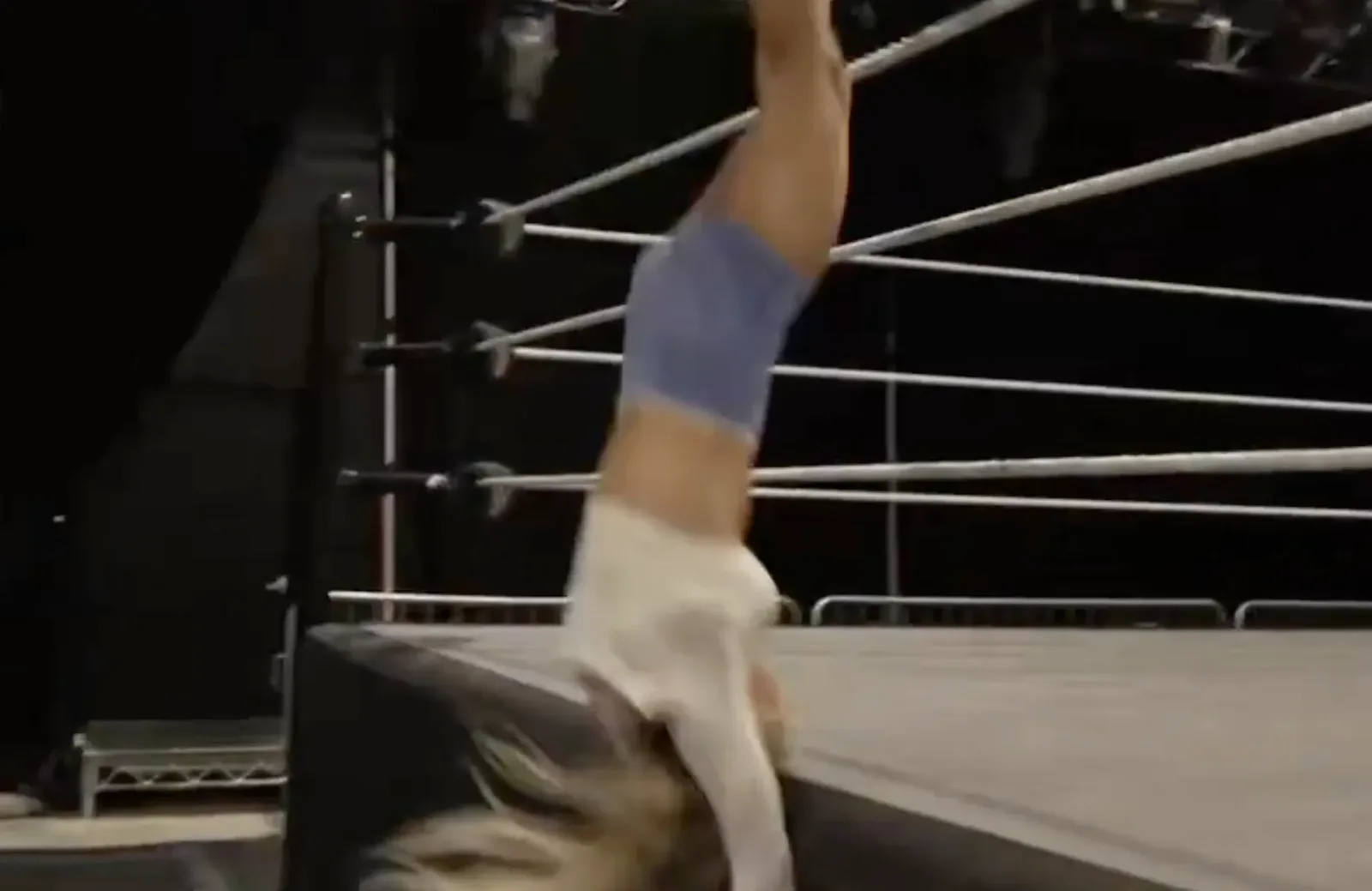
Tiffany Stratton has explained the training mishap that made the rounds online after a recent livestream showed the WWE star attempting a dive over the top rope before landing awkwardly near the ring apron.
The moment was unsettling to watch. Stratton went over the top rope during the live session, appeared to strike her head on the apron, and fell in an uncomfortable position on her neck. Fortunately, Stratton was okay after the incident. While the clip quickly attracted attention because of the frightening visual, Stratton has now offered context for what she was trying to accomplish and why the attempt did not go as intended.
Speaking on Battle on Battleground, Stratton said the livestream was meant to document her process of developing a new variation of a dive. Rather than presenting the move as something she had already mastered, she intended to show the work involved in building toward it.
“My idea for that stream was to learn how to do the dive over the top of the rope. Hit the ropes and dive over. You see all the women who go through the ropes, and I also go through the ropes. I’ve always wanted to be able to go over the ropes.”
For more background on this topic, read Kurt Angle Withdraws From UK Appearances After Not Being Medically Cleared to Travel.
Stratton’s explanation places the viral moment in the setting of a training session, not a finished in-ring performance. She noted that she regularly performs dives through the ropes, but wanted to expand her arsenal by learning how to clear the top rope instead. The distinction is significant. Although both types of dives require timing, body control, ring awareness, and trust in the people positioned to receive the move, going over the top rope brings a different set of mechanics and risks.
For performers, a new aerial maneuver is typically developed in stages rather than simply attempted at full speed without preparation. The process can include working on footwork, practicing the launch point, adjusting the distance from the ropes, refining the angle of the body in flight, and learning how to land safely. Stratton said that gradual progression was the premise behind the stream.
“I was going to do the stream where I was working my way up. Unfortunately, we had a little mishap. That happens. Wrestling is not always pretty. You have to crash and burn. I crash and burn all the time. I’m not perfect.”
That candid assessment captures a reality that can sometimes be obscured by television production and polished highlight clips. Wrestling’s biggest moments are designed to look smooth and effortless, particularly when an athlete connects with a spectacular dive, executes a high-impact move, or carries out a carefully rehearsed sequence in front of a live audience. The work that precedes those moments can be far messier.
Training involves repetition, adjustment, and the occasional failure. In some cases, the most useful part of practice is identifying the precise point where a movement breaks down: whether the approach was too close to the ropes, the jump came at the wrong angle, or the body did not clear the intended obstacle. Stratton did not offer a detailed technical diagnosis of the fall, but she made clear that it occurred during an effort to learn rather than during a routine she already had fully established.
The WWE star also did not frame the incident as a reason to abandon the goal. Instead, she said she still plans to return to the over-the-top-rope dive and document that process for viewers.
“Unfortunately, I didn’t get to work my way up to doing it over the ropes, but I will be redeeming myself here soon. Stay tuned for that stream. Giving fans a little inside scoop as to what a training session looks like. It doesn’t always go as planned.”
Stratton’s comments provide an important update for anyone concerned by the clip: she said she was okay, and she is already looking ahead to another attempt. At the same time, her remarks do not minimize how dangerous the visual appeared. A fall involving the head, neck, and ring apron naturally draws concern, especially given the unforgiving nature of the ring area. Stratton instead acknowledged the reality of the mishap while emphasizing that difficult moments are part of the learning curve.
A Look Inside the Training Process
Stratton has used livestreaming to give fans a view beyond WWE television, streaming on both Twitch and Kick. That format can offer a more immediate perspective on an athlete’s routine, including workout sessions, ring training, and the small adjustments that are usually not visible once a wrestler reaches a televised match.
There is a clear appeal in that kind of access. Fans can see the discipline required to maintain athletic performance and can gain a greater appreciation for the difference between watching a move and learning one. A dive over the top rope may last only a few seconds in a match, but those seconds depend on a large amount of physical preparation. The wrestler must generate momentum, judge a rapidly approaching set of ropes, commit to the jump, control rotation or posture while airborne, and protect both themselves and anyone involved in catching or receiving the maneuver.
Stratton’s planned stream was apparently intended to highlight precisely that side of wrestling: the unfinished version of the process. The mishap altered those plans, but it also demonstrated the point she later made. The road to adding a move can include setbacks, and not every training attempt will be clean enough to be turned into a highlight.
Her willingness to discuss the fall directly also prevents the clip from being reduced solely to a shocking social-media moment. Viral wrestling footage often travels without the broader context surrounding it. A viewer may see a few seconds of an unsuccessful spot without knowing whether it was from a match, a rehearsal, a wrestling school session, or a controlled attempt to introduce a new skill. Stratton clarified that this was a live training exercise built around working toward an unfamiliar type of dive.
Stratton Remains Focused on Expanding Her Offense
Stratton’s stated goal is notable because it reflects an ongoing effort to add to her in-ring repertoire. She already identified dives through the ropes as something she performs, but she wants to be capable of taking the more dramatic route over the top. For a wrestler, expanding that toolbox can create fresh options in matches and add another layer to their presentation.
However, attempting something new is not simply about escalating risk for its own sake. A move has to suit the wrestler performing it, fit their timing and athletic strengths, and be executed with sufficient control to be used responsibly in a match environment. Stratton’s comments suggest that she recognizes that standard. Her original plan was not to immediately unveil a perfected dive; it was to show herself working toward the point where she could perform it.
That distinction matters in a profession where confidence is essential but overconfidence can be costly. Stratton did not claim that the botched attempt was insignificant or pretend that every practice rep is flawless. She said plainly that she crashes and burns and that she is not perfect. That is a grounded response from a performer whose job regularly asks her to make difficult athletic feats look natural under pressure.
The next stream, whenever it takes place, will carry added interest because Stratton has publicly promised to redeem herself. She has not provided a date for that return attempt or specified exactly how the training session will be structured. What she has made clear is that the over-the-top-rope dive remains a goal rather than a discarded idea.
The Importance of Perspective After a Viral Clip
For wrestlers, especially those sharing behind-the-scenes training content in real time, there is an unavoidable tradeoff. Greater access allows fans to witness the dedication behind the performance, but it also means that mistakes and frightening moments can spread just as quickly as successful ones. Stratton’s experience is a reminder that professional wrestling is built on both polished execution and the hard work required to reach it.
The fall was alarming, and the fact that Stratton was okay is the most important part of the update. Beyond that, her response has been centered on persistence. She had hoped to show incremental progress toward a new dive, encountered an unexpected setback, and now intends to continue that journey rather than allow one unsuccessful attempt to define the project.
In her own words, wrestling “doesn’t always go as planned.” For Stratton, the next chapter of this particular training goal will be about proving that a difficult livestream moment was a temporary obstacle on the way to developing another element of her game.

Darryl Polo
Darryl Polo is a passionate wrestling fan covering WWE, AEW, TNA and beyond. He loves great rivalries, breakout stars and the moments that keep fans talking long after the bell. How we work.