
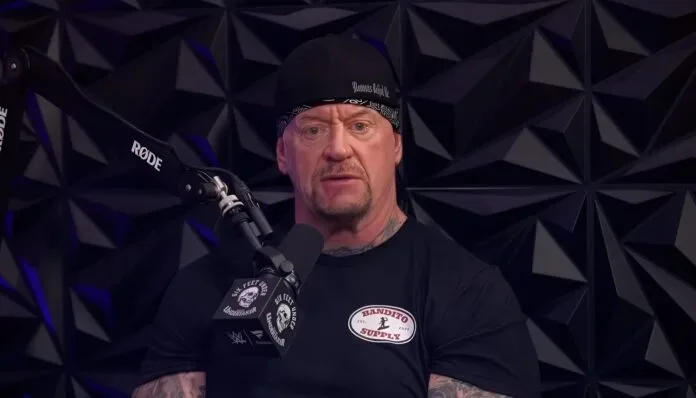
The Undertaker and Kane built one of the most enduring family rivalries in WWE history, but the power of that presentation remains so strong that some fans still believe it reflected real life. Mark Calaway, the man behind The Undertaker, says he continues to encounter people who are surprised to learn that he and Glenn Jacobs, who portrayed Kane, are not actually brothers.
Speaking on an episode of Six Feet Under, The Undertaker reflected on how frequently the question is raised during his interactions with people away from the wrestling environment. His answer illustrated just how convincingly WWE sustained the mythology around the two characters for decades.
“There’s not a day — honestly, if I’m around people on the outside, it’s hardly a day goes by where either I get the question or I get the thing like, ‘I just found out that you and Kane really weren’t brothers.’ That was a 25 year story, I think that’s why they get so disappointed when they find out like, ‘Ugh, really?’”
The revelation may seem surprising to longtime viewers who have followed the performers outside the ring, but it also speaks to the reach of a storyline that became central to WWE’s presentation across multiple eras. The Undertaker and Kane were framed not simply as rivals or occasional partners, but as siblings tied together by an elaborate and often tragic history. That premise gave their matches added emotional stakes and made their alliance-and-conflict dynamic distinct from a typical wrestling feud.
For more background on this topic, read Trick Williams Keeps Roman Reigns Match in His Sights: ‘Somebody Got to Do It’.
A WWE Storyline That Became Part of Wrestling Culture
Kane’s arrival established one of the defining chapters of The Undertaker’s career. Presented as The Undertaker’s long-lost brother, Kane entered WWE surrounded by mystery, physical intimidation, and a connection to the Deadman that instantly made him feel important. The characters’ shared past was gradually explored through WWE television, with the story becoming a foundation for years of confrontations, reunions, betrayals, and championship pursuits.
At the heart of the narrative was the idea that the two men were bound by family trauma and resentment. The Undertaker’s supernatural persona already invited audiences to suspend disbelief, but adding Kane to that world gave WWE a second, equally imposing figure who could directly challenge him. Kane did not arrive as just another challenger; he was positioned as somebody who knew The Undertaker in a way no other opponent could.
That approach helped the story resonate beyond a single event or a short-term program. Wrestling storylines often rely on personal grudges, but the brothers angle had a built-in sense of history. Whenever The Undertaker and Kane crossed paths, audiences could view it through the lens of their fictional family relationship. Even when they stood together, there was always the potential for their troubled past to resurface.
Their on-screen relationship also gave WWE enormous flexibility. The Undertaker and Kane could be mortal enemies, reluctant allies, or a powerful team depending on the needs of the moment. They were able to return to the central brotherhood theme repeatedly without it feeling disconnected from what viewers had already seen. That continuity is a major reason the angle retained its identity for so long.
The Brothers of Destruction Legacy
As a team, The Undertaker and Kane became known as the Brothers of Destruction. The name captured the essence of their pairing: two towering, feared personalities with destructive reputations and a shared family connection. Their visual contrast was memorable as well. The Undertaker’s dark, funeral-inspired presence and Kane’s masked, fire-associated image made them instantly recognizable individually, while their presentation together made them feel nearly unstoppable.
Their partnership was especially effective because it did not erase the conflict that defined them. The audience knew that the bond between the characters was never uncomplicated. That tension gave their team a dramatic edge, since any moment could potentially become another fracture in the relationship. WWE could draw on years of established history whenever it revisited the pairing.
For Calaway and Jacobs, the storyline created an association that has outlived countless changes in WWE. Both men had prominent careers beyond their work together, yet the connection between The Undertaker and Kane remains one of the first subjects many fans raise. The fact that people still ask whether the performers are related demonstrates how effectively the fictional relationship became attached to their public identities.
That is not an accidental result of a single segment or one major match. It reflects the cumulative impact of a story told over a long period of time. Viewers saw the characters fight, reconcile, protect one another, and turn against each other. They heard the history of their supposed family repeated and expanded. For many fans, particularly those who grew up watching WWE during the height of the angle, the brothers storyline was simply part of the world of The Undertaker.
Why the Question Still Endures
Professional wrestling has always been built around performances that invite audiences to invest emotionally in characters and rivalries. While fans today have greater access to behind-the-scenes information than ever before, there are still people whose connection to wrestling begins with what they see on screen. For them, the line between an especially well-developed storyline and reality can be less obvious, particularly when performers remain strongly identified with their roles.
The Undertaker is an especially unique case. For much of his career, Calaway carefully protected the mystique of the character. The Undertaker was presented as an extraordinary presence whose world operated by different rules from the rest of WWE. Kane was not merely a supporting player in that mythology; he was an essential extension of it. Their relationship therefore carried a level of seriousness that made it feel more believable to some viewers than a conventional feud.
Calaway’s comments also point to the generational nature of wrestling fandom. A person may discover old WWE footage years after it originally aired, watch only selected moments, or be introduced to the product through family members. In that context, learning that two performers who were consistently presented as brothers are not related can be a genuine surprise. The disappointment Calaway described is less about confusion and more about discovering that a cherished piece of wrestling mythology was fictional.
There is also a compliment embedded in that response. The continued questions reflect the strength of the work done by both men. A storyline can have elaborate writing and major production behind it, but it only lasts if the performers make the audience care. Calaway and Jacobs had the presence, chemistry, and consistency to make the relationship feel significant over an exceptionally long span.
An Unusually Durable Fictional Family
WWE has featured many storyline relatives over the years, but few fictional family connections have had the longevity or influence of The Undertaker and Kane. Their story was not a brief twist designed only to shock viewers. It became a recurring pillar of both characters’ identities, shaping how they were viewed in singles competition, tag team settings, and major rivalry programs.
The premise also succeeded because each character had a distinct role within the relationship. The Undertaker was the established icon whose ominous legacy preceded him. Kane arrived as the terrifying figure from that past, carrying anger and unresolved pain. Their conflicts felt monumental because the characters were treated as forces rather than merely athletes competing for a position on a card.
Even after the masks, costumes, alignments, and WWE landscape changed around them, the brotherhood angle remained easy for audiences to understand. It gave fans an immediate emotional entry point. They did not need to know every development in the story to recognize that these two men had a bond unlike anyone else in WWE.
Calaway’s observation that the story lasted roughly 25 years helps explain why it remains so deeply ingrained. A generation of viewers had repeated exposure to the idea of The Undertaker and Kane as brothers. In wrestling, sustained storytelling can create a kind of permanence. A narrative may be fictional, but when it is reinforced over decades and attached to two iconic characters, it becomes part of how fans remember the performers themselves.
For those who do discover the truth later, the answer remains straightforward: The Undertaker and Kane were not biological brothers outside WWE. But the surprise that still follows that answer is a lasting measure of the Brothers of Destruction’s impact. More than a wrestling angle, their fictional relationship became one of WWE’s most recognizable pieces of character history, and it continues to spark reactions long after its earliest chapters were written.

Darryl Polo
Darryl Polo is a passionate wrestling fan covering WWE, AEW, TNA and beyond. He loves great rivalries, breakout stars and the moments that keep fans talking long after the bell. How we work.