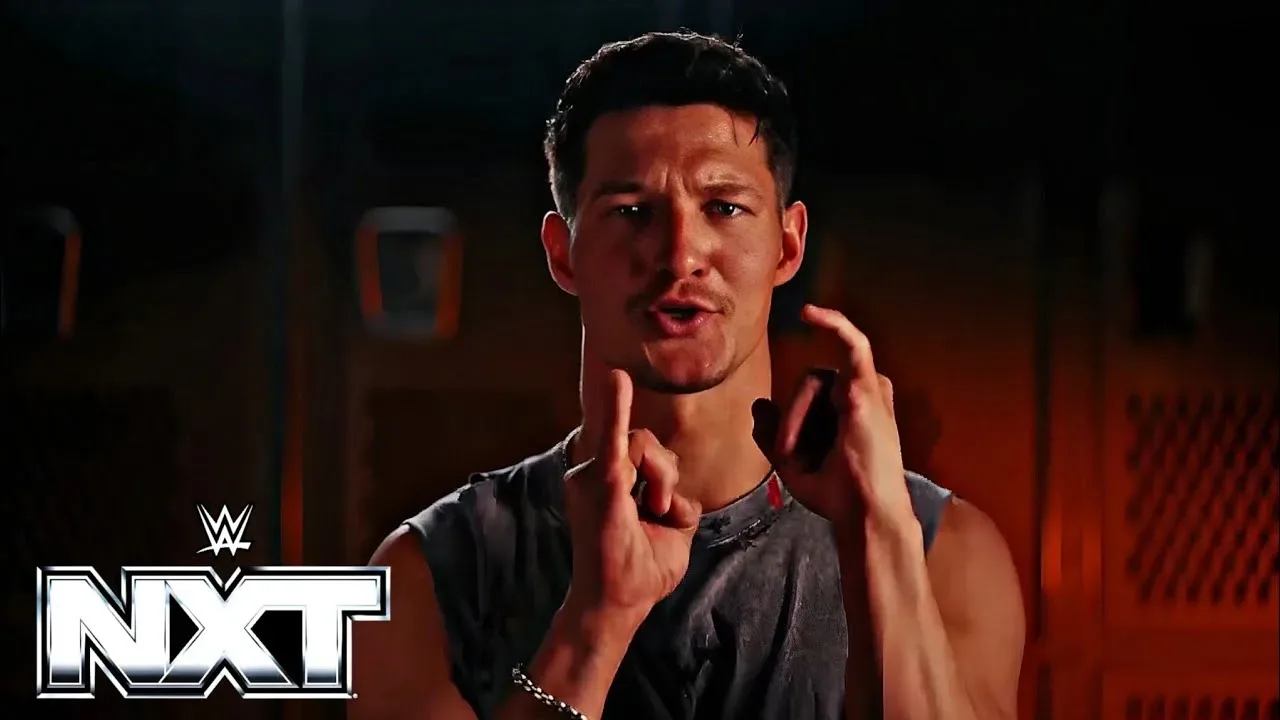
Tate Wilder’s route to WWE was not built through a conventional wrestling background or a long-established connection to the industry. Instead, the NXT talent says it began with a remarkable sequence on the football field at Arizona State University: three broken face masks in three consecutive games.
Wilder, whose real name is Case Hatch, spent four years playing college football at Arizona State. He moved between positions during that time but appeared in at least 10 games in three of his four seasons. While the goal at that stage was football and a possible opportunity to play professionally, an eye-catching stretch during his junior year brought unexpected attention from WWE.
Speaking in a new interview, Wilder recalled how clips of his physical play gained traction and eventually found their way to people within WWE. That exposure led to an invitation to WrestleMania 38 in Texas, his first direct experience with the company, and eventually opened the door to an NIL agreement.
Three Consecutive Games, Three Broken Face Masks
Wilder described the sequence as the unusual turning point that put him on WWE’s radar. The story spread online after he broke an opponent’s face mask in each of three straight games, creating a viral football moment that went well beyond Arizona State’s usual football coverage.
For more background on this topic, read Rob Conway Says La Resistance Was Broken Up ‘Way Too Soon’ in WWE.
“My junior year, I played football at ASU. I had this story come out on like Barstool Sports and I think ESPN might’ve ran with it a little bit, where I broke three face masks in three consecutive games. Someone from WWE saw that clip and it got sent up to higher ups.”
For Wilder, it was not initially a wrestling audition or a calculated attempt to attract sports-entertainment interest. It was a football moment that reflected the aggressive, physical style he was playing with at the time. But WWE saw potential in the clip and in the athlete behind it.
The face-mask story is also a fitting introduction to the qualities that frequently make football players appealing prospects for WWE. Size, explosiveness, comfort with contact, competitive instincts and experience performing under pressure can all translate into valuable tools for a developmental wrestler. Those traits alone do not guarantee success in the ring, where timing, character work and the ability to connect with a live crowd are essential. Still, Wilder’s story illustrates how WWE can identify potential from an athlete’s visibility outside wrestling.
WrestleMania 38 Became His First WWE Experience
After the viral clips circulated, Wilder was invited to WrestleMania 38, which took place in Texas. He said the trip marked his first real involvement with WWE. At that point, he was still focused on football, and the invitation was simply an opportunity to see a major WWE event firsthand.
“They invited me out to a WrestleMania in Texas. Again, this is my first involvement with WWE. I’m like, ‘Okay, let’s go check it out. Free trip to Texas, sounds good.’”
What began as an invitation quickly became more substantial. Wilder said WWE signed him to an NIL contract during that early connection with the company. The agreement gave him an avenue into WWE while he continued his college football career and weighed what a future in sports-entertainment could look like.
“We go out there and they sign me to a NIL contract. I was like, ‘Man, this is insane. Does it fit my lifestyle? Who knows, we’ll find out.’”
That uncertainty is an important part of Wilder’s account. A football player with professional ambitions does not necessarily enter WWE with the expectation that wrestling will become his primary career. Wilder’s comments make clear that, at first, he did not treat the agreement as an immediate replacement for football. He kept pursuing the sport he had spent years playing while WWE remained a developing possibility.
Football Remained the Priority Until the Path Changed
Wilder continued with football after signing the NIL deal. His time at Arizona State included frequent position changes, an experience that can demand flexibility and a willingness to adapt to changing responsibilities. That adaptability may prove meaningful in NXT as well, where new talent must absorb unfamiliar training, develop an in-ring identity and find the right presentation for television.
At the time, however, the focus remained on football. Wilder said he continued to pursue his dream of playing “in the league.” Only when that goal came to an end did WWE reconnect with him about taking the next step.
“So, I just kept going with football and when the dream of playing in the league came to an end, WWE reached out and invited me to come to a NIL tryout almost.”
Wilder clarified that the gathering was not necessarily framed as a traditional, isolated tryout. Rather, it brought in the NIL class he had been part of and gave those athletes an opportunity to experience WWE’s environment. The distinction matters because Wilder was not a stranger walking into a scouting session; he had already established a relationship with the company through the NIL deal that followed his WrestleMania 38 trip.
That continuity allowed WWE to evaluate whether his athletic background, physicality and potential could translate from the football field to the Performance Center system and, ultimately, NXT.
From NIL Opportunity to an NXT Contract
Wilder said that visit led directly to an offer to sign with NXT. It was the moment his football-to-WWE transition became a full-time professional wrestling opportunity.
“It wasn’t necessarily like a specific tryout, but it was just the NIL class I was with coming in and checking it out. They ended up offering me an opportunity to sign with NXT and it’s just been rock and roll since.”
The phrase “rock and roll since” captures the speed of the change in Wilder’s career direction. A viral run of football highlights led to WrestleMania 38, followed by an NIL agreement, a return visit when his football aspirations concluded and an eventual NXT contract. It is a highly specific path, but it also reflects WWE’s interest in finding athletes before they have a traditional wrestling résumé.
For Wilder, the challenge now is different from breaking through a line of scrimmage or taking on a new position in college football. NXT demands that prospects master the mechanics of professional wrestling while also becoming recognizable personalities. Athletic credentials can create an opening, but they are only the starting point once training and television opportunities begin.
Wilder’s football history gives him a clear foundation for a physical presentation, and the origin of his WWE connection is already a memorable part of his story. Three broken face masks across three games is the kind of detail that immediately communicates intensity. The next stage is determining how that intensity develops inside a wrestling ring and in front of an NXT audience.
Myles Borne Has Helped Wilder Along the Way
Elsewhere in the interview, Wilder discussed Myles Borne taking him under his wing. Borne has become a familiar name within the NXT environment, and Wilder’s acknowledgment points to the value of having guidance while making the transition from another sport into professional wrestling.
For a newcomer, learning the physical demands of wrestling is only one piece of the process. There is also the adjustment to WWE’s training culture, the need to develop confidence as a performer and the importance of understanding how to construct a match and communicate with an audience. A more experienced peer can help make those early stages less daunting, particularly for an athlete whose previous experience came in a completely different competitive setting.
Wilder’s rise has not followed a standard wrestling-school narrative. It began with college football, a viral moment of unusual physicality and an invitation to WWE’s biggest annual event. The path from there was gradual rather than immediate: an NIL agreement, continued football, a later visit with his NIL group and then an NXT opportunity.
Now, Wilder’s task is to build on the opportunity that those three consecutive broken face masks unexpectedly helped create. His story shows that WWE’s talent search can begin in unlikely places, and that a single viral stretch can become the first chapter in an entirely new career.
Darryl Polo
Darryl Polo is a passionate wrestling fan covering WWE, AEW, TNA and beyond. He loves great rivalries, breakout stars and the moments that keep fans talking long after the bell. How we work.