
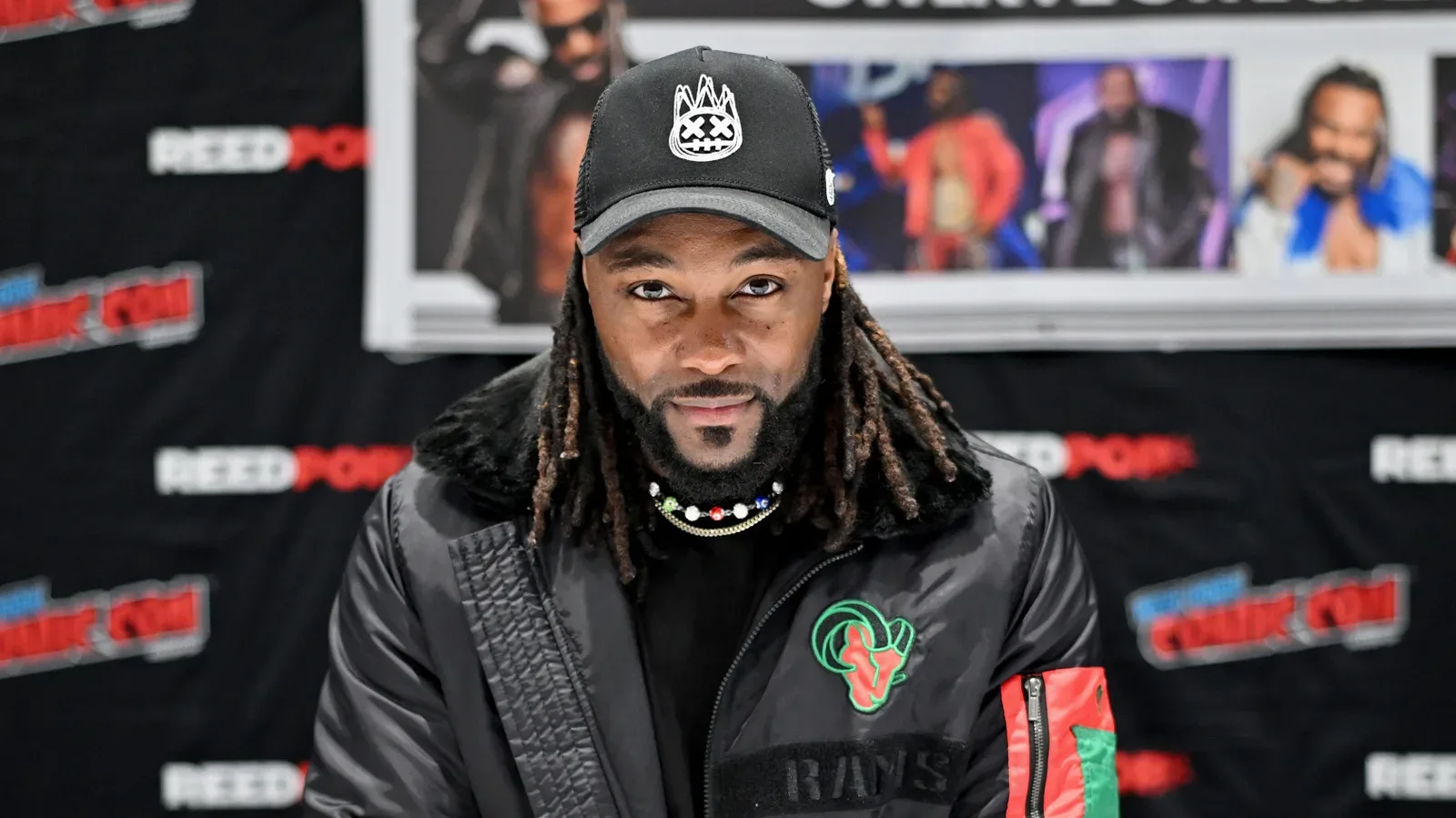
Swerve Strickland believes professional wrestling psychology has become more individual, more situational and more closely tied to the emotional history between performers than it was in prior eras.
During an appearance on Black Couch Booking, Strickland addressed one of wrestling's most frequently debated subjects: what psychology means in a match and how it should be applied. The AEW star framed the concept less as one fixed rulebook and more as an evolving tool that changes with the wrestlers involved, their characters and the intensity of the issue bringing them together.
Strickland credited fellow AEW performer AR Fox, who has also been a major rival during Strickland's career, as an important influence in helping him understand that side of wrestling. While there are longstanding fundamentals to how audiences follow a match, Strickland said the modern landscape has moved away from a single, universal approach.
“The thing about psychology, everybody has their significant psychology,” Strickland said. “I think that something that has changed and differentiated from older ways and forms of, like, structure of wrestling... when a new wrestler comes onto the scene, yada yada yada, there was a blanket psychology that just weighed over everybody. Now, everybody has a different psychology.”
For more background on this topic, read Kris Statlander Says Pro-Wrestling: EVE Crowd Reaction Meant ‘So Much’ After Title Win.
That distinction is central to how Strickland views his own work. Wrestling psychology is often used as a catch-all phrase, but it can include a performer's strategy, selling, pacing, body language, reaction to an opponent's offense and the way a match reflects an established feud. Strickland's point is that those elements cannot always look identical from one rivalry to the next.
For a performer with a character as defined as Strickland's, the opponent is a major part of that equation. His reactions, his aggression and even the way he chooses to absorb punishment or fight back can be shaped by the relationship already established between both competitors. A championship defense against a team seeking to regain gold does not carry the same emotional texture as a personal rivalry, and a personal rivalry does not necessarily call for the same choices as a fresh matchup.
Different opponents create different emotional stakes
Strickland specifically pointed to the contrast between working with “Hangman” Adam Page and working with Ricochet. Those are two opponents who can demand very different presentations from him, not simply because they have different styles inside the ring, but because the energy and history surrounding each matchup can be different.
“Like, I sell differently against ‘Hangman’ compared to how I sell differently against a Ricochet, you know what I mean?” Strickland said. “My psychology of my character is going to be different. There’s no way we can have the same psychology, because there’s different levels of this, like, hatred and feud and energy that two different wrestlers possess.”
It is a useful window into Strickland's approach to character-based wrestling. He is not describing psychology solely as a technical instruction to work a certain body part or follow a predetermined sequence of escalating exchanges. Instead, he is emphasizing the emotional logic of a bout. Why does a wrestler make a specific decision? Why does one strike provoke a bigger reaction than another? Why might a competitor take a risk against one opponent but show more restraint against someone else?
Those questions can matter as much as the moves themselves. Strickland's comments suggest that consistency does not mean repeating the exact same performance every night. A character can remain consistent by responding in ways that fit the specific situation. The audience's understanding of prior confrontations, betrayals, mutual respect or outright hatred can change the meaning of the action in the ring.
That is particularly relevant in a current wrestling environment where fans have access to a wide variety of styles. Performers are expected to establish their own identity while also adapting to opponents with distinct strengths and reputations. Strickland's view leaves room for the traditional fundamentals of making conflict understandable, while recognizing that a modern roster can feature numerous approaches rather than one overriding formula.
AR Fox's influence and a long-running connection
Strickland's acknowledgment of AR Fox adds another layer to his explanation. Their connection has included both shared professional history and rivalry, making Fox a fitting person for Strickland to mention while discussing how a wrestler develops an understanding of psychology. The best lessons in that area are often not limited to verbal instruction; they can also come through repeated in-ring experience, studying how another performer creates urgency, and learning how to make a particular match feel different from the one before it.
By identifying Fox as someone who helped him learn, Strickland also underscored that psychology is not necessarily a finished skill. It develops over time as a wrestler gains more experience, works with new opponents and figures out the details that make their character connect with an audience. The same wrestler may refine their choices from one stage of their career to another, particularly as their role, rivals and championship position change.
Strickland's comments do not reject the foundations that shaped earlier generations. Rather, he sees a difference between older structures that could be broadly applied and a present-day approach that is more specific to the people and stories involved. That leaves each performer with the responsibility to understand not only their own character, but also what makes the opponent across from them unique.
Trios title defense awaits on AEW Dynamite
Strickland will have an immediate opportunity to put that philosophy into practice on Wednesday's AEW Dynamite. He is scheduled to defend the AEW World Trios Championships alongside Austin Creed and Kofi of New Level against Kyle O'Reilly, Orange Cassidy and Roderick Strong.
The championship match represents the second defense for Strickland and New Level since they won the titles at AEW All In. Their first defense came last week, when they faced Dezmond Xavier, Myron Reed and Zachary Wentz of The Rascalz in a match described as an exciting opening defense of the reign.
The upcoming challengers present a different kind of task. O'Reilly, Cassidy and Strong are former champions, which gives the match an inherent competitive focus beyond the usual pressure carried by a title defense. As Strickland explained, the psychology of the match will not merely come down to the trios format or the championship stakes. It will also be dictated by the combination of personalities in the ring and the individual relationships that emerge during the contest.
That is where Strickland's broader argument becomes especially relevant. In a six-man tag team match, every participant has to establish a role in the narrative of the contest. The champions must work as a unit while protecting their position. The challengers must show why their previous championship experience makes them dangerous. Individual exchanges can take on different meaning depending on who is involved, while the eventual momentum shifts need to feel earned within the structure of the bout.
For Strickland, the answer is not to force every match into the same emotional pattern. His stated approach is to assess the rival, the feud and the energy of the moment. Whether he is sharing the ring with Page, Ricochet, Fox or a trio of former champions, the goal remains to make the audience understand why this particular encounter should feel unlike the last one.
That perspective places character interaction at the center of the wrestling process. Moves, athleticism and championship stakes all remain important, but Strickland's explanation stresses that the strongest psychology comes from matching the performance to the conflict. In his view, there is no single blanket method that can account for every rivalry. Each opponent brings a new dynamic, and each dynamic calls for a different response.
Wednesday's trios championship defense will offer the next test of that belief as Strickland and New Level look to continue their reign against O'Reilly, Cassidy and Strong on AEW Dynamite.
In pictures
Darryl Polo
Darryl Polo is a passionate wrestling fan covering WWE, AEW, TNA and beyond. He loves great rivalries, breakout stars and the moments that keep fans talking long after the bell. How we work.