
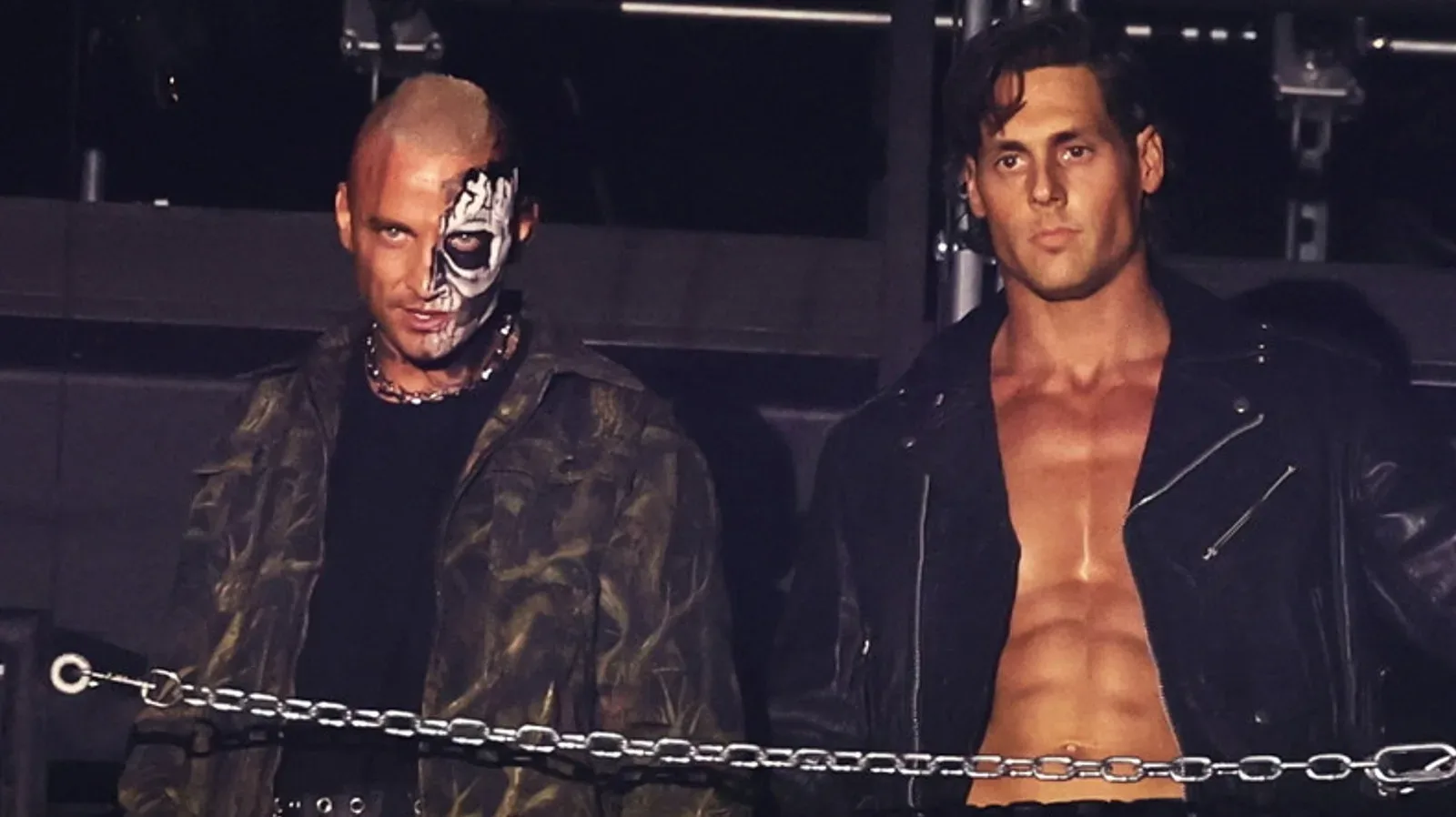
Steven Borden has made a conscious choice not to walk into AEW as a full recreation of Sting, despite the obvious temptation and the immediate recognition that would come with it. The face paint, long coat and baseball bat are among the most enduring images in professional wrestling, and Borden’s connection to those visuals is unlike anyone else’s. He is Sting’s son, he has already appeared alongside Darby Allin, and fans have naturally noticed both the physical resemblance and the echoes of his father’s presence.
But Borden believes leaning too heavily into that legacy too early could prevent him from building an identity of his own. Speaking alongside Allin during an appearance on 101XL – Jacksonville Sport Radio, Borden explained that he wants to use tributes selectively rather than make them the foundation of his entire act.
“The last thing I want to do is be playing The Greatest Hits,” Borden said. “I think, you know, you can do callbacks when time – when it makes sense, at the right time, but I think if I were to come out with face paint, and a trench coat, and a bat, like, I probably could have been booed out of the building in the beginning; and I’m still in the beginning right now.”
It is a revealing assessment from a performer who enters wrestling with a surname that carries enormous weight. Sting was not simply a successful wrestler; he became one of the medium’s defining figures across several generations. His evolution from colorful athlete to the silent, Crow-inspired vigilante gave him a visual identity that remained instantly recognizable for decades. Attempting to replicate that package without the years of experience and audience trust that made it work would present an immense risk.
For more background on this topic, read AEW Teases Toni Storm’s Next Chapter With ‘Play Me’ Package Video.
Borden’s comments show that he understands the difference between honoring a legacy and trying to inherit it wholesale. A face-painted entrance could generate a loud initial reaction, but it might also invite the audience to judge him only against Sting’s established persona. That is not an easy comparison for any newcomer, particularly someone still learning the rhythms and demands of the ring.
Building an AEW Identity Beyond the Family Name
The decision to present himself without Sting’s signature look does not mean Borden is rejecting his family history. His early association with Allin has already created a strong bridge to it. Allin’s relationship with Sting was central to the latter portion of Sting’s in-ring career, with the two forming a bond that became a major emotional element of AEW programming. Borden wrestling alongside Allin therefore carries natural symbolism without requiring him to put on the same paint.
That approach allows Borden to acknowledge where he comes from while still being seen as a developing wrestler rather than a nostalgia act. The resemblance between father and son will remain impossible to ignore, and that is part of the story. Several longtime figures in the industry, including Jim Ross, have remarked on how strongly Borden resembles Sting. They also share a background as impressive athletes outside professional wrestling, another connection that has fueled curiosity around Borden’s potential.
Still, resemblance alone does not make a career. Borden appears to recognize that AEW audiences are likely to respond best if they are allowed to see his own strengths, personality and progression emerge over time. Rather than arriving in a trench coat with a bat and asking fans to accept him as the next version of Sting, he is trying to earn acceptance as Steven Borden.
That may be the more difficult road, but it is also the one with greater long-term upside. Wrestlers with famous relatives routinely face the challenge of deciding how much to embrace their family connections. In some cases, a familiar name or visual presentation creates a useful starting point. In others, it can become a ceiling, making every match and every promo feel like an imitation of someone else’s success. Borden’s view is that an occasional callback has value, while a permanent recreation would be too much.
The Importance of Timing for Sting References
Borden did not dismiss the possibility of Sting-related callbacks altogether. Instead, he emphasized timing. That distinction matters because wrestling has long relied on symbolic moments, surprise appearances and visual references that connect different eras. A face-paint tribute can be effective when attached to a meaningful match, an emotional storyline or a moment where the audience understands why it is happening.
Used too often, however, those same callbacks can lose their significance. Borden’s concern about “playing The Greatest Hits” speaks to the danger of relying on familiar imagery simply because it is guaranteed to draw recognition. Sting’s look became iconic because it was attached to a unique performer and a body of work built over decades. For Borden, the more sustainable plan appears to be making a few carefully chosen acknowledgements while establishing traits that belong specifically to him.
That also fits the stage of his career. Borden described himself as still being “in the beginning,” an accurate reflection of where he stands professionally. He has been wrestling for less than a year, which means every appearance is part of an education process in front of a national audience. In that setting, the priority is not to prove that he can evoke Sting. The priority is to prove that he can develop the skills, confidence and credibility necessary to succeed on his own.
A full Sting-inspired presentation could have made that task even more complicated. Fans would understandably expect familiar poses, familiar intensity and perhaps even familiar storytelling beats. By declining to rely on the paint, coat and bat, Borden creates room for his own presentation to evolve. It also gives AEW flexibility if it decides to revisit those symbols at a later point, when the moment carries more narrative importance.
A Setback Has Not Changed Borden’s Approach
Borden’s early run has not been entirely free of adversity. The second-generation wrestler suffered a concussion during a match, a significant setback for anyone and especially for an athlete just beginning to establish momentum. Ahead of his Blood & Guts bout, Borden addressed the injury and expressed confidence in how he felt after regaining consciousness.
He also framed his mentality around a refusal to run from pressure. That attitude is understandable in a wrestler entering a high-profile environment with substantial expectations attached to his name. At the same time, the injury served as an early reminder of the physical stakes involved in professional wrestling. Borden’s athletic background may help him adapt to the intensity of the sport, but ring experience is developed over time, often through difficult lessons as well as successful performances.
The response to the concussion does not alter the central point of his current presentation: Borden is trying to build carefully, not rush into a role that audiences already associate with his father. His association with Sting will always be a major part of his story, and it should be. That heritage is meaningful to fans and is clearly meaningful within his own career. But Borden’s choice is to make the connection a layer of his character rather than the whole character.
Steven Borden’s Next Test Is Patience
The most interesting aspect of Borden’s explanation is his awareness that he is still a newcomer. Wrestling history has plenty of examples of performers being pushed toward familiar nostalgia because it offers an easy emotional shortcut. Borden is resisting that shortcut, at least for now. He knows that wearing the paint may create an immediate response, but he also knows that immediate recognition is not the same thing as lasting investment.
His path in AEW will be shaped by the work he does without those unmistakable Sting visuals. Fans will watch his development in the ring, his chemistry with Allin and the way he handles the pressure of carrying one of wrestling’s most famous family names. If he continues to progress, any future homage to Sting could become more powerful precisely because it has not been treated as routine.
For now, Borden is choosing evolution over imitation. He is not erasing Sting’s influence, nor could he. Instead, he is trying to ensure that when audiences see face paint, a trench coat or a bat connected to him, it feels like a purposeful moment rather than a substitute for creating his own legacy. In a career that is still in its earliest chapter, that patience may be one of his most important assets.
In pictures

Darryl Polo
Darryl Polo is a passionate wrestling fan covering WWE, AEW, TNA and beyond. He loves great rivalries, breakout stars and the moments that keep fans talking long after the bell. How we work.