
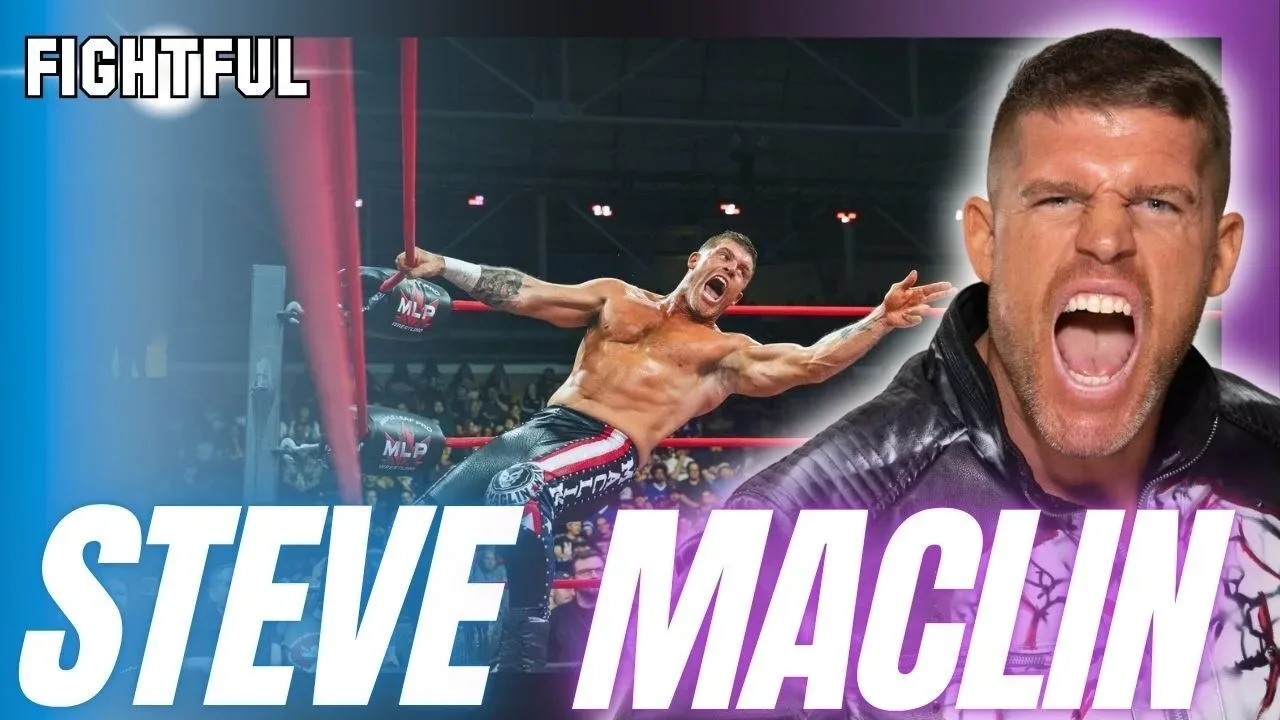
Steve Maclin has opened up about the thought process behind his first-ever match with Adam Copeland at MLP Northern Rising, describing the Street Fight as a carefully constructed attempt to stand apart on a stacked card while honoring the history that made the setting so meaningful.
Copeland and Maclin met at MLP Northern Rising in a first-time singles encounter that carried added significance because of the venue and the Canadian atmosphere surrounding the event. For Maclin, the planning was not simply about putting together a hard-hitting Street Fight. It was about determining how to make the match feel distinct after other major bouts had already raised the energy in the building.
Maclin explained that he entered the process with a number of ideas, but with uncertainty over precisely where he and Copeland would land on the card. He believed there was a realistic possibility of the match closing the show, given the importance of Copeland competing in Maple Leaf Gardens.
“Obviously in my head, too, and I explained it in the documentary,” Maclin said. “I’m going to probably say that a lot too. I explained it in the two part series on our YouTube page for Boots to Boots. But no, it’s like, ‘Alright, I have this idea. How do we want to do this match?’”
For more background on this topic, read Robert Stone Sees Kendal Grey and Kelani Jordan as Future WrestleMania Main Eventers.
The key question, in Maclin’s telling, was how to create something memorable without merely repeating what fans had already seen earlier in the night. That is a particularly significant challenge on a card where performers have already established a high standard, especially when a Street Fight provides the freedom to go in many different directions.
Maclin specifically pointed to Stu Grayson and Josh Alexander as an example of the type of match that had to be considered during the planning. Their bout had already made a major impression on the crowd, leaving Maclin and Copeland to think not only about their own match, but also about the overall rhythm of the event.
“I wasn’t sure where we were on the card yet and I had an idea that we might be main event, because why wouldn’t Adam Copeland be main eventing in the Maple Leaf Gardens in his dream match that he’s always wanted?” Maclin said. “I knew that we would be following matches like Stu Grayson and Josh Alexander, who tore the house down. So it’s like, ‘Alright, now creatively, what do we do that’s different from every other match?’”
That approach underlines a central part of Maclin’s description of the contest: it was built around more than the usual expectations of a Street Fight. Rather than focusing exclusively on weapons, chaos or escalation, Maclin said the goal was to connect the action to the wrestling memories shared by the people involved and by the audience watching.
Copeland’s place in Canadian wrestling history made that concept especially fitting. Competing in Maple Leaf Gardens represented a dream scenario for him, and Maclin said that the match ultimately became a celebration of childhood fandom and of the performers Copeland had crossed paths with throughout his career.
“Like, how do we get to this moment and make the most of this?” Maclin said. “I think Adam and I, for the day, we put a love letter to our childhoods, of his childhood dream of wrestling there, but then also my childhood dream and everybody else’s childhood dream to pro wrestling where we’re doing all of the opponents that he’s ever faced or teamed with signature moves. It was just beautiful.”
The use of signature moves associated with Copeland’s past opponents and partners gave the match an additional layer beyond the immediate rivalry. It allowed the contest to draw from a much broader wrestling vocabulary, one rooted in the matches, alliances and eras that have shaped Copeland’s career. For Maclin, it also offered an opportunity to participate in a match constructed around the same kind of wrestling history that influenced him as a fan.
That is an important distinction in the way Maclin characterized the experience. He did not frame the match merely as an opportunity to work with a prominent veteran or to wrestle in a notable venue. Instead, he described a rare level of confidence and presence during the match itself, saying he felt unusually settled in the ring despite the scale of the moment.
“I’ve never felt more comfort in a wrestling ring and more calmness than I did that night,” Maclin said. “Again, it’s something I’m going to be chasing for a long time where my ears were open to the people, but every bit of me was in the moment.”
For wrestlers, a crowd can shape every decision in real time. That is even more true in a match built around references, emotion and a Street Fight environment, where the performers need to understand which moments are resonating and when the audience is ready for the next development. Maclin’s comments suggest he felt fully connected to that process at Northern Rising, hearing the crowd while remaining focused on the match unfolding in front of him.
The setting played an obvious part in that feeling. Maclin praised the Canadian audience at the event, which drew more than 3,000 people. He described the atmosphere as electric throughout the night and contrasted the energy of Canadian crowds with the particular crowd identities found in the United States and the United Kingdom.
“When you have over 3,000 people there in that place, it’s electric energy all night,” Maclin said. “Canadian wrestling fans are a different breed than American wrestling fans, and the same with the UK. Everybody has their own niche of how they act and their energy. It’s fun to see.”
Maclin’s appreciation for the Canadian wrestling scene also has a personal dimension. He noted that wrestling in Canada had long been a goal, yet he had relatively few opportunities to do so during his WWE tenure. He recalled appearing on the pre-show at an early TakeOver event in Toronto, but said that he otherwise had not truly had the chance to establish a presence in the country during that period.
Since leaving WWE, Maclin said his relationship with Canada has become much stronger through his work after that run, including his time in TNA and his current free-agency period. His comments portray Northern Rising as part of a larger personal journey rather than an isolated booking.
“It’s always funny that I dreamed of wrestling in Canada, and then I was in WWE for so long, never even stepped foot in Canada except for one of the Takeovers in Toronto that we had early on,” Maclin said. “I was on the pre-show on that one, but before that I was never really in Canada and I’d been married to Canada pretty much since my time leaving WWE and TNA and then now just in the free agency.”
That background adds context to why the MLP Northern Rising match clearly means so much to Maclin. It brought together a Canadian venue with major historical resonance, an audience he has come to value deeply, and a first-time opponent whose own connection to the location was central to the story of the night.
It also reflects Maclin’s broader interest in the creative side of wrestling. His recollection focused repeatedly on the questions that guided the match: where it would be placed, what had already happened on the card, how it could avoid feeling repetitive, and how both performers could make the most of the occasion. Those considerations are especially relevant when a match is designed to serve both as a physical confrontation and as a tribute to wrestling history.
Maclin has also discussed his path to Northern Rising in a two-part Boots to Boots documentary series. The project provides further context for the event and for the importance he placed on the opportunity to face Copeland. While Maclin acknowledged that he may continue to reference that material when discussing the match, his comments make clear that the in-ring experience itself remains the part he is most eager to revisit.
For Maclin, the Street Fight was a creative challenge, a meaningful milestone in Canada and a match that delivered a feeling he hopes to find again. His description of the night is not centered on one isolated sequence or one single reference. It is centered on the atmosphere created when the venue, audience, opponent and ideas all aligned.
In that sense, Maclin and Copeland’s MLP Northern Rising meeting was designed as a reflection of pro wrestling’s past while still being experienced as a live, immediate moment. Maclin’s lasting takeaway is the sense of calm he found inside an environment that, by every other measure, was built to feel enormous.

Darryl Polo
Darryl Polo is a passionate wrestling fan covering WWE, AEW, TNA and beyond. He loves great rivalries, breakout stars and the moments that keep fans talking long after the bell. How we work.