
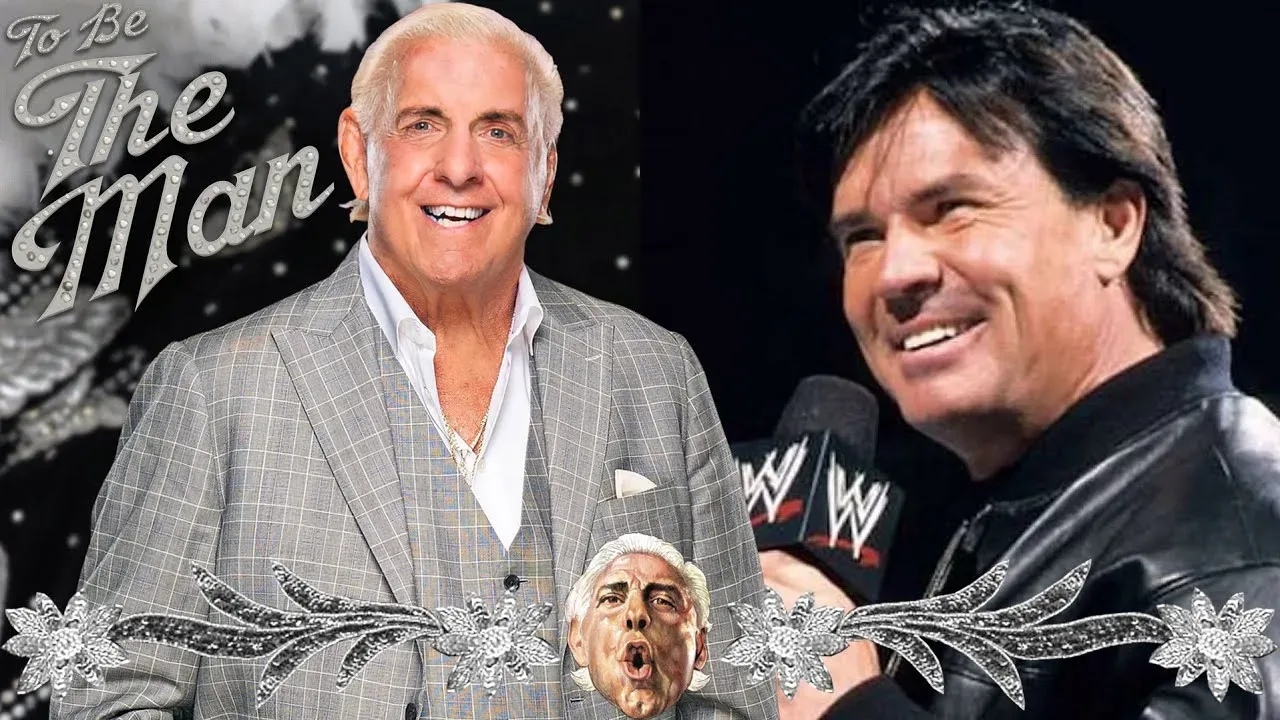
Ric Flair’s career was built around an unmistakable image. The robes, the championship belts, the “Nature Boy” persona, and especially the long blond hair all formed part of the presentation that made Flair one of professional wrestling’s most recognizable stars. For Flair, however, that image was not simply a television character. It was deeply tied to his personal identity, something Charlotte Flair says became painfully clear when she spoke with her father for an upcoming podcast project.
Charlotte and Stephanie McMahon discussed the subject during an appearance on What’s Your Story?, revisiting a period in which Ric Flair was made to cut his hair. The decision left a lasting mark on Flair, and McMahon recalled an incident in which she received word that Flair had punched Eric Bischoff in the face. The story offers another perspective on the volatile real-life tension between Flair and Bischoff, whose contentious relationship had already played out in public across WCW and WWE programming.
Charlotte Flair Saw the Emotional Weight of Her Father’s Story
Charlotte explained that she had asked Ric Flair about something he had struggled to move beyond mentally. His response centered on the effect of losing the hairstyle that had been part of his look for decades and an essential element of how audiences recognized him.
“I asked him what was something that he couldn’t get past, mentally,” Charlotte said while discussing her interview with her father. “He said when they made him cut his hair, the first time he walked through the Charlotte airport, no one knew who he was.”
For more background on this topic, read Cody Rhodes Reveals Wade Barrett Connection Behind Preston North End Support.
For a wrestler whose face, voice, mannerisms, and look had been synonymous with top-level wrestling for generations, the experience was especially difficult. Charlotte characterized her father’s reaction as being rooted in the realization that people did not immediately recognize him in public. That loss of recognition struck at the heart of what the Nature Boy image represented to Flair.
“To my dad, that’s like, ‘No one knew who I was?’” Charlotte said.
Charlotte did not reveal every detail from her forthcoming conversation with Ric Flair, but she described seeing the pain on his face as he revisited that chapter. She added that Flair credited Arn Anderson and Charlotte’s mother with helping him work through the difficult period. Even so, the memory clearly remains significant for him.
The haircut was not merely a cosmetic issue in Flair’s eyes. It represented a dramatic alteration of the image that had accompanied him through his rise as a world champion, his famous rivalries, and his standing as one of the industry’s most enduring personalities. Charlotte also said that Flair told her his hair “never grew back the same,” a detail that further underlined how permanent the experience felt to him.
Stephanie McMahon Remembers the Call About Eric Bischoff
McMahon responded to Charlotte’s comments by asking whether Ric Flair had described what he did to the person responsible for making him cut his hair. Charlotte confirmed that he had. McMahon then shared her recollection of receiving a call that Flair had punched Bischoff.
“I think I’m in charge of talent relations at the time, I could’ve been,” McMahon said. “At any rate, I get the call that your dad has punched Eric Bischoff in the face. I think we were in Kansas City for some reason. He held on to that. He was ready to explode. It was like his identity.”
McMahon was careful to express uncertainty about exactly what role she held at the time and why the company was in Kansas City, but she was clear on the emotional state Flair appeared to be carrying. In her recollection, the issue had stayed with him until it eventually erupted into the physical confrontation with Bischoff.
Her description of Flair being “ready to explode” aligns with Charlotte’s account of how personally Flair took the loss of his long hair. While wrestlers regularly change their appearance as part of storylines or professional reinventions, Flair’s situation carried unusual weight because of the particular connection between his hair and the Nature Boy identity. It was an image fans had associated with him through multiple eras and promotions.
A Rivalry That Extended Beyond Television
Flair and Bischoff’s conflicts were familiar to wrestling fans long before this recollection. Their difficult relationship became a prominent part of WCW television during the 1990s, with Bischoff positioned as a powerful authority figure while Flair remained one of the company’s defining performers. The on-screen material often placed Flair in humiliating situations, creating an antagonistic dynamic that audiences understood was fueled by a genuine edge.
Flair was frequently embarrassed during WCW storylines involving Bischoff, though he also had moments of revenge. One of the most memorable examples came when Flair shaved Bischoff’s head. That moment gave Flair a measure of televised payback after the many confrontations between the two figures.
Their shared history did not end with WCW. Both later appeared in WWE, where their complicated past remained part of the wider wrestling conversation. The pair’s history became emblematic of an era in which wrestling’s fictional conflicts and deeply personal tensions could seem difficult to separate. Their chemistry on camera was shaped by the fact that fans were aware there was real hostility behind the presentation.
McMahon’s story does not add a new in-ring result or a previously detailed business dispute, but it does emphasize how intensely Flair viewed the change to his appearance. In the wrestling business, a performer’s look can be as important as a signature move or catchphrase. For Ric Flair, it was inseparable from decades spent creating and protecting the character that made him a global attraction.
Why the Image Mattered to Ric Flair
Ric Flair’s visual presentation was never accidental. His long hair moved with every strut, every fall, and every emphatic reaction in the ring. Alongside the elaborate robes and the confident interviews, it contributed to the larger-than-life persona that made “Nature Boy” a fitting description rather than simply a nickname.
That kind of image has special value in wrestling because performers are often recognized in public through the traits that television viewers see every week. A sudden, unwanted change can feel like more than a change in style. It can affect how a wrestler sees himself and how he believes the audience sees him. Charlotte’s airport story captures that feeling in direct terms: Flair encountered a moment in which the public response no longer immediately reflected the identity he had known for much of his adult life.
It is also notable that Charlotte framed the subject around what her father could not fully get past mentally. That phrasing suggests the story was about more than an old disagreement. It was part of a larger conversation about the experiences that remained emotionally difficult for Ric Flair long after the immediate events had passed.
Charlotte did not disclose the complete interview, saying she did not want to give away all of what Ric Flair shared. Still, her comments and McMahon’s recollection offered a revealing glimpse at a deeply personal chapter for the WWE Hall of Famer.
A Personal Story Behind a Familiar Wrestling Feud
For fans, the Flair-Bischoff rivalry has long contained memorable television moments, power struggles, humiliation angles, and revenge. McMahon and Charlotte’s discussion adds a more personal layer to that history. It identifies Flair’s hair as an issue that touched his sense of self in a profound way, rather than simply serving as another element of a wrestling storyline.
McMahon’s recollection of the call about Flair punching Bischoff presents the confrontation as the result of frustration that had been building. Charlotte’s comments, meanwhile, show that Ric Flair still associates the haircut with a moment of pain and disconnection from an image he had spent a lifetime establishing.
The Nature Boy has been reinvented, celebrated, criticized, honored, and challenged across an extraordinary career. Yet the conversation with Charlotte makes clear that even a legendary performer can have a defining visual identity that feels impossible to replace. For Ric Flair, losing his hair was not a small adjustment. As McMahon put it, it was tied to “his identity.”

Darryl Polo
Darryl Polo is a passionate wrestling fan covering WWE, AEW, TNA and beyond. He loves great rivalries, breakout stars and the moments that keep fans talking long after the bell. How we work.