
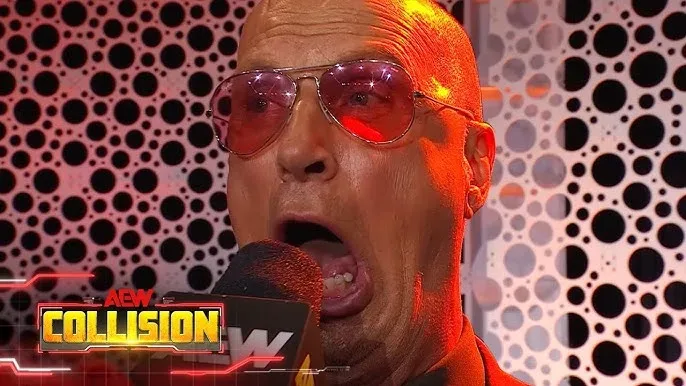
Speedball Mike Bailey has not given up on Kevin Knight, even after the breakup of JetSpeed and Knight’s decision to align himself with the Don Callis Family. Bailey believes his former tag team partner remains a fundamentally good person, but he has made it clear that he sees Don Callis as the driving force behind Knight’s change in attitude.
In a new interview, Bailey spoke about his continued efforts to reach Knight and delivered a characteristically blunt assessment of Callis. The AEW manager has built the Don Callis Family around an expanding collection of elite wrestlers, but Bailey views the group less as a supportive unit and more as a corrupting influence.
“I mean, I think fundamentally he’s a good person, and I mostly blame Don Callis,” Bailey said. “If you don’t follow AEW, Don Callis is the patriarch of something he calls the Don Callis Family, which is just a bunch of the world’s best wrestlers who have decided that they were going to play dirty and cheat, and I think he’s running some kind of multi-level marketing scheme. I’m not sure exactly what he’s doing or what service Don Callis offers. But all you need to know is that he is a very, very bad person.”
Bailey Still Sees a Path Back for Kevin Knight
The heart of Bailey’s comments is not simply his dislike of Callis. It is his belief that Knight can still be reached.
For more background on this topic, read Maria Kanellis Reveals AEW Extended Her Deal During Recovery From Tumor Surgery.
JetSpeed had been built around the connection between Bailey and Knight, two athletes known for speed, explosiveness, and a high-risk style that made them natural partners. Their alliance represented a shared competitive identity: two wrestlers capable of excelling individually while bringing an especially dynamic approach to tag team competition.
That relationship changed earlier this year when Knight turned heel and joined the Don Callis Family. The move broke up JetSpeed and placed Knight in the orbit of one of AEW’s most manipulative figures. Callis has long presented himself as a mastermind and adviser to top-level talent, but his alliances have routinely been marked by self-interest, deception, and a willingness to use wrestlers as pieces in larger plans.
For Bailey, Knight’s decision does not erase what they had as teammates or necessarily define Knight’s character forever. Bailey’s wording suggests he considers the turn a result of Callis’ influence rather than proof that Knight was always destined to betray him. That distinction leaves room for a more personal conflict than a straightforward rivalry between former partners.
Rather than portraying Knight as beyond redemption, Bailey is framing Callis as the central obstacle. It is a familiar kind of problem for anyone pulled into the Don Callis Family: the manager offers access, opportunity, and association with proven stars, but the cost often appears to be loyalty, sportsmanship, and independence.
The Don Callis Family’s Influence in AEW
Callis’ faction has become synonymous with high-level talent operating without many moral limits. Bailey’s description of the group as “a bunch of the world’s best wrestlers” is not intended as praise alone. It acknowledges the caliber of athlete associated with Callis while emphasizing the behavior that has come to define the Family’s methods.
The Don Callis Family’s members and associates have repeatedly benefited from Callis’ strategic mind, but that help is rarely clean. His approach depends on creating division, exploiting frustration, and persuading wrestlers that betrayal or rule-breaking is a necessary step toward success. That makes Bailey’s “multi-level marketing scheme” line particularly fitting as a criticism of Callis’ on-screen persona.
Bailey was not claiming that Callis is literally operating such a business. Instead, he used the comparison to ridicule the Family’s recruitment tactics and the way Callis sells his vision to wrestlers. In Bailey’s view, Callis is peddling something difficult to define, while somehow convincing exceptional athletes to sign on and abandon the standards they once claimed to hold.
It is also a pointed insult because Callis often operates with the confidence of someone who believes he is offering an obvious path to greatness. He presents himself as a man who recognizes talent before anyone else does, then uses that perceived insight to position himself at the center of every success. Bailey’s comments challenge that image directly. To him, Callis is not a visionary mentor. He is a bad person taking advantage of good wrestlers.
Why the JetSpeed Split Matters
The split between Bailey and Knight has given this issue more emotional weight than a typical faction recruitment angle. Tag teams are often defined by trust, timing, and shared purpose, particularly when the partners rely on the kind of athletic precision that Bailey and Knight brought to JetSpeed.
Bailey’s ring style has made him one of wrestling’s most distinctive performers, combining striking, speed, and an unrelenting willingness to take risks. Knight’s athleticism and aerial ability complemented that approach. Together, they had a recognizable identity built around movement and momentum, and the name JetSpeed captured that combination effectively.
When a team with that kind of chemistry comes apart, the aftermath naturally becomes about more than wins and losses. Bailey’s frustration is rooted in the fact that Knight was not merely another opponent. He was a partner Bailey trusted. Knight’s heel turn therefore created an opening for Callis to become more than a manager standing in the background; he is now the person Bailey holds responsible for poisoning that bond.
That does not mean Knight is absolved of responsibility. He made the choice to join Callis, and he has embraced the role that came with the decision. Still, Bailey’s comments establish that he is not treating the situation as closed. He is continuing to look for the person he knew before the Don Callis Family became part of Knight’s career.
Bailey’s Criticism Keeps the Focus on Callis
Bailey’s assessment is notable for how directly it identifies Callis as the problem. The Don Callis Family thrives on shifting blame and creating chaos around its targets. Callis can be especially effective when he persuades wrestlers that their frustrations are caused by teammates, rivals, or management rather than by the person encouraging them to make increasingly destructive choices.
Bailey is refusing to accept that narrative. His message is that Knight’s underlying character is still worth fighting for, even if Knight is currently acting in ways that bear little resemblance to the teammate Bailey once knew. By casting Callis as the architect of the situation, Bailey is challenging both men at once: Knight to reconsider his path, and Callis to answer for the damage his influence has caused.
The multi-level marketing comparison also gives Bailey a memorable way to describe the Family’s strange appeal. He openly admitted that he does not know what “service” Callis is offering, but he sees enough to know that the arrangement is harmful. That uncertainty is part of the joke, yet it also reflects Callis’ ability to market himself as indispensable without ever seeming to have the best interests of everyone around him at heart.
Callis has always benefited from being surrounded by wrestlers talented enough to make his promises look credible. When those wrestlers win, he takes credit. When they resort to questionable methods, he treats those tactics as proof of their evolution. Bailey sees the pattern for what it is and is determined not to let Knight’s decision be explained away as simple ambition.
An Unfinished Rivalry Between Former Partners
Bailey’s comments leave the JetSpeed story with considerable room to develop. There is a clear personal issue between Bailey and Knight, but there is also an ongoing conflict between Bailey and the Don Callis Family as a whole. If Bailey is still trying to get through to Knight, then any confrontation carries the possibility that their history could matter as much as the physical contest itself.
For now, Bailey’s position is simple. He believes Kevin Knight is a good person who has fallen under the influence of a bad one. He believes the Don Callis Family has encouraged Knight to play dirty and cheat. And, in perhaps the most memorable summary of all, he believes Callis is effectively running a “multi-level marketing scheme” around some of the best wrestlers in the world.
Whether Knight eventually rejects that influence remains to be seen. What is clear is that Bailey has not accepted the end of JetSpeed as the final word on their relationship. He remains willing to call out Callis, confront the Family’s methods, and remind Knight that the promise of success offered by the faction may come with a far greater cost than he realized.
Darryl Polo
Darryl Polo is a passionate wrestling fan covering WWE, AEW, TNA and beyond. He loves great rivalries, breakout stars and the moments that keep fans talking long after the bell. How we work.