
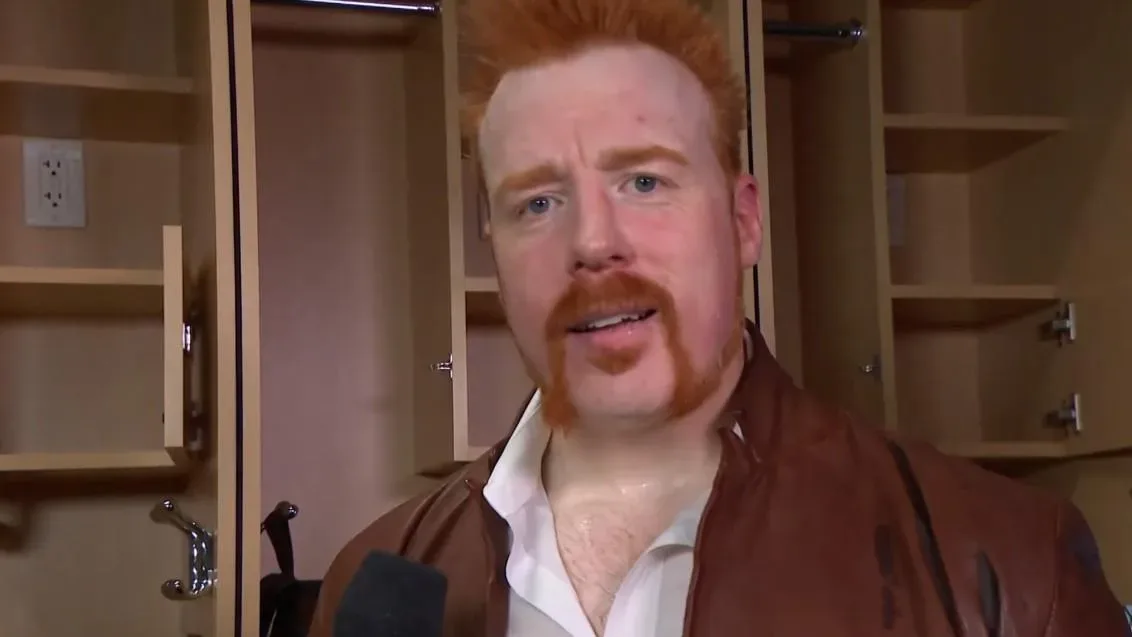
Sheamus has built a WWE career on impact, intensity, and a willingness to make every strike look and feel like it matters. The former world champion has never been a performer who relies on flash alone, and he made it clear in a new interview that the bruising nature of his work is not accidental. It is the central principle of how he approaches a match.
Speaking with Strength Required, Sheamus described himself as perhaps the most physical wrestler currently working. The Celtic Warrior acknowledged that his approach can be punishing for both him and the person standing across the ring, but he also explained why he believes that level of contact creates a distinct reaction from an audience.
“My style is very physical, probably more physical than anybody in the business. I pride myself on that, but it comes at a cost because when I dish it out to my opponent, I expect them to dish it back. I enjoy that part of it, I’m kind of weird. I remember Grayson Waller said I’m a lunatic who just enjoys pain and stuff, maybe I do on some level. But I also enjoy the fact that I can get a crowd intrigued and hypnotized by what happens, kind of second guessing like, ‘Well, I thought this was entertainment’ when they see a Sheamus match.”
Physicality Has Long Defined The Celtic Warrior
That statement is consistent with virtually every phase of Sheamus’ WWE run. From the explosive Brogue Kick to the repeated forearms to the chest that have become a staple of his offense, Sheamus has always worked with an emphasis on force. His matches are often structured around escalation: hard shots become harder, a chest turns red from punishment, and the crowd is invited to react not merely to the result of an exchange but to the apparent toll of it.
For more background on this topic, read Camping World Stadium Viewed Internally as Leading Candidate for WWE Royal Rumble 2028.
For Sheamus, that is the point. Wrestling is an athletic performance, but it is also an emotional exchange between the ring and the audience. His comments suggest he sees physicality as one of the clearest ways to close the distance between those two elements. When the crowd can hear the impact of a strike and see the reaction on both wrestlers’ faces, it becomes easier for fans to invest in the struggle unfolding in front of them.
There is a fine line involved in that style. Wrestling requires cooperation, trust, and communication, particularly when a performer’s signature identity is based on delivering heavy offense. Sheamus’ remark that he expects opponents to return what he gives underscores the mutual nature of the approach. The exchanges that resonate most are not simply one wrestler absorbing punishment; they are battles in which both competitors establish toughness, urgency, and a refusal to back down.
His reference to Grayson Waller calling him a “lunatic” also captures the personality that has helped make the presentation work. Sheamus has frequently leaned into the idea that he enjoys a fight more than most people should. Whether he is fighting as a fan favorite or presenting a more antagonistic edge, that disposition gives a match a clear foundation. He does not just want to win; he wants to prove he can endure and inflict more than his opponent.
Late-Career Matches Reinforced His Reputation
In recent years, Sheamus’ physical approach played a major role in a memorable stretch of WWE matches. His hard-hitting contests with Gunther and Drew McIntyre, in particular, gave fans vivid examples of the kind of environment he was describing. Those opponents brought their own reputations for forceful offense, creating matchups where neither side appeared interested in taking a backward step.
The appeal of those bouts was rooted in contrast as much as similarity. Gunther’s precise, imposing style and McIntyre’s power-driven offense presented formidable challenges, while Sheamus supplied his own veteran toughness and escalating aggression. The results were contests that felt consequential because the competitors treated every exchange as a fight for control rather than a transition to the next sequence.
Sheamus’ comments do not frame physicality as an empty test of toughness. Instead, he links it directly to crowd engagement. His goal is for fans to be so absorbed by the action that they question how much of what they are seeing can possibly be entertainment. That sense of uncertainty is a valuable reaction in wrestling. A crowd that believes a contest has become especially intense will often respond louder to every near fall, reversal, and final burst of offense.
It is also a reflection of Sheamus’ experience. After spending years at the highest level in WWE, he understands that a wrestler needs a recognizable identity beyond one move or one catchphrase. His identity is built around being relentless. Even when opponents know a Brogue Kick may be coming, the anticipation is strengthened by everything that precedes it: the clubbing blows, the loud contact, the expressions of exhaustion, and the sense that Sheamus is willing to take punishment to create an opening.
The Cost of a Demanding In-Ring Approach
Sheamus was equally candid about the downside. “It comes at a cost,” he said, a simple acknowledgement that a highly physical style is demanding over time. A wrestler who wants to make every encounter feel like a battle is taking on a different kind of workload than someone whose presentation is centered on evasion, speed, or technical control. The wear and tear is real, even when the performance is executed by highly trained professionals.
That context makes his recent return to in-ring activity especially notable. Sheamus had been away from the ring for more than a year, but he recently shared social media footage that indicated he had not lost the sharpness associated with his performances. The video offered fans a look at a wrestler continuing to prepare for the same kind of intense work that has defined his career.
Time away can test any performer, especially one whose effectiveness depends so heavily on timing, conditioning, and physical credibility. Sheamus’ style requires more than delivering a strike with authority. It requires knowing how to receive offense, how to pace a contest, how to build a crowd’s anticipation, and how to make the final exchanges feel larger than the ones that came before. His reputation has been built on handling all of those demands simultaneously.
The fact that he is openly proud of that responsibility says plenty about his mindset. Sheamus does not describe physicality as something he has to endure in order to wrestle. He describes it as the reason he loves wrestling. Even his admission that he may enjoy pain “on some level” is delivered with the self-awareness of a performer who recognizes how unusual that mentality may sound outside the industry.
Why the Style Still Connects
In an era with a wide range of in-ring styles, Sheamus remains easy to identify. WWE features athletes whose strengths include aerial innovation, technical grappling, speed, charisma, and powerhouse offense. Sheamus can work within many of those environments, but his calling card remains the feeling that a match has become a rugged confrontation.
That does not mean physicality alone is enough to create a great match. The strongest wrestling contests need character, structure, urgency, and a reason for fans to care. But Sheamus’ approach gives him a dependable tool for making those ingredients more immediate. When he and an opponent trade blows with escalating intensity, the audience understands the emotional stakes without needing a lengthy explanation.
His statement also speaks to an enduring quality of WWE’s biggest battles: fans want to see competitors who appear willing to sacrifice everything to win. Sheamus has made that principle central to his persona. The Celtic Warrior’s best work often carries the sense that he will continue absorbing punishment as long as there is one more chance to throw a forearm, land a knee strike, or connect with the Brogue Kick.
As Sheamus continues his WWE journey following his extended absence from the ring, his comments offer a clear reminder of what audiences can expect. He intends to make his matches feel forceful, uncomfortable, and impossible to ignore. For a wrestler who has spent his career turning impact into an art form, that commitment remains as strong as ever.

Darryl Polo
Darryl Polo is a passionate wrestling fan covering WWE, AEW, TNA and beyond. He loves great rivalries, breakout stars and the moments that keep fans talking long after the bell. How we work.