
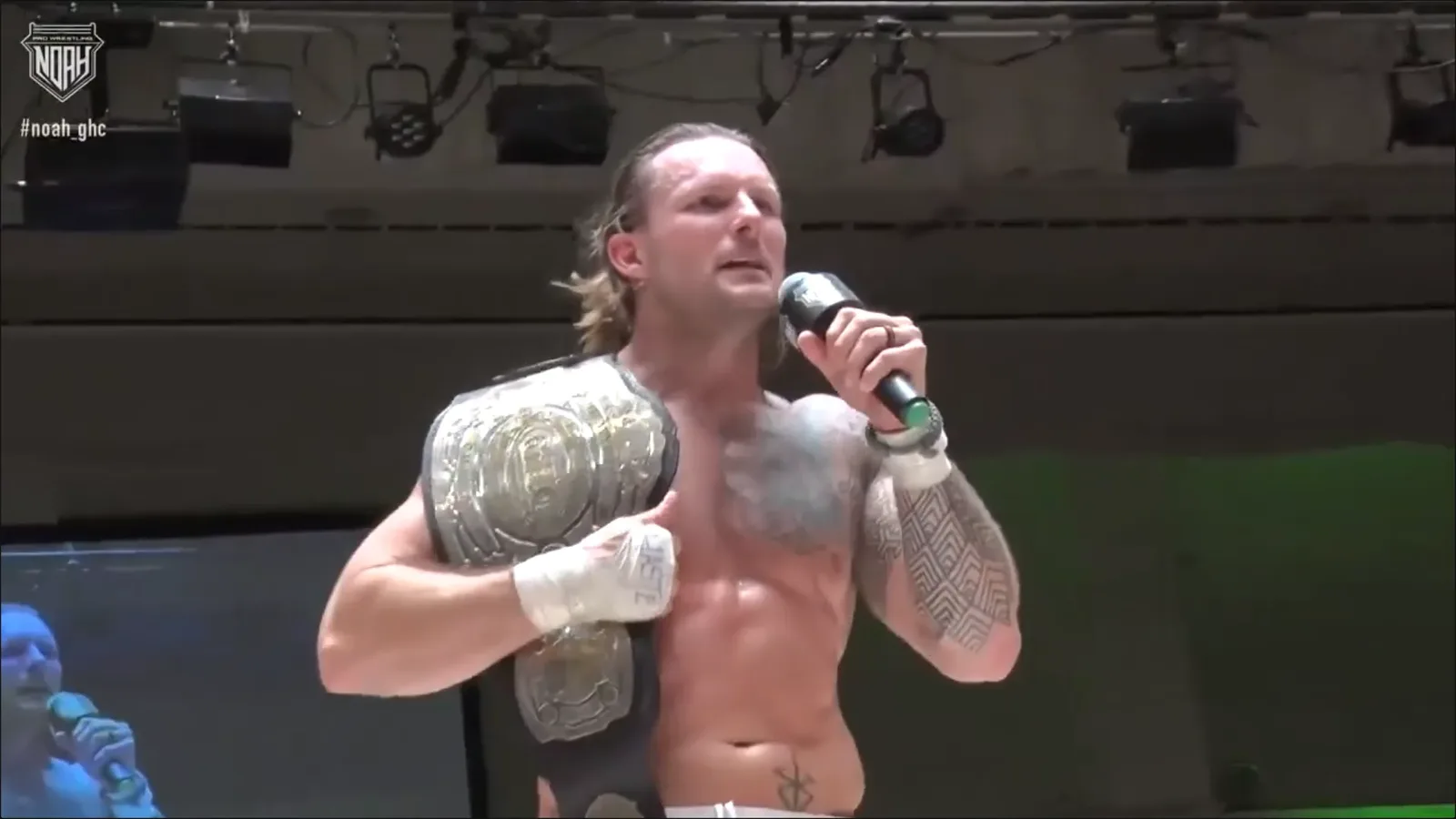
Shane Haste’s GHC Heavyweight Championship reign may have lasted only a few months, but the Australian standout has identified the match that changed how he viewed himself at the top of Pro Wrestling NOAH.
Haste captured the championship on May 2 at Spring Mayhem Ryogoku, defeating Yoshiki Inamura in a result that quickly shifted the conversation around his return to the company. While Haste had established a strong reputation through his tag team work and his previous experience in Japan, there was not widespread expectation that he would rapidly move into NOAH’s premier singles title picture and leave Ryogoku as champion.
That is exactly what happened. Haste unseated Inamura, beginning a reign that carried through most of the summer before Tetsuya Naito defeated him for the GHC Heavyweight Championship at Legacy Rise on August 9.
For Haste, however, the title win itself was only the beginning of the challenge. The new champion has explained that defeating KENTA on May 13 was the performance that gave him the internal validation he needed. It was the point where the pressure of following a major title victory became a source of confidence rather than doubt.
For more background on this topic, read Chavo Guerrero Details On-Set Rewrite Work for ‘The Iron Claw’.
From major title win to a bigger personal test
Haste described his Ryogoku championship victory as a surreal experience. Beating Inamura on an established, high-profile event was a significant achievement, and it placed Haste in a rare position: he was suddenly responsible for representing the GHC Heavyweight Championship in singles competition.
Yet Haste did not regard the title change as the final examination. In his mind, the immediate question was whether he could support that moment with another convincing title defense and demonstrate that his championship status was not merely about the atmosphere surrounding a major event.
“Yeah, it felt surreal. That was a surreal thing and that match went really well but also, I was in there with someone great and it was an established show, it was a big show. So, the real test for me was the next match, which I had Kenta two weeks later.”
The distinction matters. Winning a championship can be a career-defining result, but a reign is built on the matches that follow. Haste knew that the responsibility had changed. As champion, he was no longer simply trying to earn a spot at the top of the card. He had to prove he belonged there while carrying the promotion’s most prominent prize.
His next assignment came against KENTA, one of the most recognizable and popular wrestlers in the NOAH environment. Haste acknowledged both KENTA’s standing with the audience and the different conditions surrounding the match. Whereas the Inamura bout took place on a major show, the KENTA encounter happened on a smaller event, placing more emphasis on the champion’s ability to command the moment.
KENTA bout delivered the reassurance Haste wanted
Haste said he entered the KENTA match feeling the weight of his new position. The crowd reaction for KENTA was a factor, but Haste did not present that as an excuse or a burden he could avoid. Instead, he understood that it was his job to meet the occasion as champion and deliver a match strong enough to reinforce the decision to put the title on him.
“Kenta is over as hell, so that also made it help, but it was a smaller show. It was definitely on me going into it as the champion that I had to back it up. That match went fantastic, it was awesome, it was sick and everyone loved it.”
The match did more than add another successful defense to Haste’s record. It changed his mindset. The champion had gone from experiencing the shock and excitement of winning the title to recognizing that he could thrive in the role on his own terms.
“That’s where like after that one, I’m like, alright, I’m the fucking champ. I’m good.”
It is a candid assessment of the difference between possessing a championship and feeling like its rightful holder. Haste’s win over Inamura gave him the belt, but the KENTA match gave him a level of certainty. In Haste’s view, he had successfully answered the immediate question that follows any unexpected or rapid championship ascent: can the new champion keep delivering once the title celebration is over?
A summer at the top of NOAH
Haste’s GHC Heavyweight Championship run began at Spring Mayhem Ryogoku on May 2 and concluded at Legacy Rise on August 9, when Tetsuya Naito won the championship. The reign covered the majority of the summer and ensured that Haste’s return to NOAH was defined by far more than a single surprise result.
His comments also underline why the KENTA victory holds a particular place in that stretch. The match came early enough in the reign that it had the potential to set the tone for everything that followed. A strong reception and a performance Haste believed in allowed him to move forward with greater assurance.
There is often an adjustment period for a wrestler entering a top championship role, especially when that wrestler is better known to some fans for tag competition. Haste’s career has included prominent work alongside Mikey Nicholls, and the pair remain an active unit. But the GHC Heavyweight Championship reign gave Haste an opportunity to be evaluated through a different lens: not only as part of a successful team, but as an individual trusted with NOAH’s central singles championship.
Haste’s recollection does not diminish the importance of defeating Inamura. Beating the champion at Ryogoku was the achievement that created the entire opportunity. Instead, it reveals how Haste measured the next stage of his journey. He wanted evidence that he could sustain the standard expected of a champion, including when the setting was smaller and the opponent brought the kind of audience connection KENTA possesses.
Why the moment resonated
Professional wrestling championships are both competitive accomplishments within the ring and statements of confidence from a promotion. For the wrestler holding the title, the responsibilities can become especially clear in the first defense after a major win. Fans watch to see whether the new champion can generate the same energy again. Opponents seek to expose any uncertainty. Every performance is judged against the expectation created by the championship victory.
Haste’s account of the KENTA match reflects that reality. He was not only defending a belt; he was trying to confirm to himself that he could carry the role. The quality of the match and the reaction it received left him satisfied that he had done so.
That response also helps explain the directness of Haste’s conclusion. By the time the match was over, he no longer needed to wonder whether he belonged in the position. The KENTA victory provided a personal turning point during a reign that had begun with a major breakthrough.
Even after losing the championship to Naito in August, Haste has continued to appear for NOAH. His most recent match for the promotion took place on October 25, when he teamed with Nicholls against the Good Brothers and Passionate RATEL’S.
The GHC Heavyweight Championship is no longer around Haste’s waist, but the experience appears to have left a meaningful impression. His return to NOAH produced a Ryogoku title win, a summer as champion, and a confidence-building contest against KENTA that Haste now sees as the moment he truly accepted his place at the top.
For Haste, the defining feeling was not simply that he had won a prestigious title. It was that, after the KENTA match, he felt equipped to live up to what being champion required.

Darryl Polo
Darryl Polo is a passionate wrestling fan covering WWE, AEW, TNA and beyond. He loves great rivalries, breakout stars and the moments that keep fans talking long after the bell. How we work.