
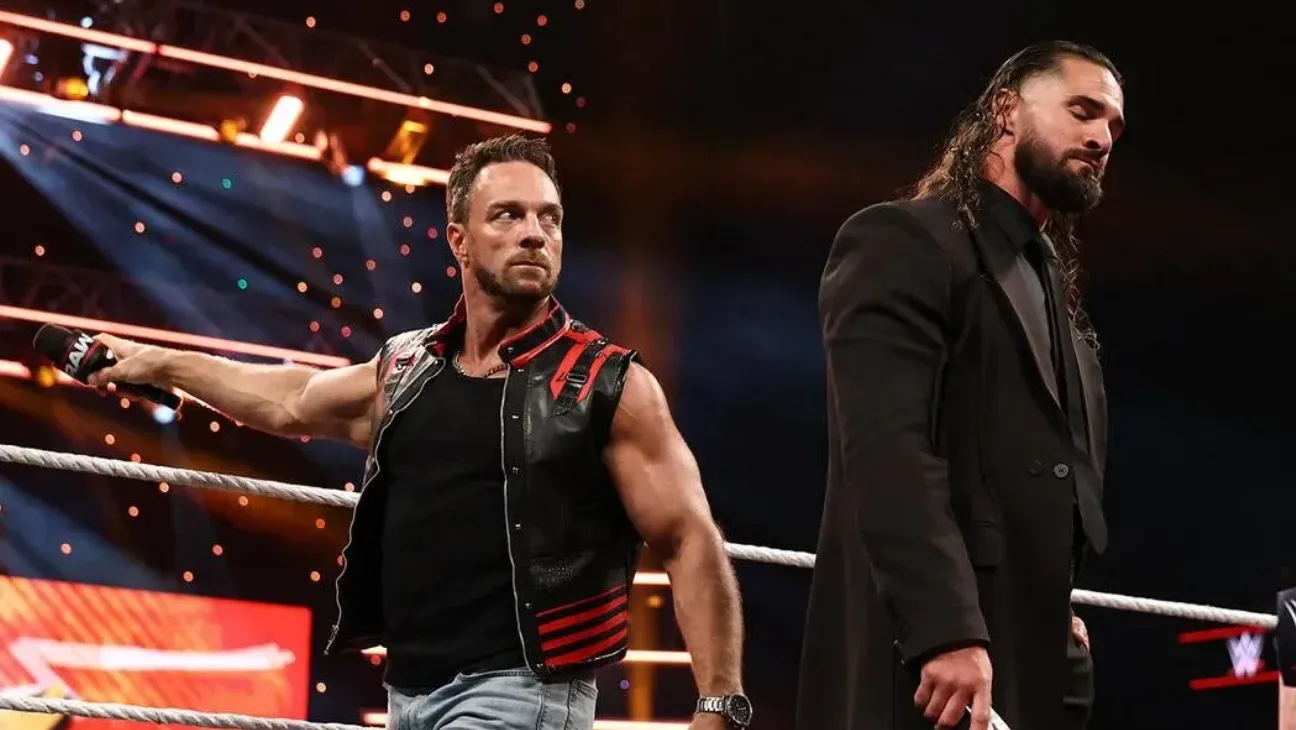
Seth Rollins did not pass up the chance to take a playful shot at LA Knight when an NFL-to-WWE comparison game put Knight’s name alongside Buffalo Bills quarterback Josh Allen.
Rollins and Becky Lynch appeared on The Kittle Things with San Francisco 49ers tight end George Kittle and Claire Kittle. During the conversation, George Kittle introduced a game matching NFL players with WWE personalities. When the discussion turned to Allen, the Bills quarterback was initially framed as a rising fan favorite whose biggest career accomplishment may still be ahead of him.
“I think he’s a babyface,” Rollins said of Allen. “He hasn’t reached the summit yet. That’s the thing is he’s still on the come up.”
That assessment fits the broad outline of Allen’s standing in the NFL. He is among the league’s most prominent quarterbacks and has led Buffalo into major postseason situations, but the pursuit of a championship remains a defining part of his story. In pro wrestling terms, Rollins’ description placed Allen in the role of a popular star still chasing the ultimate mountaintop moment.
For more background on this topic, read Stephanie Vaquer Cleared For WWE Return, But TV Timeline Remains Uncertain.
Then came the LA Knight comparison.
When Rollins was asked directly whether Allen was WWE’s equivalent of Knight, he paused and appeared to reconsider how far he wanted to take the bit. “Ooh. I shouldn’t say that. I shouldn’t say anything. I should just bite my tongue on that one,” Rollins said.
He ultimately chose not to hold back.
“I was gonna say one of them is talented,” Rollins laughed. “I said it anyway.”
The line was delivered with laughter, making it clear that Rollins was engaging in the kind of competitive banter that regularly follows WWE stars into interviews and media appearances. Still, it also gave fans another memorable Rollins-Knight soundbite, particularly because both men have been major figures in WWE’s main-event picture in recent years.
Rollins Takes a Familiar Competitive Approach
Rollins has long been comfortable mixing humor with sharp commentary whenever he is asked about fellow WWE talent. His on-screen persona and off-screen interviews have often reflected that same confidence: he is willing to praise peers when warranted, but he is rarely reluctant to underline his own place near the top of the company.
That attitude is especially notable when the subject is Knight. LA Knight’s connection with audiences has been one of WWE’s most significant crowd-driven developments. His catchphrases, swagger, and ability to direct an arena have made him an unmistakable babyface presence, and the comparison to an NFL star such as Allen is rooted in that visible popularity.
There is also an easy logic behind putting Allen and Knight together in a lighthearted comparison game. Each performer projects confidence, each has a vocal following, and each is associated with the idea of breaking through to an even greater level. Allen remains in pursuit of the NFL’s biggest prize, while Knight has pursued WWE’s top championship opportunities amid strong support from the audience.
Rollins, however, put his own spin on the comparison. His initial read of Allen as a babyface who has not yet “reached the summit” was relatively measured. The punchline involving Knight shifted the segment from analysis to playful rivalry.
LA Knight’s WWE Position Remains a Major Talking Point
Knight has remained active for WWE in dark matches and at house shows following his loss to Roman Reigns in a WWE World Heavyweight Title match at the Money in the Bank Premium Live Event.
That stretch has kept Knight in front of live crowds even as fans continue to watch for clarity regarding his next major televised direction. Dark matches and non-televised live events can be important opportunities for performers to stay sharp, receive immediate audience feedback, and preserve momentum away from weekly television storylines.
For a wrestler with Knight’s audience connection, those crowd reactions are particularly relevant. His presentation has consistently relied on direct interaction with the fans, from his recognizable cadence on the microphone to the response he receives when he leads the crowd through his signature phrases. Whether he is in a featured television segment or a house-show bout, that relationship with the crowd remains central to his identity.
The loss to Reigns was a major moment because it placed Knight in a championship-level setting against one of WWE’s defining stars. Even in defeat, competing for a world title reinforced that Knight had moved beyond being viewed solely as an emerging act. He had become a wrestler positioned to challenge at the highest level.
That is part of why Rollins’ joke has an extra layer. Comparing Allen to Knight was not simply a comparison between two newcomers. It was a comparison between two popular, established names whose supporters believe they are capable of accomplishing even more. Rollins’ response played off that premise while also asserting the kind of hierarchy that is always present among top WWE stars.
Football and Wrestling Make for Natural Comparisons
The NFL-WWE comparison game also highlighted the natural overlap between football and professional wrestling culture. Both industries are built around larger-than-life personalities, passionate fan bases, weekly performance pressure, and the ability to thrive in major spotlight moments. Athletes and wrestlers can be compared through a range of familiar ideas: leadership, charisma, crowd support, longevity, championship success, and the capacity to deliver when the stakes are highest.
Allen being labeled a babyface is an example of how easily wrestling language can translate. A babyface is typically the performer the audience is encouraged to rally behind, someone presented as heroic, resilient, or especially relatable. Allen’s public image as a high-profile quarterback leading a franchise with devoted supporters made the label an understandable one.
Knight is likewise an easy name to reach for when discussing a wrestler with clear fan momentum. His appeal is built on personality as much as athletic performance. He carries himself with the confidence of a headliner, makes every phrase sound designed for a crowd response, and has shown that he can command attention in high-pressure segments.
Rollins represents a different type of comparison altogether. A multi-time world champion and one of WWE’s most recognizable modern stars, he has already reached the kind of summit he referenced while discussing Allen. That established success gives his remarks their edge: the joke comes from a performer who has consistently operated in the championship conversation and understands exactly how difficult it is to turn popularity into sustained top-level accomplishment.
A Joke That Will Keep the Conversation Going
There is no indication that Rollins’ comment was anything beyond a humorous jab during a relaxed interview setting. Wrestling fans are accustomed to this kind of exchange, especially when prominent names are asked to compare themselves with peers or assess another performer’s standing.
At the same time, comments like this tend to travel because Rollins and Knight are both figures who generate immediate reactions. Knight’s fans are fiercely supportive, while Rollins has his own extensive following and a reputation for speaking his mind. The combination ensures that even a brief quip can become part of the broader conversation surrounding two major WWE personalities.
For Knight, the most meaningful answer will continue to come through his next opportunities in WWE. His recent activity in dark matches and house shows confirms that he remains involved, while fans await the next major chapter after his title-match loss to Reigns. For Rollins, the appearance provided another reminder of the quick wit and competitive energy that have helped make him such a compelling presence.
And for Allen, the comparison began as a flattering wrestling parallel: a beloved babyface still trying to reach the peak. Rollins’ follow-up ensured that the discussion ended with a laugh—and with LA Knight unexpectedly placed at the center of the joke.

Darryl Polo
Darryl Polo is a passionate wrestling fan covering WWE, AEW, TNA and beyond. He loves great rivalries, breakout stars and the moments that keep fans talking long after the bell. How we work.