
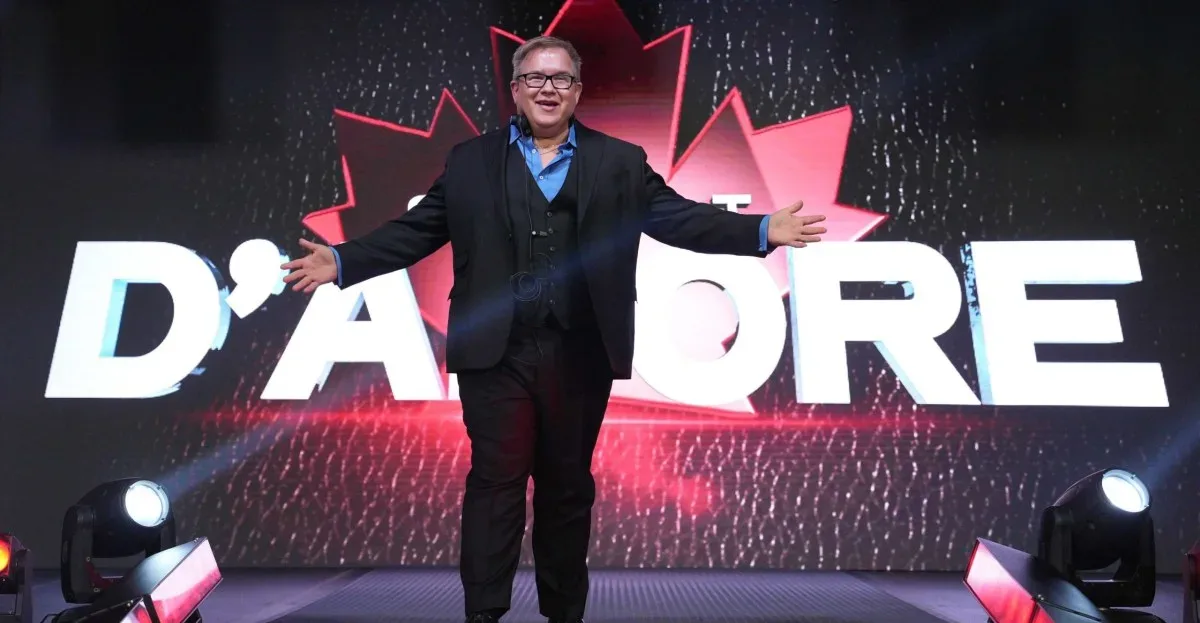
Scott D’Amore has laid out an ambitious identity for Maple Leaf Pro Wrestling as the promotion heads toward its sold-out Northern Rising event on October 3. D’Amore wants MLP to become a distinctly Canadian destination for professional wrestling talent, comparing the company’s intended role to that of the Canadian Football League.
Northern Rising will take place at the Mattamy Athletic Centre, the Toronto venue formerly known as Maple Leaf Gardens. The sold-out status gives MLP a notable setting for a show built around the promotion’s larger objective: creating a meaningful route for Canadian wrestlers, from newcomers looking for their first opening to established independent performers seeking a larger platform.
Speaking about the concept behind the company, D’Amore emphasized that the wrestling industry’s United States-centered structure can create a built-in challenge for performers attempting to build careers from Canada. His answer is not simply to run wrestling events in the country, but to establish an infrastructure that can identify, develop and present Canadian talent while also bringing in standout wrestlers from elsewhere.
“There needed to be a development pipeline for Canadian talent to be able to go out there,” D’Amore said. “Because there is an inherent advantage to being American in this business. It’s just so U.S.-based and the idea of Maple Leaf Pro was to create that – to create a talent scouting, development and showcasing pipeline that took it from soup to nuts.”
For more background on this topic, read Katsuyori Shibata Announced for New Texas Pro’s Eight-Year Anniversary Show in Houston.
That description is central to what D’Amore is trying to establish with MLP. The goal is not limited to finding wrestlers who already have a polished independent wrestling résumé. D’Amore’s vision includes people who have never stepped inside a ring but hope to pursue wrestling, as well as working talent that could benefit from guidance, exposure and new opportunities.
In that respect, the development component is as important as the shows themselves. A wrestling promotion can provide matches and moments, but D’Amore’s stated plan reaches beyond a single event card. He is describing a pipeline intended to connect scouting, training, development and presentation. For Canadian wrestlers, that could mean having a more visible home-country platform without the expectation that every major step forward must begin in the United States.
A Canadian League With an International Standard
D’Amore used the CFL comparison to explain the balance he wants Maple Leaf Pro to strike. The CFL is a Canadian league that features athletes from various backgrounds, while retaining a clear Canadian identity and an important place for Canadian player development. MLP’s intended model follows that same principle: an organization rooted in Canada that remains open to elite talent from around the wrestling world.
“The idea was to build something, something truly Canadian, as a platform that could showcase not just Canadian talent, but the very best in the world and really have a focus on Canada and, in essence, being the CFL of wrestling,” D’Amore said. “This is our league that’s going to feature great players, great athletes, from all over the world, but it’s also going to make sure there’s a ton of Canadian representation and development going on.”
The distinction matters. A Canada-focused promotion does not have to be isolated from the rest of the wrestling landscape, and D’Amore is not presenting MLP as one. Instead, his comments point to a league identity in which Canadian performers are prominently represented and supported while competing alongside recognized names and high-level visitors.
For the audience, that approach can give events a different kind of stakes. The attraction is not only seeing major names appear in Canada. It is also seeing Canadian wrestlers positioned in an environment designed to make their progress and visibility part of the promotion’s purpose. If MLP can consistently maintain that blend, it would give the company a recognizable mission in a crowded wrestling marketplace.
The name Maple Leaf Pro immediately signals that mission, but D’Amore’s comments put more detail behind it. He is describing a company that wants to be an active part of the country’s wrestling ecosystem rather than merely a touring brand that visits Canadian cities. Scouting, development and showcasing are all long-term commitments, and each part depends on the others. New talent needs a place to learn, rising talent needs opportunities to perform, and established talent needs meaningful platforms that can broaden its profile.
Northern Rising Brings the Mission Into Focus
The October 3 Northern Rising card arrives at an appropriate moment for MLP to showcase that ambition. Running a sold-out event at the Mattamy Athletic Centre carries obvious historical weight given the building’s past as Maple Leaf Gardens, a venue tied closely to Canadian sports culture. For a promotion trying to build a league-like Canadian presence, the location adds another layer to the occasion.
One announced match underscores MLP’s plan to combine Canadian representation with established international-level talent. Steve Maclin is scheduled to face Adam Copeland, who enters the event as one-half of the current AEW World Tag Team Champions.
Maclin’s inclusion offers MLP a proven, high-profile wrestler, while Copeland brings one of Canada’s best-known wrestling careers to a show centered on a Canadian promotion’s future. The matchup is therefore significant beyond the individual names involved. It fits the philosophy D’Amore described: use major talents and recognizable competition to elevate the stage while keeping the promotion’s Canadian focus at the forefront.
Copeland’s current AEW championship status gives the bout additional relevance, though Northern Rising is not being framed solely around one outside star. D’Amore’s broader message is that MLP’s value will ultimately rest on its ability to continually create opportunities. A single major match can draw attention, but a functioning developmental and showcase system is what would allow the promotion to build a lasting role.
The Challenge of Building a Pipeline
D’Amore’s assessment of the industry is straightforward: American wrestlers can possess an inherent geographic advantage because so much of professional wrestling’s structure is based in the United States. That does not mean Canadian talent lacks a rich history or a deep pool of ability. Canada has long produced influential wrestlers and passionate wrestling audiences. The issue D’Amore is targeting is access to a sustained, visible pipeline that can help performers progress without having to rely entirely on opportunities outside their home country.
Creating that kind of system is a significant undertaking. It requires more than identifying promising wrestlers. It means providing a setting where performers can gain experience, be evaluated, develop their skills and appear in front of audiences that can follow their growth. It also means presenting those wrestlers in a way that makes fans understand why their development matters.
MLP’s weekly Mayhem program provides an additional outlet for that purpose. A regular television presence can help turn individual event appearances into a more continuous story for both the promotion and its roster. For a company built around showcasing talent, consistency is crucial. The more frequently fans can see wrestlers compete and evolve, the more effective the platform can become.
At the same time, D’Amore’s use of the word “league” is revealing. He is positioning Maple Leaf Pro around an identity that is larger than an occasional supershow. A league implies continuity, investment in participants and a shared sense that the talent is part of something with a distinct home base. MLP’s Canadian foundation is meant to be a strength, not a limit.
A Clear Statement of Purpose
As Northern Rising approaches, D’Amore has given MLP a clear standard against which it can be measured. The company wants to offer Canadian wrestlers a route from aspiration to opportunity, and it wants to do so while delivering events capable of featuring leading names from across the wrestling world. The sold-out October 3 show will be another opportunity to put that framework in front of fans.
For now, the key takeaway from D’Amore’s comments is the company’s intended role. Maple Leaf Pro is not simply seeking to present Canadian wrestling as a location. It is seeking to build a Canadian wrestling structure: one that develops talent, spotlights homegrown performers and competes for attention through a combination of local investment and international-caliber matches.
With Northern Rising set for the Mattamy Athletic Centre and Maclin versus Copeland on the schedule, MLP has a high-profile stage for that message. D’Amore’s CFL comparison gives the promotion an easy-to-understand aspiration. The next challenge will be converting that aspiration into a durable pipeline and a consistently recognizable Canadian league identity.

Darryl Polo
Darryl Polo is a passionate wrestling fan covering WWE, AEW, TNA and beyond. He loves great rivalries, breakout stars and the moments that keep fans talking long after the bell. How we work.