
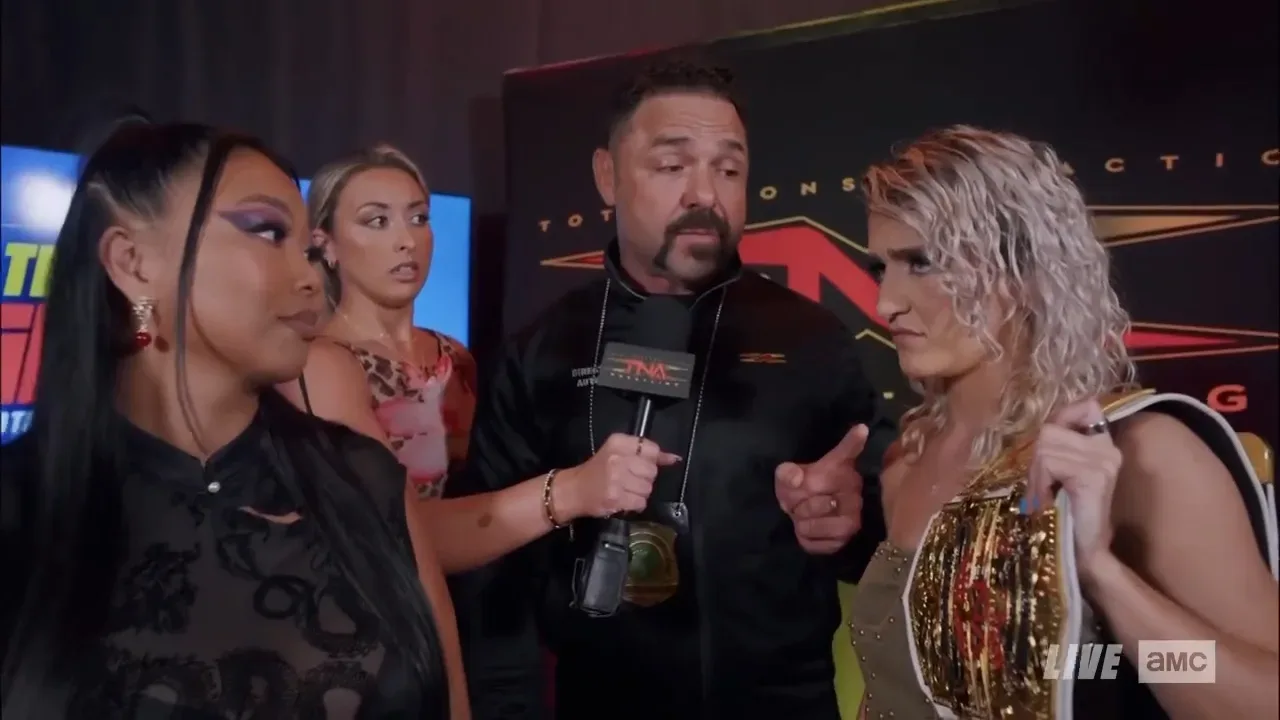
Santino Marella believes TNA Wrestling’s willingness to give its talent individual creative latitude is one of the company’s clearest points of difference in a crowded major-promotion landscape.
Marella, who has spent the past several years with TNA as an on-screen authority figure and ambassador for the promotion, discussed what he sees as separating the company from WWE and AEW during an appearance on the We R Wrestling Podcast. His answer centered on the balance TNA tries to strike between producing a nationally televised wrestling program and allowing the wrestlers themselves to shape how their characters speak and perform.
“So TNA is not overproduced. We don’t have 15 writers or we don’t have 15 producers. We have more freedom. The individuals in the ring have a little more freedom,” Marella said.
That distinction is especially notable coming from Marella, whose career has included substantial time in WWE before he joined TNA. He has been positioned prominently in TNA’s presentation as an authority figure, while also serving as a recognizable public voice for the company in interviews and promotional appearances. Marella recently signed a new contract with TNA, extending a relationship that has made him one of its most familiar personalities outside the ring as well as on television.
For more background on this topic, read Santino Marella Reveals He Pitched Cobra vs. Mr. Socko Showdown for 2012 Royal Rumble.
His comments were not framed as an argument against structure or planning. Instead, Marella emphasized that creative freedom can be valuable when performers understand their personas and can communicate in a natural voice. In his view, that room for personal expression connects to lessons from earlier generations of professional wrestling, when talent was generally expected to develop its own character work and verbal style across different territories.
“And when you have freedom, because you hear about back in the golden day of wrestling, they didn’t write their promos for them. They knew their characters. They came from other territories, and you’ll hear guys like Roddy Piper back in the day say, yeah, they didn’t write any promos for me, and that was the golden era,” Marella said.
Freedom Within a Television Framework
Marella’s point was not that modern wrestling television can operate without oversight. National programming comes with obligations to networks, advertisers, sponsors, and a broad audience. He acknowledged that promotions must know what is being presented on their broadcasts and must provide quality control, particularly where language or subject matter could create problems for business partners.
“So there’s something, you know, I know today it’s different, right? You’re on television, you’re on a network. You have to—there has to be some quality control. You got to make sure that people aren’t saying things that are, you know, going to offend sponsors and stuff,” Marella said.
That caveat is central to his argument. Marella is not suggesting that wrestlers should be sent onto television with no direction, no standards, or no awareness of the show’s broader plans. Rather, he sees the benefit in a process where performers have enough information to work within the program’s needs while retaining the ability to make their delivery feel personal and immediate.
“You do have to know what’s happening on television that basically every second, right? To protect yourself,” he continued. “But I think that’s one of the strengths in TNA is that we do have some more creative freedom at the individual level.”
For a wrestling promotion, the difference between a heavily prescribed segment and one shaped by the personality delivering it can be significant. Promos, reactions, entrances, matches, and confrontations all depend on performers being able to convincingly inhabit the characters audiences are asked to invest in. A consistent creative framework can keep a show organized, but Marella’s view is that too much production can risk smoothing away the distinctive traits that make wrestlers memorable.
Why the Approach Matters for TNA
TNA has long built much of its identity around performers who bring different styles and backgrounds to the roster. In that environment, individual presentation can be a major asset. The company’s talent are not simply asked to execute moves or advance stories; they are also tasked with making viewers understand who their characters are, what motivates them, and why each rivalry matters.
Marella’s comments place authenticity at the center of that process. When a wrestler has a firm grasp on a character, giving that person more flexibility can make a promo sound less recited and allow an in-ring moment to develop a more spontaneous energy. That does not guarantee every segment will succeed, but it can help create the sense that audiences are watching personalities respond in the moment rather than merely reciting a fixed script.
The approach also reflects a practical reality of wrestling: no two performers communicate in exactly the same way. Some are strongest with concise, direct statements. Others excel when they can build a longer story, use humor, or react to a crowd. Some of the most effective in-ring performers express character primarily through body language and match structure. A creative environment that allows for those differences can help talent lean into what makes them effective rather than forcing every act into an identical format.
At the same time, Marella’s acknowledgment of television standards shows the limits of that freedom. Wrestling promotions need continuity in their stories, a clear understanding of what can and cannot be said, and an overall product that meets the expectations of its partners. The challenge is not choosing between complete control and complete improvisation. It is finding a workable middle ground in which the show remains coherent while wrestlers can still sound like themselves.
Marella’s Role in TNA’s Public Identity
As an authority figure, Marella occupies a role that naturally puts him in the middle of on-screen conflict. Authority characters often need to establish order, react to escalating issues, and provide a recognizable face for major storyline developments. Marella’s broader ambassadorial work means he is also regularly asked to explain what TNA represents and where it believes it fits within the wrestling industry.
His answer on creative freedom offers a straightforward version of that message. TNA, in Marella’s assessment, is not trying to define itself by the size of a writing staff or the amount of production surrounding every moment. Instead, he argues that its strength lies in creating an environment where the people in the ring have a greater opportunity to contribute their own instincts.
That philosophy can be particularly important for a company seeking to make every wrestler stand out. A roster grows more compelling when audiences can quickly identify the voice, attitude, and priorities of each act. Those qualities are difficult to manufacture solely through production. They are often most effective when the performer has ownership of the character and understands how to communicate it.
Marella’s mention of past territory-era stars, including Roddy Piper, was not a claim that contemporary wrestling can simply reproduce an earlier business model. He explicitly recognized that television has changed the responsibilities of promotions. But he also pointed to a lasting principle from that period: performers who deeply understand their characters can often create their strongest work when trusted with room to operate.
A Defining Point of Emphasis
There is no single formula for wrestling television. WWE, AEW, and TNA each operate with their own creative structures, presentation styles, and priorities. Marella’s remarks do not erase those differences or suggest that one model works for every performer. What they do make clear is how he wants TNA’s approach to be understood.
For Marella, more individual freedom is not the absence of responsibility. It is the chance for talent to apply its personality, experience, and understanding of character within the necessary safeguards of a televised product. TNA can maintain control over its programming, protect its relationships with sponsors and networks, and still permit wrestlers to bring more of themselves to the screen.
That combination, Marella said, is one of TNA’s strengths. As he continues in his role with the promotion following his new deal, it is also likely to remain a key part of the identity he promotes: a company that values structure, but does not want that structure to come at the expense of individuality.

Darryl Polo
Darryl Polo is a passionate wrestling fan covering WWE, AEW, TNA and beyond. He loves great rivalries, breakout stars and the moments that keep fans talking long after the bell. How we work.