
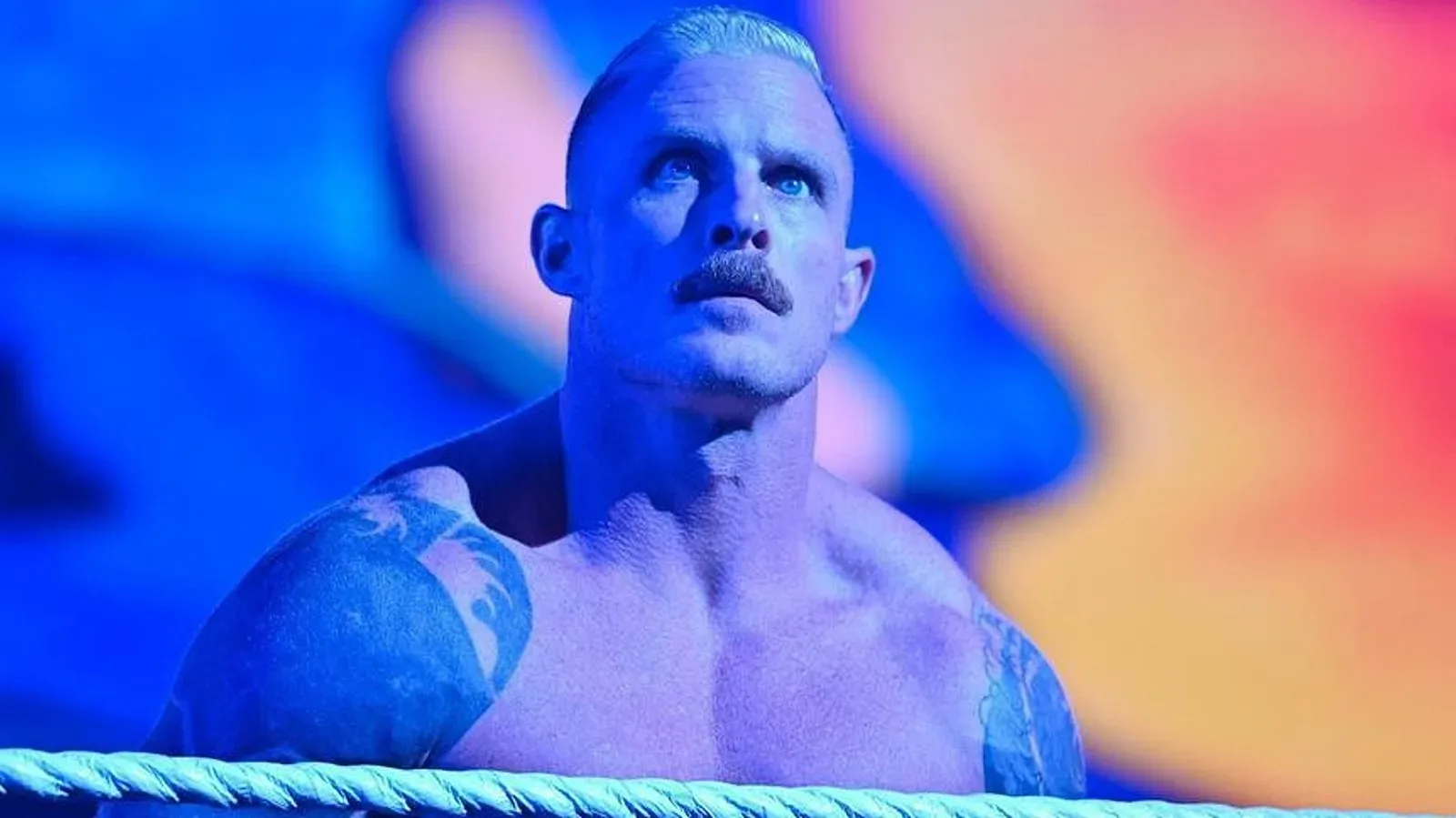
Samuel Shaw built one of modern wrestling’s most distinctive character presentations around something most performers are rarely asked to give up: his voice.
Known in WWE as Dexter Lumis, Shaw portrayed an unnerving, silent figure whose cold stare, deliberate movement and unsettling composure did much of the work normally handled by a microphone. It was a significant evolution from his earlier TNA portrayal, where his serial-killer-inspired character spoke in a quiet, controlled manner. In WWE, however, Lumis became entirely non-verbal.
Speaking on INSIGHT with Chris Van Vliet, Shaw addressed that contrast and the unusual creative task it created. He acknowledged that some fans discovering his recent work on the television series Tacoma PD have been surprised to hear him speak at all.
“I do actually speak. I was playing a character, you know,” Shaw said on INSIGHT with Chris Van Vliet.
For more background on this topic, read Awesome Kong Reflects On WWE Signing After Years Of Doubt.
That reaction is a reminder of how thoroughly the Dexter Lumis presentation worked. Silence was not merely a quirk attached to the character. For a sizable portion of the audience, it became one of Lumis’ defining traits. The lack of verbal explanation forced viewers to take in the details of the performance differently: where he looked, how long he stared, when he remained still, and how he responded when the chaos around him intensified.
Shaw said he does not know precisely why WWE elected to remove the speaking element from the character. Still, he developed his own rationale for why the decision suited the role. In a wrestling environment filled with interviews, confrontations and frequent declarations of intent, he saw silence as a way to become immediately different.
“Everybody talks. Almost, like in my opinion, too much. So, how can I be different?” Shaw said.
That perspective gets to the heart of the Dexter Lumis character. Professional wrestling is a medium driven heavily by speech. Promos establish rivalries, lay out motivations and give performers opportunities to shape their relationship with the crowd in direct terms. A wrestler who cannot use that tool has to find another route. For Shaw, the silence created a constraint, but it also gave the performance a clear identity.
He described the appeal of presenting someone who simply has “a cold stare” and does not speak. The result was a character who could feel imposing without needing to announce himself as a threat. Lumis did not have to explain why he was strange or why another wrestler should be unsettled by him. The presentation asked the audience to reach that conclusion through his behavior.
It also gave Shaw a central creative question to answer every time he appeared. Rather than treating the absence of dialogue as a limitation to work around, he made it the objective of the character work.
“Can I elicit emotion from the fans without saying a word? Can I make them feel a certain way? Can I get my emotion that I’m trying to get across to these fans without saying anything?” Shaw said on INSIGHT with Chris Van Vliet.
Shaw said that became “the goal; the mission.”
That mission demanded a different kind of discipline. A non-verbal character cannot quickly clarify a motivation through an in-ring interview or shift the crowd’s perception with a single well-timed line. Every reaction must be visible. A look has to register. A pause has to mean something. Physical actions need to communicate enough for the audience to understand the intended mood, whether that mood is discomfort, intrigue, humor, danger or anticipation.
For Lumis, the silent approach helped create a memorable contrast. He could be present in a scene without behaving like anyone else in it. While other wrestlers argued, shouted or sought the spotlight verbally, Lumis’ composure could make him stand apart. His stillness was part of the message. In a setting where everyone is trying to be heard, refusing to speak can be its own attention-grabbing choice.
From TNA’s Samuel Shaw to WWE’s Dexter Lumis
Shaw first explored the dark character territory in TNA as Samuel Shaw, drawing on the type of serial-killer figures associated with characters such as Patrick Bateman and Dexter Morgan. That version was soft-spoken rather than mute. The underlying concept already leaned into an unsettling calmness, but the WWE interpretation took the idea further by eliminating spoken dialogue altogether.
The change illustrates how character concepts can be adapted across promotions without losing their core appeal. Both versions relied on discomfort, restraint and a deliberately off-kilter presence. WWE’s Dexter Lumis emphasized those traits through silence, making body language and visual presentation even more essential.
Shaw’s comments make clear that he viewed the adjustment as an opportunity to sharpen the character’s distinction. He did not frame the decision as something he fully understood from a creative-planning standpoint; instead, he explained the internal logic he used to make it work. That distinction matters. A performer may not always control every broad creative choice, but the details of how that choice is brought to life can determine whether a character connects.
In this case, Shaw’s answer was to embrace the question of differentiation. If the wrestling landscape was full of people speaking at every opportunity, Lumis could be the one performer whose refusal to talk made audiences lean in. The silence was not empty. It was filled by expression, posture and the tension created by what the character would not say.
The Value of a Clear Character Rule
Wrestling characters often become recognizable through simple rules that audiences can understand immediately. A visual trademark, a specific cadence, a repeated gesture or a unique entrance can establish an identity before a match even begins. Lumis’ silence functioned in much the same way. It gave the audience a reliable expectation and gave Shaw a firm guideline for his work.
That does not make the role easier. On the contrary, the rule removes one of the most flexible tools available to a performer. Words can be used to add layers, provide context or recover attention when a story needs momentum. Without them, the performer has to trust the audience to pick up on smaller choices. The character needs to be coherent enough that viewers recognize the emotion or purpose behind an appearance even when no explanation is offered.
Shaw’s description of his process suggests that this was exactly what made the role compelling. The challenge was not simply to look intimidating. It was to make fans feel something specific without verbal cues. That can mean generating suspense through a stare, creating curiosity through an unexpected appearance, or making the audience react to a moment because the character’s expression says more than a line of dialogue might.
The contrast with Shaw’s work outside wrestling has also become apparent through fan encounters. As he noted, some convention attendees familiar with his portrayal of Lumis have encountered his work on Tacoma PD and reacted to hearing his natural speaking voice. That response reflects the extent to which audiences can associate a performer with a particularly committed characterization.
For Shaw, that association appears to be less a source of frustration than evidence that the performance landed. Dexter Lumis was designed to be unlike the talk-heavy personalities surrounding him, and the non-verbal approach ensured that he could not be mistaken for another standard wrestling character.
His comments also offer a useful look at the acting demands within wrestling. The microphone is often treated as the clearest test of personality, but silence can be just as revealing. It exposes whether a performer can hold focus, tell a story through physicality and establish an emotional connection without directly telling viewers what to think.
Shaw’s answer was to turn that pressure into the defining purpose of Dexter Lumis. By making each appearance about communicating without speech, he found a way to make the character’s silence feel intentional rather than absent. In a business where nearly everyone has something to say, Lumis’ refusal to say anything became his loudest statement.
In pictures

Darryl Polo
Darryl Polo is a passionate wrestling fan covering WWE, AEW, TNA and beyond. He loves great rivalries, breakout stars and the moments that keep fans talking long after the bell. How we work.