
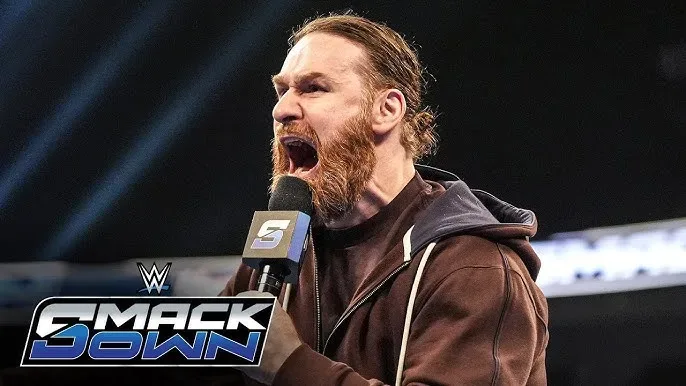
Sami Zayn’s road from beloved underdog to one of WWE’s more complicated top characters was not designed to follow the traditional blueprint of a heel turn. There was no single night where Zayn simply abandoned everything the audience knew about him, no abrupt declaration that he was now a villain, and no intention to discard the emotional foundation he had built with fans.
Instead, Zayn has described the transition as an ongoing process shaped by disappointment, crowd reactions, championship success, and the unpredictable rhythm of weekly WWE television. The reigning Undisputed WWE Champion says he wanted the audience’s feelings about him to change gradually, with cheers and boos existing together before the balance eventually moved further in a different direction.
Speaking on Insight with Chris Van Vliet, Zayn reflected on the evolution that began after his WWE Royal Rumble loss to Drew McIntyre. At the beginning of the year, Zayn was still positioned as the familiar fan-favorite competitor striving to win his first WWE Championship. That pursuit did not end with the breakthrough he wanted, and Zayn viewed the defeat as a signal that his presentation needed to move forward.
“There’s a lot of evolution that’s happened, and part of what I’ve liked about this sort of turn is that it wasn’t done as a conventional turn,” Zayn said. “It wasn’t done, good guy, good guy, good guy. Now I’m bad. You know what I mean? It was just like a very gradual process. It all started when I lost to Drew at the Royal Rumble.”
For more background on this topic, read Kelani Jordan Explains Why Wrestling Imperfection Was Her Toughest NXT Adjustment.
That loss, in Zayn’s view, made it difficult to simply return to the same inspirational underdog story that had connected with audiences. He explained that WWE had already played that particular card and that it would not have felt right to repeat it unchanged. Rather than forcing an immediate reinvention, he wanted to gently redirect the audience response while retaining the character’s existing history.
The goal was a delicate one. Zayn did not necessarily want an arena to suddenly reject him across the board. He wanted enough disapproval to build from, a small but audible faction of fans who could be encouraged to see him differently while the larger audience still had reasons to support him.
Zayn’s ideal cheer-boo balance
Zayn put numerical terms on the type of response he hoped to cultivate. Early in the process, he recalled hearing the beginnings of scattered boos amid overwhelming cheers. That small negative reaction was something he believed could be developed naturally, provided the character continued to make choices that gave fans a reason to question him.
“I’d like it to be gradual, and I’d like it to just feel the audience, and I’d like to obviously nudge the audience in a certain direction, but I want to do it in this sort of delicate way,” Zayn said.
For Zayn, the ideal destination was not necessarily a complete reversal in which every fan jeered him. He discussed wanting a response closer to a 70-30 split, or perhaps 60-40, allowing the crowd to remain divided. That type of reaction can give a character more range than a clean-cut hero or villain, particularly for a performer with Zayn’s long and visible history in WWE.
“In January or whatever, just enough to hear one or two guys going boo! I’m like, okay, I can work with that, and I’ll just gently tip those scales,” Zayn said.
His approach underlines a key reality of WWE storytelling: performers can plan a direction, but they cannot fully dictate how an audience will react to the moments that occur along the way. A character’s momentum can change in one segment, one match, or one rivalry. Zayn acknowledged that unexpected developments can speed up a story, slow it down, or push it toward a path that was not initially anticipated.
He described those developments as the kind of unforeseen opportunities and circumstances that emerge in live television. A wrestler must be able to recognize what is happening in the moment and adjust. In Zayn’s case, the desired middle ground proved harder to reach on his original timetable.
The Carmelo Hayes win changed the equation
The decisive acceleration came when Zayn defeated Carmelo Hayes to win the WWE United States Title. Before that victory, Zayn believed he had begun to establish the kind of mixed reaction that could support a slow-burn change. But the championship win altered the crowd dynamic dramatically.
Zayn said the response before the title victory had moved from an approximately 80-20 cheer-to-boo split to something closer to 90-10. In other words, the room was still heavily behind him, but he had identified a small amount of negative energy that could be used as a foundation for the next stage of the character.
Then, after beating Hayes, that balance did not gradually inch toward the intended 70-30 range. It swung sharply in the opposite direction. Zayn said it felt like a light switch had been flipped, with the fan response moving to roughly 90-10 the other way.
“But then when I beat Carmelo Hayes overnight, I was at like 70-30 at that point, and then it just went like 90-10 in the other way as soon as I beat him,” Zayn said. “The stuff with Trick was all contributing to it at that time as well. But then when I beat Carmelo, it was like a light switch. So okay, that’s gonna accelerate the process a little bit.”
The reference to Trick Williams is important in understanding the wider atmosphere around Zayn’s character work. Zayn feuded with Williams at a time when Williams was rapidly gaining popularity despite being positioned as a heel. Those shifting audience dynamics added another layer to Zayn’s own changing relationship with fans. When a supposed antagonist is getting louder positive reactions, the person opposing him can find the crowd’s perception changing in unexpected ways.
The win over Hayes and the Williams program therefore did more than advance Zayn’s title picture. They helped create a setting where Zayn’s evolving attitude could be received differently from week to week. Rather than resisting that response or trying to reset the character, Zayn accepted that the process had accelerated.
Evolution over reinvention
Even with the reaction changing quickly, Zayn emphasized that he did not want to scrap the persona audiences had followed and replace it with a generic bad-guy version. That distinction is central to the way he sees the current chapter. The heel elements are not meant to erase the underdog, the competitor, or the emotional investment fans had in him. They are meant to grow out of those earlier versions of Sami Zayn.
“I didn’t want to take this character and go well, now I’m a bad guy, crumple it up and do something else,” Zayn said. “I really like evolving into things.”
Zayn pointed to the longer trajectory of his WWE character, particularly from around 2019 onward, as evidence that his major changes have generally flowed from what came before. Each phase, in his estimation, has bled into the next instead of functioning as an isolated reset. That continuity is especially valuable for a performer who has experienced many different audience reactions during a lengthy WWE career.
It also explains why his current presentation can remain emotionally recognizable even as fans react to him with more hostility. Zayn is still fighting for the people he identifies as his ride or dies, but the way he approaches that loyalty and the way he pursues his goals have become central to the audience’s changing view of him.
Now holding the Undisputed WWE Championship, Zayn’s gradual turn has reached a stage far beyond the handful of scattered boos he heard at the start of the year. Yet his comments make clear that he does not see the character as a finished product. The response to his title victories, his opponents, and his decisions will continue to inform where the balance goes next.
For Zayn, that is the value of letting a WWE character evolve in real time. The strongest direction is not always the one that unfolds exactly as planned. Sometimes the crowd changes faster than expected, a championship win reframes a performer overnight, and the best move is to recognize the reaction and let the next chapter emerge from it.

Darryl Polo
Darryl Polo is a passionate wrestling fan covering WWE, AEW, TNA and beyond. He loves great rivalries, breakout stars and the moments that keep fans talking long after the bell. How we work.