
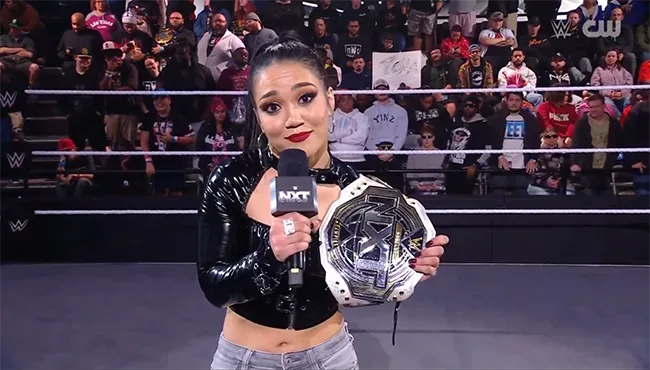
Roxanne Perez has offered a thoughtful perspective on the relationship between WWE talent and the fans who support them, emphasizing that appreciation and personal boundaries can exist together.
In a recent interview, Perez spoke about the excitement that comes with meeting supporters while also addressing the situations in which a fan interaction can become inappropriate or difficult. The WWE Superstar made clear that she values the audience deeply, particularly because she grew up as a wrestling fan herself and understands what it means to meet a performer.
At the same time, Perez said there needs to be an understanding that wrestlers are people with private lives, travel schedules and responsibilities outside of their appearances in front of a live crowd.
“First off, I love my fans so much. I love all of the fans,” Perez said. “We wouldn’t be able to do what we do without the fans.”
For more background on this topic, read Andrade and Rush Salute Penta and Dragon Lee After WWE Raw in Mexico City.
Perez’s comments arrive amid continued discussion across professional wrestling about the appropriate ways for fans to approach talent outside of shows. Wrestlers regularly travel from city to city for television, premium live events, live events, media commitments and promotional appearances. That demanding routine can create moments where a talent is accessible in public, but not necessarily available for an autograph, photograph or conversation.
The issue is not Perez rejecting the idea of meeting fans. In fact, she specifically acknowledged the emotional significance of those encounters. Having once been in the audience herself, she said she can view the situation from both sides: as a performer whose work inspires supporters and as someone who remembers the thrill of meeting a WWE star.
Perez understands the fan perspective
Perez noted that wrestling fans bring passion to the industry because they admire the people they watch. For many, an opportunity to have a photograph taken or an item signed is a memorable experience. She recognized that enthusiasm and did not dismiss its importance.
“I think these fans, they love what we do; they respect us so much. They admire us. It is a big deal when they get to meet us, and they get their picture signed,” Perez said.
That understanding is particularly notable coming from Perez, whose path to WWE was shaped by an early love for the business. Her remarks frame the conversation as one of mutual respect rather than a divide between wrestlers and the audience. Fans are essential to wrestling, but a wrestler’s public role does not erase the need for normal personal space.
WWE has established environments for those interactions. Events, designated meet-and-greets and other official appearances give fans a clear opportunity to see Superstars and seek autographs or photos. Perez pointed to arenas as the natural setting for that connection, recalling that those were the kinds of places where she met WWE performers as a young fan.
“We obviously have the arenas,” Perez said. “The arenas are where we show up. There’s an exact location where you go and meet the WWE superstars. That’s always what I did when I was a kid.”
Official appearances provide a more organized experience for everyone involved. Fans know when and where talent will be present, and performers can set aside time to engage with the public. That does not mean every interaction elsewhere is automatically unwelcome, but Perez’s point is that the location and timing matter.
Hotels and airports are different situations
The distinction Perez drew centered on life on the road. WWE’s schedule requires performers to spend extensive time away from home, often moving quickly between venues, hotels and airports. In those circumstances, a Superstar may be attempting to rest, prepare for the next commitment or simply make a flight.
Perez described hotels as a form of home for talent while they are traveling. Her wording reflects the reality of a career in which a hotel room can be one of the few private spaces available during a busy run of dates. Airports present another challenge, especially when schedules are tight and missing a flight can affect an entire travel day.
“When we are on the road, our hotels are our home,” Perez said. “When we’re running late for a plane and trying to catch our flight, it does break my heart to tell people no, but at the same time, we do have to respect everybody’s privacy.”
That final point is central to Perez’s message. Saying no to an interaction is not a statement that a performer is ungrateful for fan support. It can simply mean that the performer needs to get somewhere, is dealing with a personal moment, or does not have the time and space to stop.
Perez did not present this as a one-sided demand. Instead, she acknowledged that it can be disappointing for a fan to hear no and said it is difficult for her to turn down someone who is excited to meet her. The mutual humanity in that exchange is what she asked fans to keep in mind.
A clear line without losing appreciation
Perez summarized her stance by stressing that WWE Superstars are still people beyond their on-screen roles. The larger-than-life nature of professional wrestling can make its performers feel constantly accessible, especially in an era when fans can follow them across television, social media and public appearances. Perez said that reality does not change the need for a reasonable line between public engagement and private life.
“We are just humans. We are WWE superstars, but we are just humans,” Perez said. “We’re trying to live our life while also trying to make the fans happy. But there’s gotta be some line.”
Her comments do not ask fans to stop caring or to stop attending opportunities designed for interaction. They ask for awareness. A fan who sees a wrestler in a public place may be thrilled by the unexpected encounter, but the performer may be rushing, resting or handling something unrelated to wrestling. Respecting that possibility can preserve a positive relationship between the audience and the talent they support.
Perez also wanted to ensure that the boundary she described would not be misread as a lack of gratitude. She closed her thoughts with a direct reassurance to supporters: “But we do love you guys, OK?”
That balance has been evident in Perez’s current stretch of activity. While maintaining her WWE profile, she also scored a major victory at AAA TripleMania 34 last weekend. Perez won a No. 1 Contenders Fatal 4-Way match over Faby Apache, La Hiedra and Nattie Neidhart.
The win positioned Perez for a future AAA Reina de Reinas Championship match against reigning champion La Catalina. No date for that title challenge was specified, but the result gives Perez a significant opportunity outside her usual WWE competition.
A major opportunity after TripleMania 34
Perez’s TripleMania 34 victory underscores why fans have continued to follow her work closely. The Fatal 4-Way format required her to overcome three opponents with very different levels of experience and backgrounds, including Faby Apache, La Hiedra and Nattie Neidhart. By emerging as the No. 1 contender, Perez earned the right to pursue one of AAA’s most prominent women’s championships.
La Catalina now awaits Perez in the eventual Reina de Reinas title match. The championship bout will offer Perez the chance to add another defining achievement to her resume, while La Catalina will enter as the reigning champion tasked with defending her position.
For Perez, the upcoming title opportunity and her message about fan conduct both reflect the realities of being a modern WWE Superstar. The rewards include performing for enthusiastic crowds, building connections with people who have followed her journey and competing on major stages. The demands include constant travel and the need to protect time away from the spotlight.
Her request is straightforward: support the performers, enjoy the shared experience of wrestling, and understand that respect is just as important as excitement. Perez remains appreciative of every fan who helps make WWE possible, but she believes that appreciation works best when there is room for Superstars to be people, too.
Darryl Polo
Darryl Polo is a passionate wrestling fan covering WWE, AEW, TNA and beyond. He loves great rivalries, breakout stars and the moments that keep fans talking long after the bell. How we work.