
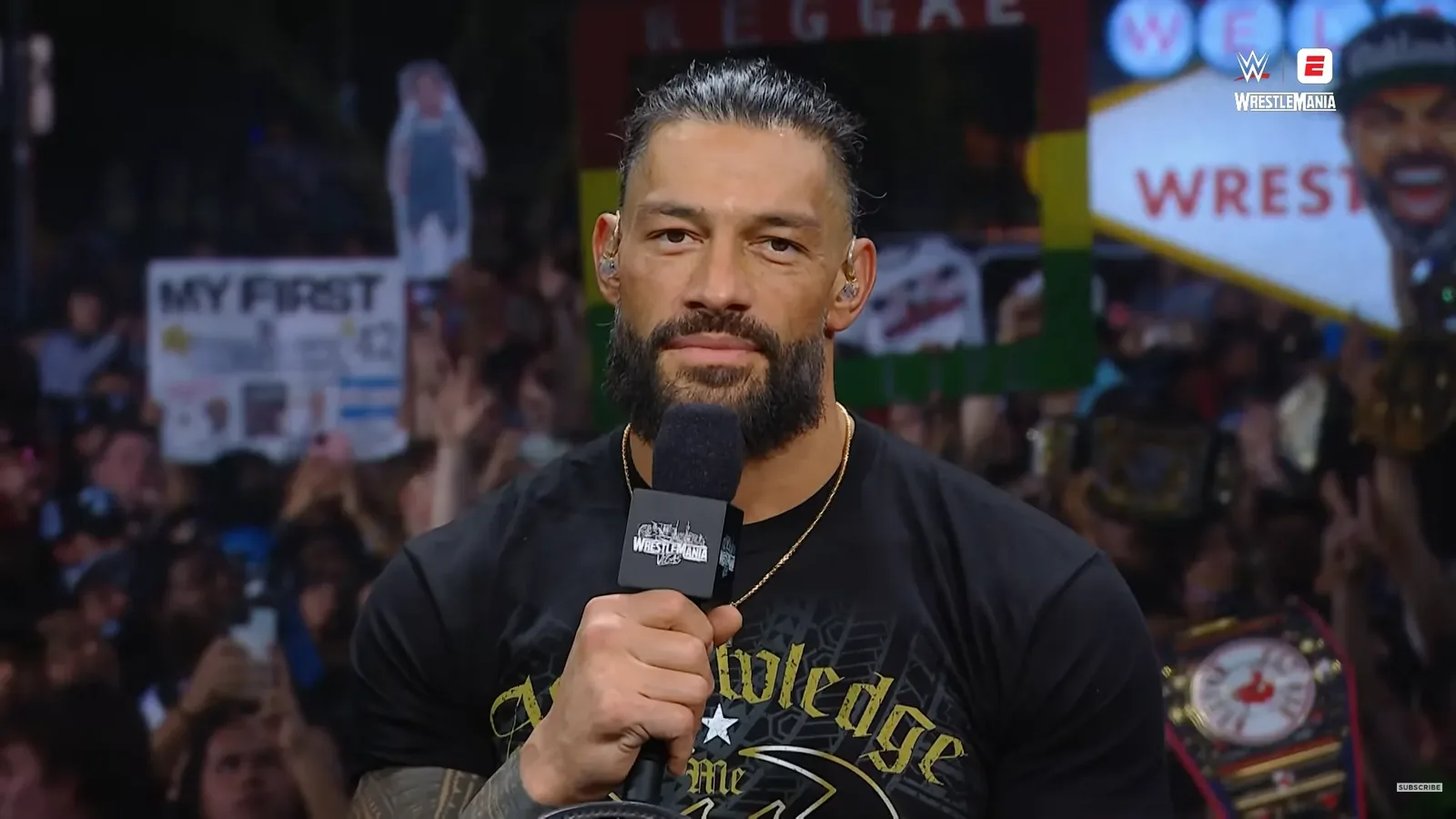
Roman Reigns has spent years making physical confrontation look believable in WWE, and he says that experience translated directly to his work opposite Andrew Koji in Street Fighter.
Reigns plays Akuma in the upcoming film, while Koji takes on the role of Ryu. The two share one of the movie’s major action sequences, and Reigns described their time together as a process that required him to find a rhythm with a performer who was already deeply immersed in the production’s fight work. In the end, the former WWE Universal Champion said the on-set adjustment felt remarkably familiar.
“It was awesome,” Reigns said in a recent interview. “That was kind of a part of the difficulty because we trained so much with John Valera’s team and I was training a lot with Andrew’s stunt double. I was starting to really get his chemistry and his timing and his rhythm, because Andrew’s shooting the whole time. So, as I’m training and trying to get in, he’s already been doing all the work.”
The challenge, Reigns explained, came when it was time to move from training with Koji’s double into working directly with Koji. The timing had to be recalibrated, but the need to establish a physical connection between two performers was an environment Reigns immediately understood from professional wrestling.
For more background on this topic, read Cody Rhodes Says WWE Locker Room Keeps Gaming Monitor Available Backstage.
“By the time got together, I had to adjust a little bit and it felt like being in wrestling. It felt like being in the WWE.”
That comparison is notable because wrestling and screen combat demand many of the same fundamentals, even though they are built for very different formats. Both rely on timing, trust, positioning, body control, and the ability to communicate through movement. A wrestling match is typically performed live with limited opportunity to stop and reset, while a movie sequence can be constructed through rehearsals, multiple takes, camera angles, and editing. Still, the performers must make every strike, reaction, and near-miss look convincing while protecting one another.
For Reigns, that adjustment apparently became easier because Koji brought a physical approach that did not feel overly distant from the contact Reigns is accustomed to in WWE. Reigns praised his co-star’s toughness and willingness to make the exchange feel real.
“He’s a tough guy. He actually had to deal with some adversity and he just trucked right through it. But yeah, he’d get in there and make some contact, he’d lay it in there, which is good because that’s what I’m used to anyways. It brings that authentic feeling to the movie.”
Reigns did not specify the adversity Koji dealt with during the production, but his comments made clear that he came away impressed by Koji’s resilience. The WWE star also emphasized that measured contact helped give the action a greater sense of authenticity. That is a familiar principle for Reigns, whose biggest WWE rivalries have depended on making high-impact exchanges feel consequential to an audience.
As one of WWE’s most recognizable modern stars, Reigns has had a career built around presence as much as athletic execution. Whether competing in a stadium main event or delivering a major promo as the Tribal Chief, he has been expected to project control and intensity. Akuma presents a different kind of role, but the character’s imposing nature and reputation as a dangerous fighter create an obvious fit for Reigns’ screen persona.
At the same time, Street Fighter asks Reigns to work in a more structured cinematic setting than the one he knows from WWE television and premium live events. His remarks about training with John Valera’s team and Koji’s stunt double illustrate the preparation involved in adapting to that format. Rather than merely arriving for a sequence with the finished choreography in place, Reigns had to build familiarity with the movement, pace, and timing before stepping in with Koji himself.
Finding Chemistry Beyond the Ring
Reigns’ explanation also highlights why stunt doubles and fight teams are so important to action filmmaking. Training with a double can help an actor learn a sequence safely and repeatedly, especially when another principal performer is occupied filming other material. But the final product still requires the main actors to establish their own on-camera chemistry when they are together.
That transition was the aspect Reigns compared to working in WWE. A wrestler may prepare extensively before a match, but there is always an adjustment period when working with a particular opponent. Different wrestlers move at different speeds, react differently to contact, and bring their own habits into the ring. Reigns said he had begun to absorb the timing and rhythm of Koji’s double, then had to shift when he worked directly with the actor playing Ryu.
Koji’s background makes that dynamic especially relevant. His portrayal of Ryu places him at the center of a character long associated with martial arts discipline, determination, and iconic fight-game action. Reigns’ Akuma, meanwhile, is one of the franchise’s most formidable figures. Their pairing gives the film a conflict with clear physical stakes, and Reigns’ comments suggest the production aimed to make that clash feel grounded rather than relying solely on visual effects or camera tricks.
The WWE connection is also more than a simple comparison from Reigns. In wrestling, convincing physicality is a central part of storytelling. Fans do not need every blow to be full force, but they need to believe the damage, the struggle, and the emotional impact of the confrontation. Reigns said Koji’s willingness to make contact gave their scenes that kind of feeling.
That does not mean the two industries operate identically. WWE performers wrestle a demanding schedule and perform before live crowds, while film actors and stunt teams work within a carefully planned production environment. Yet Reigns’ experience shows how closely the skill sets can overlap when an action scene depends on precise coordination. The ability to hit marks, sell impact, trust a scene partner, and maintain character under pressure can be just as useful on a movie set as it is in a WWE ring.
Street Fighter Brings Together WWE, NJPW and Action Talent
Reigns is not the only wrestling name attached to Street Fighter. Cody Rhodes is set to appear as Guile, giving WWE another major presence in the cast. New Japan Pro-Wrestling’s Hirooki Goto will also be featured as E. Honda. The combination of Reigns, Rhodes, and Goto adds a notable professional-wrestling component to a project based on one of the most enduring fighting-game franchises.
For Reigns, the Akuma role represents an opportunity to bring his established intensity into a new medium. His comments about Koji point to an approach rooted in collaboration rather than simply relying on his existing WWE experience. He trained extensively, learned the choreography through work with a stunt double, and then adjusted to meet the timing of his fellow actor when the principal performers came together.
That willingness to adapt is particularly important for a character such as Akuma. The role carries major expectations for longtime Street Fighter fans, while Reigns’ involvement will naturally bring interest from WWE viewers. The action between Akuma and Ryu will be a key test of how effectively the film brings its central fighters to life, and Reigns’ description indicates that the performers treated the physical side of that matchup seriously.
Reigns has not framed the work as a substitute for wrestling. Instead, he described an action-performance experience that tapped into instincts he developed over years in WWE. The process may have required a new environment, different production tools, and a fresh partner dynamic, but the essential demand was recognizable: make the audience believe in the fight.
Street Fighter is scheduled to hit theaters on October 16. With Reigns as Akuma, Koji as Ryu, Rhodes as Guile, and Goto as E. Honda, the film will place several prominent wrestling figures within a world defined by combat, rivalries, and larger-than-life characters. Reigns’ account of working with Koji suggests that, at least for Akuma and Ryu’s clash, the production found some of its most useful inspiration in the same physical trust that has long powered WWE.
In pictures

Darryl Polo
Darryl Polo is a passionate wrestling fan covering WWE, AEW, TNA and beyond. He loves great rivalries, breakout stars and the moments that keep fans talking long after the bell. How we work.