
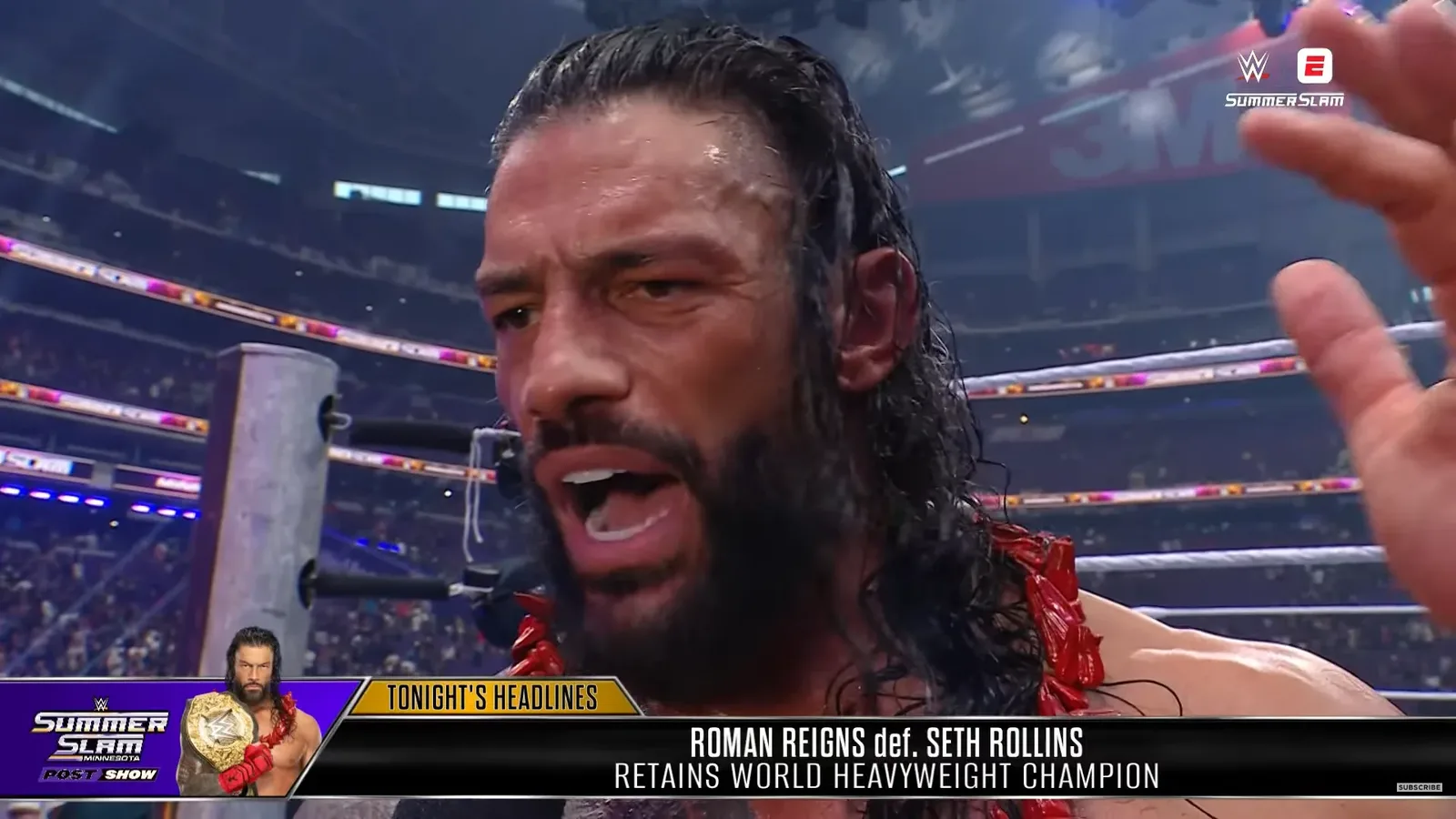
Roman Reigns understands that his place in WWE comes with a responsibility that extends beyond his own matches, title reign, and television appearances. While Reigns no longer maintains a full-time in-ring schedule, he has acknowledged that his stature also creates a challenge for the wrestlers coming up behind him: they do not have the same kind of informal access to him that previous generations had with established locker-room leaders.
Speaking with Complex, Reigns addressed the changing environment around WWE travel and talent interaction. He pointed to the way veterans once spent more time in the locker room and around the full roster, creating natural opportunities for younger wrestlers to ask questions, observe their habits, and absorb lessons that were not necessarily taught in a formal setting.
“I do think with where I’m at, there is a responsibility to try to tap into the future,” Reigns said. “Give them time to tap into my experience and my mindset and what makes me tick and what allows me to be successful.”
It is a notable perspective from one of WWE’s defining stars. Reigns has spent years operating at the center of the company’s biggest stories, and his current status means that a match or segment involving him carries considerable importance. Yet his comments show an awareness that his value to WWE is not limited to performing when the cameras are on. He sees a role in helping younger talent understand the discipline, mentality, and preparation required to succeed at the highest level.
For more background on this topic, read Aaron Solo Announced for Wrestling REVOLVER Debut in October.
A Different Locker-Room Dynamic
Reigns contrasted the current landscape with the access talent once had to The Undertaker. The comparison was not simply about seniority or star power. It was about proximity. Before the widespread use of bus travel systems, Reigns said, The Undertaker was consistently available in the locker-room environment and could take on a guiding presence for the roster.
“The Undertaker, before the bus system came around, he was always in the locker room, so he was able to have that godfather effect,” Reigns said. “I’m not just in the middle of all the talent anymore, so these guys can’t really use me as the resource.”
The idea of a veteran as a daily locker-room resource has long been an important part of professional wrestling. It can mean advice on ring work, presentation, pacing, television performance, travel, physical maintenance, or simply how to handle the pressure that comes with major opportunities. In many cases, those lessons emerge through routine interaction rather than a planned mentoring session.
Reigns’ comments underline how the structure around a top WWE act can limit those spontaneous exchanges. A performer at his level does not move through the day in exactly the same way as the majority of the roster. His schedule is selective, his appearances are heavily anticipated, and the demands around his role naturally make him less accessible than a veteran who is regularly present in the shared locker-room setting.
That does not mean Reigns is dismissing the importance of helping talent develop. In fact, his remarks suggest the opposite. He recognizes the difference between wanting to pass along knowledge and being positioned for younger wrestlers to conveniently seek it out. The responsibility, as Reigns frames it, is to find ways to bridge that distance and give the future of the roster opportunities to benefit from his experience.
Reigns’ Perspective Carries Weight
Reigns rarely works matches, though he has been more present at television as WWE World Heavyweight Champion. That combination makes his perspective especially significant. He is not speaking as someone whose role is built around appearing on every show and wrestling every week. He is speaking as a central figure whose presence itself is treated as meaningful, and who has had to understand how to maximize that presence.
That experience can be valuable to performers at many stages of their careers. Reigns’ success has involved far more than winning matches. Major WWE stars must establish a clear identity, make audiences believe in the importance of their programs, communicate on television, and maintain consistency under intense scrutiny. Reigns specifically mentioned his mindset and what makes him tick, indicating that the lessons he hopes to share are as much about approach as they are about moves or match structure.
For younger wrestlers, access to that outlook can be particularly useful. The ability to work in front of a national audience is one challenge; understanding how a top-level act thinks about presentation, responsibility, timing, and sustained success is another. Reigns has been in a position where expectations are exceptionally high, and he appears conscious that those experiences can offer practical value to talent trying to establish themselves.
There is also an important distinction in Reigns’ words. He did not portray himself as a veteran who can simply replicate the exact role The Undertaker held. Instead, he acknowledged that the circumstances are different. The Undertaker’s “godfather effect,” as Reigns described it, came from being physically immersed in the locker room on a regular basis. Reigns does not claim to have that same day-to-day availability.
That self-awareness matters. Rather than presenting mentorship as something automatic because of his name or accomplishments, Reigns described it as an effort that requires intention. If the environment no longer naturally places a major veteran in frequent contact with every member of the roster, then sharing knowledge may need to happen in more deliberate ways.
The Importance Of Passing Experience Forward
Professional wrestling has always depended on the transfer of experience from one generation to the next. The industry changes, the television environment changes, and the way performers travel changes, but the need for talent to learn from those who have navigated the highest levels remains constant. Reigns’ comments speak directly to that ongoing process.
Every era has its own standards and pressures. In Reigns’ case, his career has unfolded in a WWE environment where top performers are expected to handle the demands of major television, premium live events, public visibility, and evolving audience expectations. His understanding of those demands is part of what he believes can help the wrestlers who will carry WWE forward.
His words also offer a reminder that influence does not require a veteran to wrestle every week. Reigns’ role may not provide the same volume of interactions that a full-time locker-room presence once could, but his experience remains substantial. The question is not whether he has lessons to offer. It is how those lessons can be made available in a modern system where a star of his level is not always surrounded by the entire roster.
That issue is bigger than any individual performer. Wrestling promotions continually balance the needs of their featured attractions with the development of emerging talent. The more important a star becomes, the more protected and specialized their schedule can become. At the same time, the wisdom of those stars can be among the most valuable resources a company has.
Reigns appears to recognize both sides of that equation. He knows that he cannot function as the same always-present locker-room figure that The Undertaker was able to be in a different travel setup. But he also believes his position gives him an obligation to make an effort to connect with the future.
A Champion Thinking Beyond The Present
As WWE World Heavyweight Champion, Reigns remains one of the most consequential figures in the company. When he appears, the attention around him is substantial, and when he steps into the ring, the occasion is treated accordingly. That standing gives his reflections on mentorship additional significance.
Reigns is not merely looking back at how things used to work. He is assessing what has been lost in the shift away from the kind of regular locker-room access veterans once had, while also considering what he can do within his own circumstances. His comments make clear that he does not view the next generation as separate from his current role. He views helping them draw from his experience as part of the responsibility that comes with where he stands.
For a wrestler whose schedule is no longer built around constant in-ring activity, that may be one of the most meaningful ways to contribute outside of major WWE programming. Reigns’ legacy will be defined by his own accomplishments and memorable performances, but he is also thinking about the wrestlers who may benefit from understanding the mindset that helped him reach this level.
The access may not look like it did in the days when a veteran such as The Undertaker was routinely in the middle of the locker room. Reigns knows that. Still, his willingness to identify the gap and speak about a responsibility to close it suggests that he sees mentorship as an active part of being one of WWE’s leading figures.
In pictures

Darryl Polo
Darryl Polo is a passionate wrestling fan covering WWE, AEW, TNA and beyond. He loves great rivalries, breakout stars and the moments that keep fans talking long after the bell. How we work.