
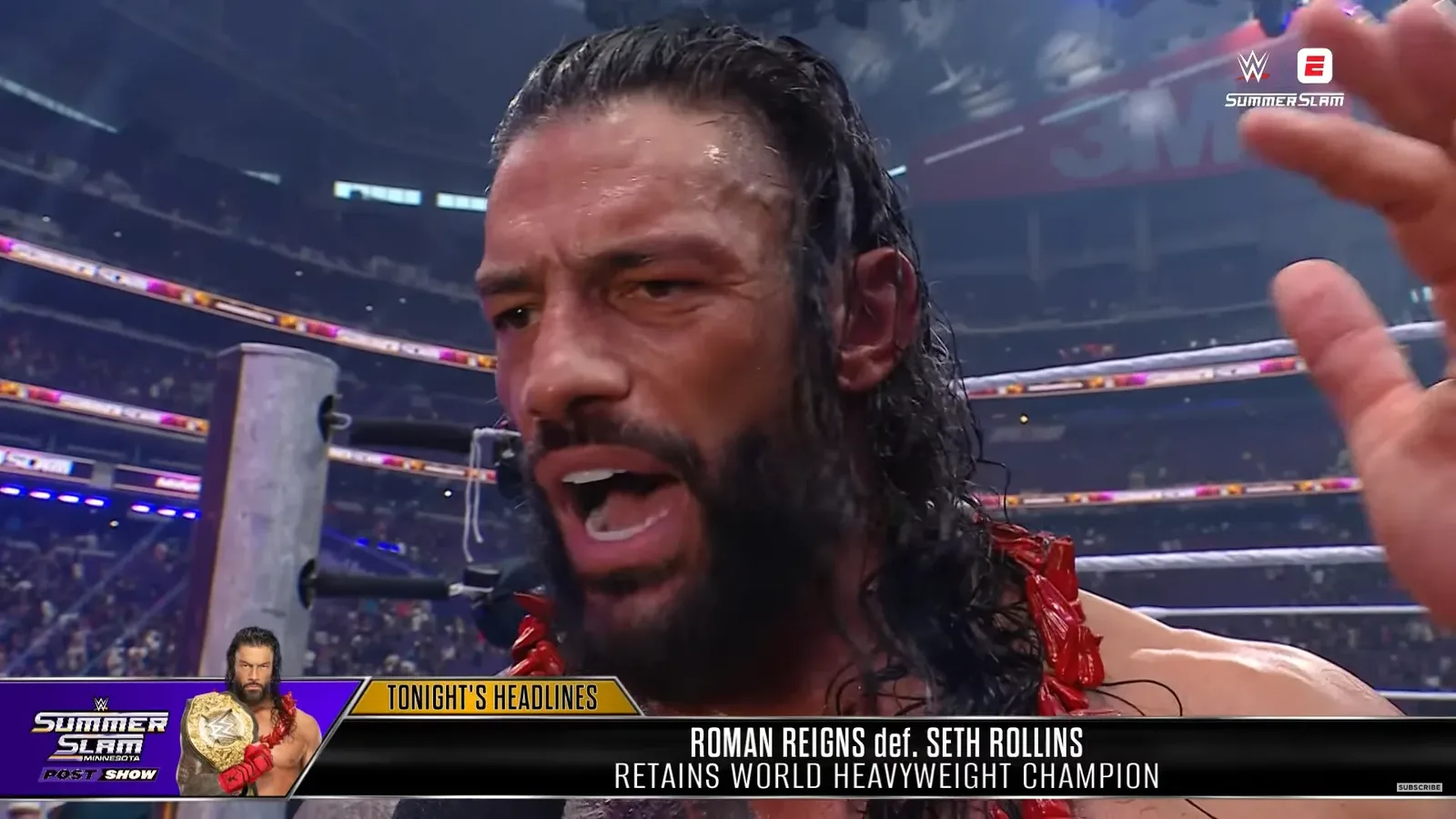
Roman Reigns has built a career defined by transformation, from his emergence alongside The Shield to his run at the very top of WWE as the Tribal Chief. Yet even with the accomplishments, championship success and major-event experience that have come to define his place in the company, Reigns can still identify moments from earlier in his career that he would handle differently.
During an appearance on Club Shay Shay while promoting the upcoming Street Fighter film, Reigns was asked whether he would change anything about his wrestling journey if he had the opportunity to go back. His answer was not centered on a particular opponent, title match or career decision. Instead, Reigns pointed to creative ideas that he now believes he could have resisted more strongly.
Reigns said that earlier in his WWE tenure, he did not yet have the stature or leverage needed to comfortably reject concepts that did not feel right to him. He was still trying to prove himself as a singles main-event talent and establish the kind of internal equity that would allow him to challenge the direction being presented.
“I probably would’ve said no a few more times early on, but I just didn’t have the equity within the company,” Reigns said. “I wasn’t rooted well enough in the main event scene. I was still auditioning, I was still proving myself, I was still earning that equity.”
For more background on this topic, read Roman Reigns Explains Why He Told Logan Paul Not To Blend In With WWE’s Locker Room.
That distinction is important in understanding Reigns’ comments. WWE performers do not all enter creative discussions with the same degree of influence. A newer act, or even a heavily featured star who has not fully secured his role at the top of the card, may be expected to execute material that an established headliner could revise, redirect or turn down. Reigns said he had not yet reached that level of security when some of the moments he would now reconsider took place.
The most famous example remains the “suffering succotash” promo, a line that has followed Reigns for years. The phrase became an easy target for fans and critics during a period when there was widespread discussion about how Reigns was being presented as WWE’s next central babyface. Although his career has since included countless major matches, signature promos and record-setting championship accomplishments, he acknowledged that the old line remains something audiences continue to bring up.
“This was like 14 years ago and they’ll still quote me for saying suffering succotash,” Reigns said with a laugh. “This was so long ago; this was 12 years ago. I’ve delivered unbelievable work since then but still, I’ll be tied to that.”
Reigns’ time frame in the interview underscored his larger point: a single awkward creative beat can have an exceptionally long afterlife in professional wrestling. Promos, finishes and segments are replayed, shared and debated for years. For a performer who is still developing their on-screen identity, material that does not connect can become part of the public perception of that act long after the character has evolved.
Still, Reigns was not suggesting that his early WWE run was defined entirely by missteps. His comments were measured. He said there were not many instances he would revisit, but he could name a small number of promos, scenarios, segments or match finishes where he would now be more assertive about his concerns.
“There wasn’t that many but there’s probably two or three promos or scenarios, segments, or finishes of a match or something like that that I would probably go back and develop the balls to be like, nah, not today, brother,” Reigns said.
The remark reflects the confidence that Reigns has developed over the course of his WWE career. His rise was not immediate or uncomplicated. Following The Shield’s split, he was positioned prominently and quickly moved into the WWE main-event picture. That ascent came with enormous attention, intense crowd reactions and a sustained examination of WWE’s approach to his character. In time, Reigns found a presentation that resonated at the highest level, embracing the Tribal Chief persona and becoming one of the promotion’s defining stars.
Part of that evolution involved a more controlled and deliberate on-screen voice. The later version of Reigns was known for concise, authoritative promos, shifting dynamics with allies and challengers, and a character built around power, family and dominance. It was a notably different presentation from the early singles babyface period that produced the “suffering succotash” moment.
His interview comments offer a clear look at the experience behind that growth. Reigns did not frame the issue as simply being handed bad material. Rather, he described a process in which he was still earning the confidence to speak up. That is a meaningful distinction for a performer operating in a large company structure. Knowing when to trust the process, when to follow direction and when to offer a firm objection can be as vital to a wrestler’s long-term development as in-ring experience.
From proving himself to shaping his presentation
Reigns’ career has shown how dramatically a WWE character can change when the performer’s strengths and creative direction align. The central figure seen in his most celebrated work was not merely a continuation of his earliest presentation. It was a refinement that allowed his natural presence, pacing and intensity to take center stage.
His acknowledgment that he would say “no” more often if he could revisit certain early decisions is therefore less about relitigating the past than recognizing the value of experience. Reigns had to spend years becoming a trusted centerpiece before reaching a point where he felt more rooted in the main-event scene. With that standing came the ability to advocate more effectively for his own character and for the details that could affect how a segment landed with the audience.
That perspective will likely resonate with wrestlers at every level of the business. A performer’s early years often involve accepting opportunities, adapting to creative direction and working to gain trust. Reigns’ reflection is that, while he understood why he approached those situations as he did, he would now bring more conviction to the small number of ideas that did not fit.
It also speaks to why the “suffering succotash” line has endured as a reference point. The phrase was not simply an unusual choice of words; it became symbolic of a specific chapter in Reigns’ development. Fans have continued to invoke it because it contrasts so sharply with the confident, polished persona Reigns later established. His own willingness to laugh at the memory shows that he understands the line’s place in the conversation, even if he believes the body of work that followed should carry greater weight.
Reigns set for Raw appearance in San Diego
Reigns is scheduled to appear on the October 19 edition of Monday Night Raw in San Diego, California. His upcoming appearance follows the Money in the Bank Premium Live Event, where Oba Femi once again put Reigns on notice.
That development adds another layer of anticipation around Reigns’ WWE schedule. Femi has emerged as a powerful presence, and his continued focus on Reigns suggests that a potential confrontation remains a significant possibility. No match or further details were specified in connection with Reigns’ scheduled Raw appearance, but the October 19 show will provide the next opportunity for the situation to develop.
For Reigns, the current spotlight arrives at a moment when his reach extends beyond WWE. He is part of the cast of Street Fighter, playing Akuma, and his media appearances have allowed him to discuss both his acting work and the path that made him one of wrestling’s most recognizable names. His comments on Club Shay Shay provide a candid reminder that even a performer with Reigns’ resume can look back at earlier stages of his career and see room for a different response.
Reigns cannot change the promos, segments or finishes that have already happened. But his reflection makes clear that those experiences helped shape the performer and decision-maker he became. The lessons were not just about what worked in front of an audience. They were also about knowing when a wrestler has earned the voice to say that an idea is not the right one.
Quotes credited to Club Shay Shay.
In pictures

Darryl Polo
Darryl Polo is a passionate wrestling fan covering WWE, AEW, TNA and beyond. He loves great rivalries, breakout stars and the moments that keep fans talking long after the bell. How we work.