
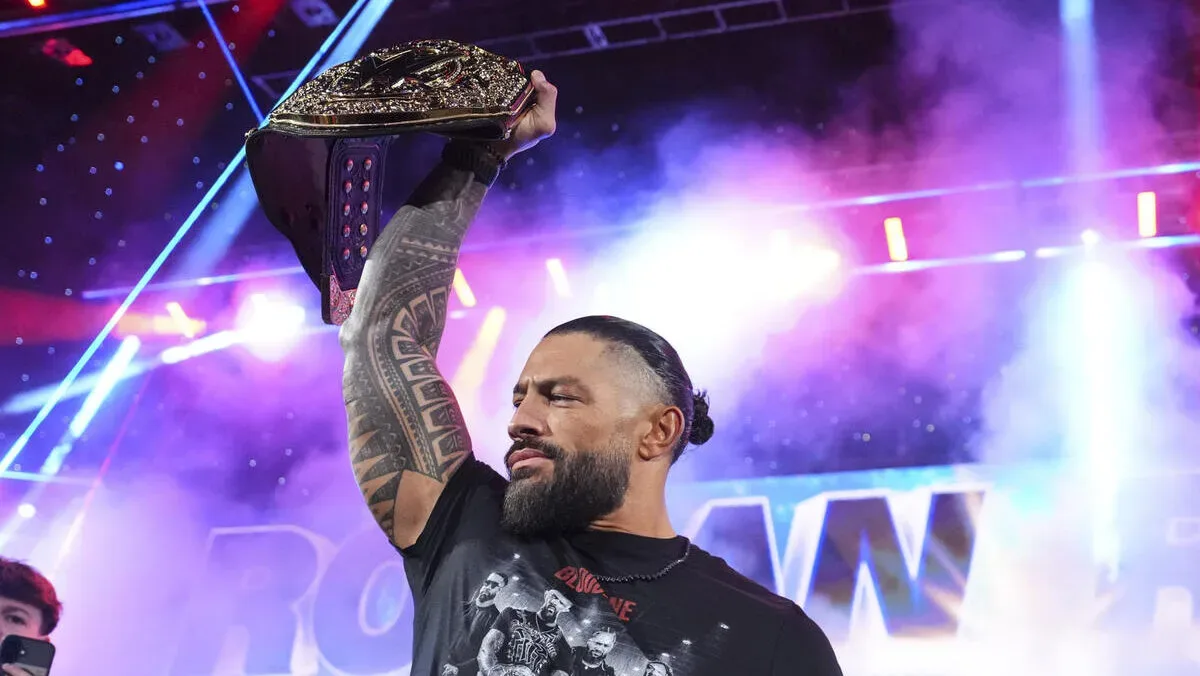
Roman Reigns has addressed one of the most frequent talking points surrounding his modern WWE schedule: why a performer with his stature is no longer a regular fixture on the company’s house show circuit.
Appearing on Club Shay Shay with Shannon Sharpe, the WWE World Heavyweight Champion explained that his reduced live-event workload is not a matter of avoiding the grind that helped establish him. Instead, Reigns pointed to the years he spent carrying an extraordinarily busy schedule, the increasingly valuable nature of WWE television and premium live events, and the risk that comes with wrestling additional matches in front of smaller non-televised crowds.
Reigns said criticism of his present-day appearances often overlooks the volume of work he performed earlier in his WWE run. He specifically pointed to the period from 2012 through 2018, saying he worked roughly 150 to 200 shows per year while developing the skills needed to perform at the highest level.
“People look at it as a highlight reel now,” Reigns said. “Every single day you’re putting in work.”
For more background on this topic, read Roman Reigns Responds to Conrad Thompson’s ‘Overrated’ Criticism.
For Reigns, live events were a crucial part of that process. WWE house shows give talent opportunities to work in front of audiences without the same time constraints, production demands, and worldwide scrutiny attached to weekly television. They can also be an important environment for wrestlers to gain experience, refine timing, test crowd reactions, and become more comfortable in longer matches.
Reigns made clear that he values that part of the business and believes there is merit in WWE pursuing more live events. At the same time, he sees a difference between the role those shows played when he was becoming a top act and the role they can play for a reigning world champion whose major appearances have substantial business implications.
Years of work before the current schedule
The champion framed his present schedule as the result of years spent proving himself rather than a shortcut around the traditional demands of WWE. Reigns said he “just outworked” his competition and emphasized that the sustained travel and ring schedule of his earlier career formed the foundation for everything that followed.
That distinction is central to his explanation. House shows are often discussed by fans as a measure of a wrestler’s workload because they represent the constant travel that has historically defined life in WWE. A talent may wrestle multiple times per week across televised programs, premium live events, and non-televised dates in different markets. For a performer at the top of the card, that repetition can be physically taxing even when the matches themselves are designed around a familiar live-event formula.
Reigns did not dismiss that model. In fact, he credited it with teaching him how to do his job. But he argued that the calculation changes when his appearances on Monday, Friday, and at WWE’s major events are carrying a much greater financial and promotional weight.
“Putting my time in, that’s where I learned how to do everything,” Reigns said.
His comments also offer a direct response to the idea that a limited schedule means a reduced commitment to WWE. Reigns’ position is that the work is being concentrated around the company’s biggest platforms, rather than spread across every available date. In that view, preserving the champion for television and premium live events is part of maximizing the value of those appearances.
The risk-reward equation for a world champion
Reigns’ most pointed comments centered on injury risk. He said that with so much money attached to WWE’s television rights agreements and its major events, it no longer makes business sense for him to work a live event for an audience of approximately 4,000 to 5,000 people when an injury could jeopardize much larger programming commitments.
“What if I got hurt?” Reigns said, explaining the concern in simple terms.
That is an unavoidable consideration in professional wrestling. Even a controlled match contains physical risk, and the cumulative effect of frequent travel and repeated in-ring performances can be substantial. A champion missing a major television episode or premium live event can alter creative plans, promotional campaigns, title programs, and the presentation of an entire card.
Reigns described WWE as operating in a business model where the stakes attached to television have changed the equation. Weekly programming and premium live events reach audiences far beyond the fans in a single building, while also serving as the most visible platforms for WWE’s top championships and leading stories. From his perspective, conserving his in-ring output is a practical decision made to protect the events where his presence is most important.
“Now, I’ve got to conserve it,” Reigns said.
That does not mean live events lack value within WWE’s overall operation. Reigns acknowledged they are beneficial and noted that the company is trying to get back to running more of them. The shows remain meaningful for fans who want to see WWE in their local markets, and they continue to provide valuable ring time for talent throughout the roster. Reigns’ argument is specifically about where a performer in his position belongs within that structure.
A schedule built around major WWE platforms
Reigns’ explanation reflects the unique expectations attached to a WWE World Heavyweight Champion. The titleholder is not simply another member of the roster; he is a central figure in WWE’s ongoing presentation, often expected to anchor marquee matches, headline major promotional pushes, and appear when the company’s largest audience is watching.
The selective nature of his schedule has been a subject of conversation for years, particularly among fans accustomed to champions appearing frequently across all forms of WWE programming. Reigns did not suggest that every wrestler should follow his approach. His comments instead focused on the circumstances that apply to him after years of high-volume work and amid the modern financial priorities of the company.
There is also a strategic benefit to scarcity. When a top attraction does not wrestle every week or appear at every live event, the occasions when that performer is announced can feel more significant. WWE has often used limited appearances from major stars to create anticipation around televised matches and premium live event title defenses. Reigns’ remarks show that, in his case, that approach is not merely creative—it is also connected to managing physical risk and protecting the most valuable dates on the calendar.
His current position gives those decisions added importance. Reigns is not discussing a hypothetical future as a top champion; he is speaking as the WWE World Heavyweight Champion, with every scheduled match carrying the possibility of affecting the title picture.
Money in the Bank victory remains his latest defense
Reigns’ latest WWE World Heavyweight Championship defense came at Money in the Bank, where he defeated L.A. Knight. The result kept the championship with Reigns and underscored why the company has reason to prioritize his availability for major events.
A world-title match on a premium live event is precisely the kind of setting Reigns referenced when discussing the importance of conserving his schedule. It is a high-profile contest designed to draw broad attention, advance championship stories, and give fans a major attraction. In contrast, Reigns believes the potential downside of adding non-televised matches outweighs the benefit at this stage of his career.
His remarks should not be read as a rejection of the work done at WWE house shows. Reigns repeatedly emphasized how essential those dates were to his own development. Rather, he drew a line between the hard-earned stage of his career that required hundreds of appearances and the current reality of being a champion whose health and presence are tied to WWE’s biggest programming priorities.
For Reigns, the message is straightforward: he has already done the mileage, learned through the live-event system, and built the credibility that comes from years on the road. Now, as WWE places enormous value on its weekly television, premium live events, and championship-level attractions, he believes his most effective contribution comes from being protected for the moments with the greatest reach.

Darryl Polo
Darryl Polo is a passionate wrestling fan covering WWE, AEW, TNA and beyond. He loves great rivalries, breakout stars and the moments that keep fans talking long after the bell. How we work.