
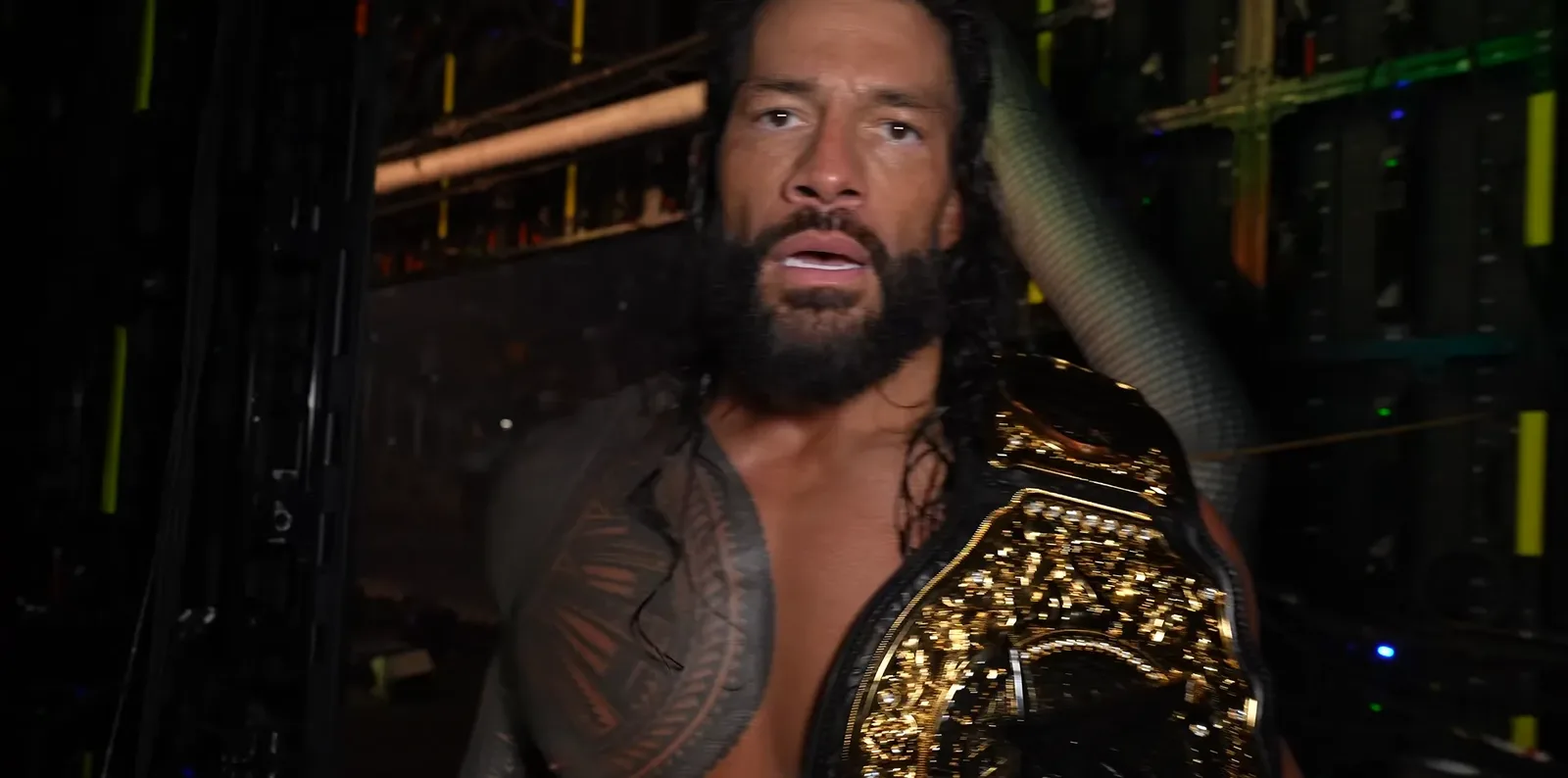
Roman Reigns is not losing sleep over being called overrated.
The WWE World Heavyweight Champion addressed criticism from Conrad Thompson during an extensive appearance on Club Shay Shay. Asked whether Thompson’s description of him as “overrated” bothered him, Reigns made clear that he sees the remark less as a personal slight and more as an example of how attention works in the current media landscape around professional wrestling.
“No, because, I mean, the truth is, are there a lot of people watching that guy’s show? So you’re gonna say stuff,” Reigns said. “I’m a metric mover. That type of stuff. They know I give views and all that stuff, so it’s fine. It is what it is.”
Reigns’ answer was measured, but it also reflected a familiar confidence from a champion who understands the value of his own name in wrestling discussion. Rather than argue the point directly or turn the exchange into a personal dispute, Reigns suggested that strong opinions involving prominent figures can be useful for attracting attention.
For more background on this topic, read WWE Files Trademark for ‘WWE: Survive The Ride’ Covering Video Game and Digital Gaming Uses.
His central message was straightforward: conversation around Roman Reigns generates interest, and that makes him a natural subject for criticism as well as praise. For Reigns, being a major topic of debate is not necessarily evidence of a problem. It is part of the territory that comes with being positioned at the center of WWE’s championship picture.
Reigns Says Attention Is Part of the Business
Reigns described himself as a “metric mover,” a phrase that speaks to his belief that his involvement can drive audience interest and engagement. He did not dispute that people may have differing opinions about his work, his status, or his place in WWE. Instead, he framed Thompson’s comment as an understandable attempt to create discussion in an industry built around personalities, rivalries, and reactions.
“If they want to use my name to get views, that’s the industry right now,” Reigns said.
That response is notable because Reigns did not present the criticism as something requiring a defense of his résumé. He treated it as a predictable part of being a visible champion. Whether fans agree with Thompson’s assessment or side with Reigns, the exchange underlines how often wrestling debates extend beyond what happens in the ring and into conversations about relevance, drawing power, and public perception.
Professional wrestling has always invited strong opinions, particularly around its top stars. Fans routinely debate who should be featured, who deserves championship opportunities, and which performers most effectively connect with the audience. Reigns’ comments place that type of discussion within a broader business context. In his view, public disagreement can have value when it keeps attention focused on a performer.
He also indicated that he was aware of the personal preferences and connections that can influence commentary. Reigns said people can look at Thompson’s background and determine where his support may lie.
“If you look at the guy’s background, you already know where his support system is, you know what I mean?” Reigns said. “All you got to do is scroll a little bit, and you see who he’s a fan of and stuff like that, and who he’s connected to.”
Reigns did not expand on those remarks or identify specific individuals. His broader point was that audiences can consider context when evaluating any public opinion in wrestling. Still, he ultimately returned to the idea that it is simply part of the present-day industry for major names to be used as topics of discussion.
A Champion Coming Off a Successful Title Defense
The interview comes after Reigns successfully defended the WWE World Heavyweight Championship against L.A. Knight at Money in the Bank. Reigns defeated Knight to retain the title, continuing his run as champion following one of WWE’s most significant recent premium live event matches.
That result gives additional context to Reigns’ stance. He spoke about outside criticism while holding the championship and coming off a victory over a major challenger. There was no indication in his comments that Thompson’s opinion had altered his outlook or caused him to question his standing. If anything, Reigns positioned the attention itself as confirmation that his name remains valuable in wrestling conversation.
The title picture often amplifies every debate surrounding the champion. A wrestler holding a top championship is judged not only by match outcomes, but by the response they create from fans, media personalities, and other observers. Reigns appeared comfortable with that scrutiny. His answer suggested that criticism is an expected consequence of being prominently featured, especially when his name can draw interest to a discussion.
That does not mean Reigns accepted Thompson’s “overrated” label. His response did not embrace the criticism, nor did it offer a point-by-point rebuttal. Instead, he minimized its importance by arguing that such statements serve a purpose in a content-driven environment. In doing so, Reigns shifted the focus away from whether the criticism was fair and toward why it was being made in the first place.
No Escalation From Reigns
There was no direct escalation in Reigns’ response. He did not issue a challenge, promise a confrontation, or turn the matter into a larger feud outside WWE programming. His remarks remained focused on the nature of commentary and visibility.
That distinction matters. Wrestling can blur the line between on-screen storytelling and off-screen debate, but Reigns addressed the situation as a question about public opinion rather than as an angle requiring further development. He acknowledged the comment, explained why it did not bother him, and moved on.
His approach may resonate with fans who see public criticism as unavoidable for a top WWE figure. It may also fuel more debate among viewers who believe a champion should answer detractors more forcefully. Reigns, however, gave no sign that he considered the situation important enough to elevate beyond its current level.
Instead, his comments were rooted in a simple calculation: if people are talking about him, then his name remains a meaningful part of the conversation. From that perspective, even negative commentary can underline a performer’s relevance.
The Debate Around Reigns Will Continue
Reigns’ response is unlikely to end the conversation over Thompson’s opinion. Wrestling audiences have rarely been uniform in how they assess top stars, and Reigns is no exception. The “overrated” label is inherently subjective, while Reigns’ counterpoint focused on measurable attention and the value of being discussed.
Those are two different arguments. One concerns creative and in-ring evaluation. The other concerns the ability to attract views, discussion, and interest. Reigns did not attempt to settle the first debate. He argued, instead, that the second explains why his name is continually brought into conversations across the wrestling landscape.
As WWE World Heavyweight Champion, Reigns remains in a position where every defense and every public appearance will be closely examined. His Money in the Bank win over L.A. Knight ensured that he remains champion, while his appearance on Club Shay Shay showed how he views the commentary that follows him outside the ring.
For Reigns, criticism from Thompson was not a distraction. It was another indication that his name carries weight. Whether supporters or critics agree with that assessment, Reigns made his position clear: discussion surrounding him is part of the business, and he is not bothered by it.

Darryl Polo
Darryl Polo is a passionate wrestling fan covering WWE, AEW, TNA and beyond. He loves great rivalries, breakout stars and the moments that keep fans talking long after the bell. How we work.