
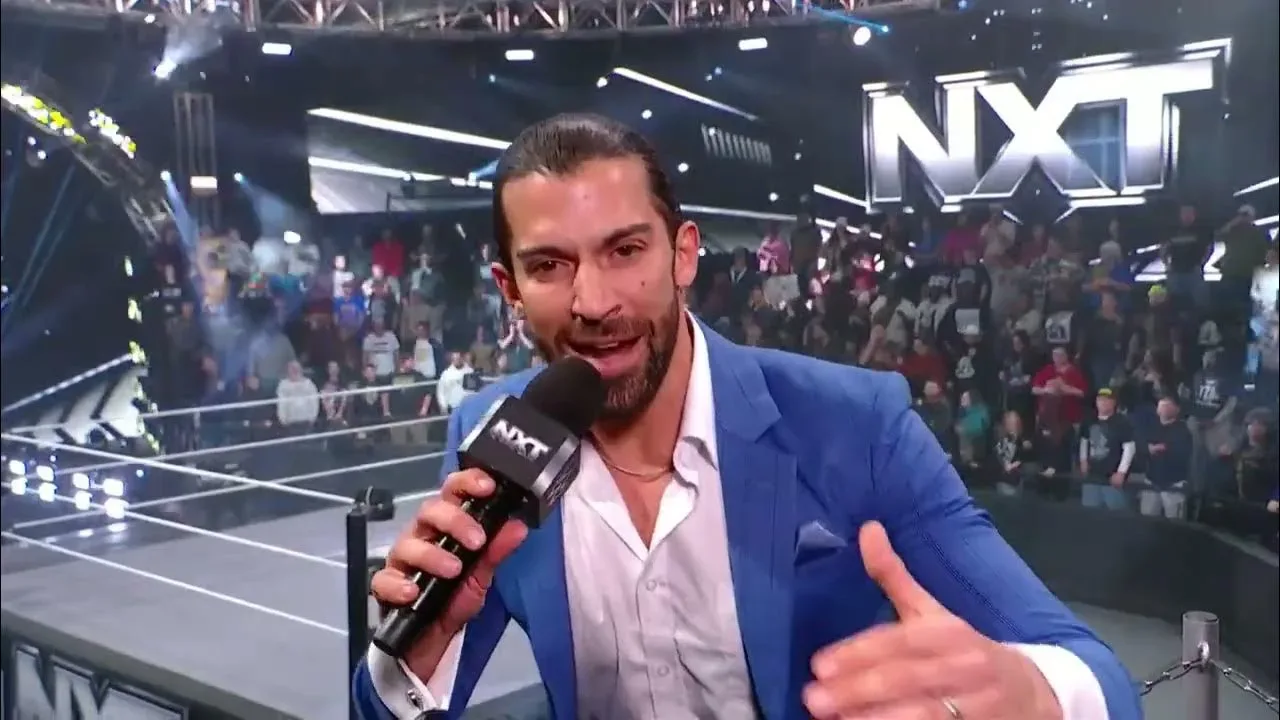
Robert Stone believes his former Robbie E character would have a place in today’s NXT landscape — even if that version of himself might test the patience of the brand’s General Manager.
Stone, who has served as NXT General Manager for almost a year, was asked whether he would sign Robbie E if the former TNA persona walked into his office looking for an opportunity. His answer was immediate: he would do it, largely because he sees the same upside-and-risk balance in Robbie E that he sees in The Vanity Project.
“100%. I mean, Robbie E back then to me is no different than The Vanity Project is now. Super young and talented in the ring. So you want that, but yeah, maybe a few screws loose, maybe a little immature, maybe might get into a little trouble, you know, when they’re not, you know, doing what they’re supposed to do or at NXT. However, you can’t take away the talent. You can’t take away the charisma. You can’t take away what a presence on television like that looks like so I think I’d say, you know what? I’d take a risk on this guy.”
The comparison is notable because Stone is effectively judging his old in-ring identity through the lens of his current on-screen authority position. Robbie E was a distinctly different presentation from the polished executive role Stone now occupies in NXT, but Stone’s remarks indicate that he sees a consistent underlying value in performers who bring personality as well as athletic ability to television.
For more background on this topic, read Izzi Dame Regains NXT Women’s North American Championship From ZARIA.
Rather than dismissing the flaws he associates with Robbie E, Stone framed them as part of the equation a decision-maker must weigh. He described the character as talented and charismatic while acknowledging the possibility of immaturity and trouble away from the core responsibilities of being at NXT. In Stone’s view, those concerns would not erase the potential value of the act.
Stone Sees a Familiar Profile in The Vanity Project
Stone’s reference to The Vanity Project provided the clearest window into how he evaluates the kind of talent Robbie E represented. He characterized both as young, skilled in the ring and capable of creating a memorable television presence. That combination, he suggested, can be worth pursuing even when a performer may need guidance, structure or a closer watch from management.
The idea of taking a risk is central to Stone’s answer. He did not portray Robbie E as a ready-made, problem-free signing. Instead, he presented the character as someone with enough raw ability and charisma to justify the investment. The assessment also fits the larger nature of NXT, where performers and acts can develop their identities while working to turn potential into sustained success.
For Stone, charisma appears to be as important as ring ability in that calculation. His answer repeatedly returned to the qualities that make a wrestler stand out on television: talent, presence and the capacity to command attention. Those are traits he believes could outweigh the potential headaches attached to an unpredictable personality.
That does not mean Stone ignored the complications. His comments specifically left room for the possibility that Robbie E could be immature or could get into trouble when not focused on his responsibilities. But his conclusion remained clear. If he were making the decision in his present role, he would sign the former character and take the chance that the upside would win out.
A Different Role for a Familiar Personality
Stone’s current position offers an interesting contrast with the version of himself he was discussing. As Robert Stone, he is associated with the duties and presence of the NXT General Manager. The role places him in a position to make judgments about the wrestlers and personalities who populate the brand, rather than simply seeking an opportunity for himself.
Robbie E, meanwhile, represents an earlier chapter of Stone’s career in TNA. By comparing that persona to a current NXT act, Stone did not suggest that the two are identical in every respect. His point was broader: each has the kind of youthful talent, confidence and unpredictability that can make an act compelling.
The response also showed a willingness to view a former character with perspective rather than embarrassment. Stone did not distance himself from Robbie E or present the persona as something that would be automatically rejected in a modern environment. He argued that the act had qualities that would still be valuable, especially in a setting built around finding distinctive performers for television.
That perspective matters because it speaks to how Stone separates imperfections from potential. A performer does not have to be fully polished to be worth signing. In fact, Stone’s comparison suggests that the presence of rough edges can be manageable if the person has enough talent and enough natural charisma to justify the effort required to develop them.
Why the Television Presence Matters
Stone emphasized that it is difficult to take away a performer’s talent, charisma or visual presence once those attributes are apparent. That is the heart of his argument for Robbie E. Even with the reservations he listed, Stone believes the character brought something that could register with an audience.
In professional wrestling, a strong television presence can come from many places. It can be confidence, a clear point of view, an ability to provoke a reaction or simply an energy that makes viewers pay attention when someone appears on screen. Stone’s comments did not break down every element of Robbie E’s presentation, but they made clear that he considers that quality a major part of the character’s appeal.
His comparison to The Vanity Project also reinforces the importance of an act being more than technically sound in the ring. Stone praised the in-ring talent involved, but he did not stop there. He placed equal focus on whether a wrestler looks like a star on television and carries a personality substantial enough to make people notice.
That standard is especially relevant for an on-screen General Manager. Stone’s answer was not merely a nostalgic reflection on a previous persona. It was presented as a talent-evaluation exercise. Faced with someone who has evident ability and a magnetic presence but may require discipline, Stone said he would still be inclined to bring that person into NXT.
Stone’s Career Perspective
The remarks arrive during a period Stone has described as particularly rewarding in his career. His current NXT run has given him a new platform and a different kind of responsibility from his work as an in-ring character. Nearly a year into his time as General Manager, Stone has become an established part of the brand’s presentation.
His willingness to imagine signing Robbie E is therefore also a reflection of where he is now. Stone can look back at an earlier version of his wrestling career while considering the traits he values from the perspective of his current position. The answer balances self-awareness with confidence: he recognizes that Robbie E could be difficult, but he also believes the persona had too much ability and personality to overlook.
There is a broader message in that assessment. Stone did not argue that every talented but unpredictable wrestler should receive an opportunity without question. Instead, he argued that the right combination of skill and charisma can make a calculated risk worthwhile. For him, Robbie E fits that description.
Ultimately, Stone’s verdict is uncomplicated. If Robbie E arrived at the NXT General Manager’s office today, Stone would see the concerns, acknowledge the possible trouble and still offer the former TNA character a chance. In his view, the talent, charisma and television presence would make the risk worth taking.

Darryl Polo
Darryl Polo is a passionate wrestling fan covering WWE, AEW, TNA and beyond. He loves great rivalries, breakout stars and the moments that keep fans talking long after the bell. How we work.