
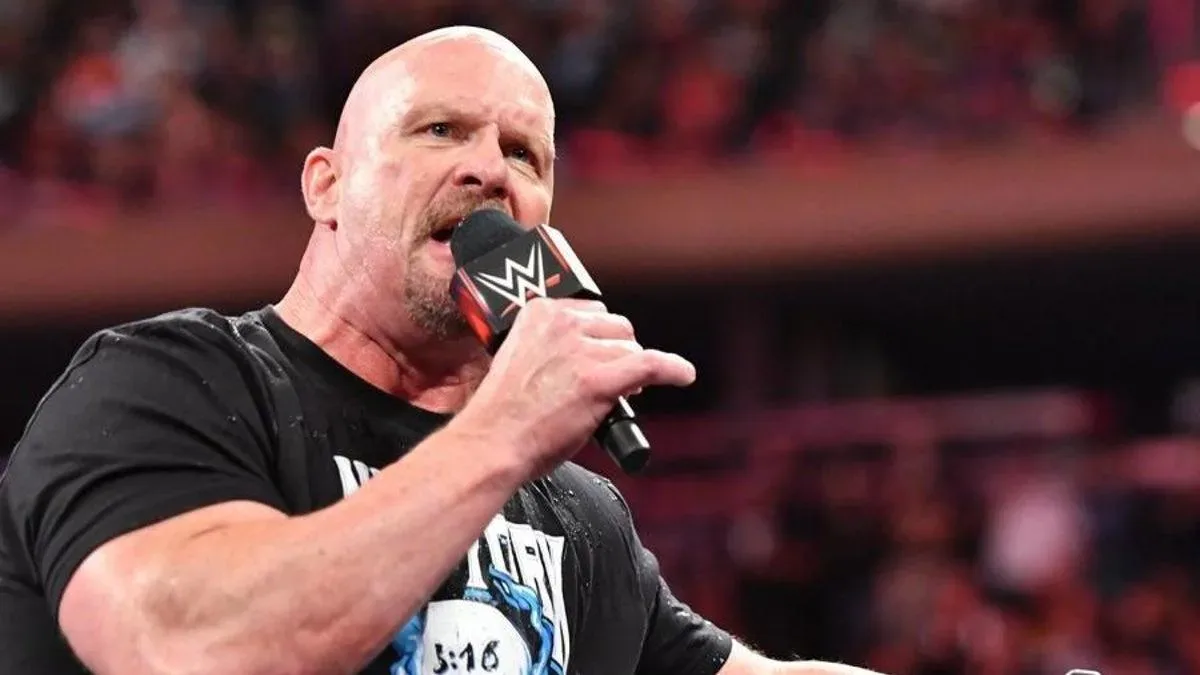
Stone Cold Steve Austin has never lacked confidence when discussing the instincts that made him one of WWE’s most enduring attractions, but the WWE Hall of Famer is not taking full ownership of one of the most recognizable crowd chants in wrestling history. Austin believes the continued life of the “What?” chant is a credit to the fans who adopted it, repeated it and carried it across generations.
More than two decades after Austin’s in-ring retirement, “What?” remains a familiar — and often divisive — part of the WWE live-event experience. It can be heard during promos on weekly television, at premium live events and in arenas filled with viewers who were not even alive when Austin was a full-time member of the roster. The chant has become so ingrained in wrestling culture that it is frequently treated as an automatic audience response whenever a speaker pauses between sentences.
Speaking in a recent interview, Austin was asked about the chant’s unusual longevity and responded with characteristic humility. While he originated the idea, he said the crowd was responsible for turning it into a phenomenon that never truly went away.
“I don’t think I did it,” Austin said. “I just put it out there and the crowd started by buying into it, and they started doing it. I’d give the crowd more credit than I would myself.”
For more background on this topic, read Buddy Matthews Names PAC, Seth Rollins, Roman Reigns Among His Top In-Ring Opponents.
That distinction matters in professional wrestling. Performers can introduce catchphrases, gestures, entrance themes and signature calls, but none of them become lasting pieces of the industry without an audience willing to participate. Austin supplied the prompt. WWE crowds made it interactive, and that audience ownership has allowed “What?” to survive long after the Texas Rattlesnake’s final full-time run.
A Crowd Response That Took on Its Own Life
The “What?” chant is a remarkably simple concept, which may be one reason it became so durable. It requires no memorized lyric, no elaborate timing and no allegiance to a particular current storyline. A fan only needs a pause in a promo, then can answer with a single word. That accessibility gave the chant a life beyond Austin himself.
For Austin, however, there is no grand formula behind why it connected. He described it as an idea that was both foolish and effective, acknowledging that he cannot fully explain the psychology that made audiences embrace it so completely.
“I came up with an idea to do it, and I guess it worked, but I don’t know what the psychology behind it was ‘cause it was so stupid, but also clever,” Austin said. “Somehow, some way it caught on.”
That uncertainty is fitting for a chant that has always operated differently from a traditional wrestling catchphrase. Many of the biggest verbal trademarks in WWE history are meant to reinforce a wrestler’s identity: a declaration of dominance, a rallying cry or a phrase that punctuates a major moment. “What?” became something else. It was a device fans could use themselves, whether Austin was in the building or not.
In that sense, it is not simply a reminder of the Attitude Era or of Austin’s celebrated WWE run. It has become part of the language of wrestling crowds. The chant can instantly change the rhythm of a segment, draw a reaction from the performer in the ring and, on occasion, become the main story of a promo because of how a wrestler chooses to handle it.
Comparing ‘What?’ to the ‘Woo’
Austin compared the chant’s spread to another famous audience sound: Ric Flair’s “woo.” The comparison illustrates how certain wrestling expressions can move past the performers who made them famous. Fans often arrive at shows already making the sound, just as they regularly begin “What?” chants before a promo has developed any obvious connection to Austin.
“Kind of like, in a different psychological aspect than the Ric Flair ‘woo,’ you know, because before shows, everybody’s out there ‘wooing,’ and people started ‘What-ing,’” Austin said.
There are obvious differences between the two. A “woo” is often celebratory, an audible tribute or a burst of excitement. “What?” is more confrontational by design. It interrupts. It challenges. It can be playful, but it can also test the ability of a wrestler to keep control of the microphone and the arena. That has helped make it a particularly notable part of modern promo culture.
Some WWE viewers have grown frustrated with the chant, especially when it repeatedly cuts into a serious storyline or a performer is attempting to establish an emotional tone. Others regard it as a living connection to Austin and an example of the unique, unscripted energy that a live wrestling crowd can bring. Both reactions underscore its unusual power. Few chants provoke such a consistent response from the audience at home and from the talent tasked with speaking through it.
Austin did not present the chant as the result of a carefully calculated master plan. Instead, he described it as something that clicked at the right moment.
“It just something that clicked because of being in the right place at the right time,” Austin said. “I mean, because how else would you explain it, right? … I’d like to act like I’m real smart over here, but I don’t know.”
The Reach of Stone Cold’s Legacy
Austin’s comments also addressed a larger point about his continued relevance to WWE audiences. He retired from active competition in 2003, yet his name, imagery, signature entrance, merchandise and defining moments remain visible within wrestling culture. That reach is especially striking when considering the number of young fans who recognize him despite never seeing his full-time career as it happened.
The WWE Hall of Famer admitted that this remains surprising to him. Asked whether he notices younger fans knowing who he is, Austin said that he does, while also expressing genuine uncertainty about how those fans discovered him.
“Of course,” Austin said. “Man, for some reason, I don’t know why it is, I think I retired, what, 2003, something like that? That’s 23 years ago. And there’s kids that are in grade school that know who I am.”
Austin pointed to several possible avenues, including WWE programming, Netflix and video games, but did not claim to know which has played the largest role. What is clear is that his legacy continues to reach viewers who encountered WWE in a completely different era from the one he helped define.
“I don’t know if it’s the stuff on Netflix or WWE or the video games or, I don’t know what it is,” Austin said. “I don’t even know how they remember who I am. I don’t know how they know who I am. So, it’s a blessing, and I’m real happy about it.”
That attitude also explains why Austin is willing to hand the greatest share of credit for “What?” back to the fans. Wrestling’s most memorable audience traditions can begin with a star, but they become permanent only when spectators decide they belong to them. The chant has outlasted roster changes, creative eras and the original context in which it was introduced because attendees continue to view it as theirs.
An Enduring, Complicated WWE Tradition
Whether fans love it, dislike it or simply expect it whenever a WWE promo slows down, “What?” remains one of the clearest examples of Austin’s influence on the presentation of professional wrestling. Its persistence is also a reminder that the biggest wrestling moments are rarely created by one person alone. They are collaborations between performers and crowds, with the audience ultimately deciding what deserves to live on.
Austin may have put the word into the air, but he sees the sustained reaction as a fan-driven phenomenon. Twenty-three years after his retirement, the sound of “What?” still echoes through WWE arenas — a small, disruptive and unmistakable testament to the connection between Stone Cold Steve Austin and the audience that helped make him immortal.

Darryl Polo
Darryl Polo is a passionate wrestling fan covering WWE, AEW, TNA and beyond. He loves great rivalries, breakout stars and the moments that keep fans talking long after the bell. How we work.