
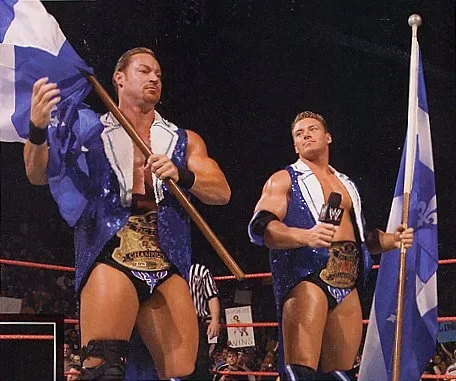
Rob Conway has offered a candid assessment of one of the more recognizable entrance themes associated with WWE’s early-2000s roster: the music used by La Résistance.
La Résistance, the WWE group featuring René Dupree, Rob Conway, and Sylvain Grenier, was formed in 2003 and was active in that form during that year. The act remains remembered for its presentation, its anti-American heel positioning, and an entrance track that had a markedly different feel from the hard-rock and high-energy music commonly attached to WWE performers of that era.
For Conway, that contrast was not a strength. Speaking with Chris Van Vliet, the former WWE Tag Team Champion said he believes fans may find the theme amusing or memorable, but he does not consider it music that created anticipation for a wrestling entrance.
“I don’t think anybody actually likes it. I think they get a kick out of it, because it’s kind of funny, but if you were getting ready to bench press 300 pounds, you wouldn’t say, let me throw on Just Look At Me.”
For more background on this topic, read Tate Wilder Recalls How Three Broken Face Masks Put Him on WWE’s Radar.
Conway’s point was not that the song failed to establish the group’s personality. In fact, its lounge-style sound was closely tied to the act’s identity. Instead, he believes the composition worked against the kind of immediate emotional lift a WWE entrance ideally provides. In Conway’s view, the audience could go from being loud and engaged to suddenly being asked to react to a much softer, more unusual musical cue.
“Let’s say, a month before I come out with La Resistance, the crowd is going crazy. You switch it to that lounge music, and I think Stone Cold could have walked out to it, and people be like, who’s this guy, and why is this music like it is?”
A Theme That Stood Apart From WWE’s Usual Sound
Entrance music has long been a major part of WWE presentation. A theme does more than fill the space between the curtain and the ring. It signals a performer’s arrival, gives fans an immediate cue to react, and can reinforce an established character before a wrestler says a word or throws a punch.
Many of WWE’s most successful entrance themes are built around a clear musical hook, a striking opening sound, or a pace that can match the reaction expected from the crowd. Whether the intent is to inspire cheers, fear, disgust, or excitement, the music often helps an audience recognize the character instantly.
La Résistance’s entrance music took a different route. Its sound was deliberately stylized, fitting the act’s on-screen portrayal and setting it apart from the rest of the roster. That uniqueness has helped make it memorable to viewers years later. However, Conway’s comments underline the difference between music that is memorable in retrospect and music that a wrestler believes is useful in the moment.
He put his opinion in particularly blunt terms.
“I’m just not a big fan. I call it a crowd killer.”
The phrase captures Conway’s central criticism: he felt the theme slowed the momentum that an entrance should generate. A crowd may understand a character’s gimmick and still not respond to the music in the way a performer hopes. For someone waiting backstage to make an entrance, that response matters. The walk to the ring is a chance to establish body language, connect with the audience, and set the tone for the match or segment to follow.
Conway Still Sees the Entrance as a Vital Opportunity
Even with his dislike for the La Résistance theme, Conway made clear that he never viewed the entrance as something to waste. Professional wrestling often requires performers to work within creative decisions they would not necessarily have chosen themselves, whether that involves music, gear, alliances, opponents, or character direction.
Conway said that a wrestler still has to maximize what is available. He acknowledged that wrestlers can share the ring with people they do not get along with, but the work itself demands professionalism and an ability to focus on the opportunity in front of them.
“I’ve wrestled people that I don’t get along with, stuff like, but when you’re out there, you do make the most of it. I mean, it’s your time to shine, and you know your entrance, even though I didn’t like the music, is the only time that, for the most part, it’s 100% focused on you.”
That observation speaks to an important reality of WWE television. A performer’s entrance can be one of the few moments in a match presentation where the audience’s attention is fully centered on that individual. Once the bell rings, the match becomes a shared performance. Promos can involve multiple personalities. Backstage scenes may be brief or divided among several storylines. The entrance, however, provides a wrestler with a concentrated window to define their presence.
For a heel group such as La Résistance, that window also had to accomplish multiple goals at once. The performers needed to project confidence and arrogance, invite negative reactions, and make the act’s presentation understandable to viewers in only a few seconds. Conway’s comments suggest that, while he did not enjoy the song itself, he understood the need to use the moment effectively.
The Music Remains Part of La Résistance’s Legacy
There is a reason the theme continues to be discussed. Wrestling fans often develop a fondness for songs, segments, and characters that were unusual enough to stand apart, even when the talent involved may have had a very different experience performing with them.
Conway acknowledged that people can get a kick out of the La Résistance music because of its comedic quality. That reaction is likely part of why it remains connected to the group in fan conversations. It is not presented as a conventional workout track or a song designed to create a thunderous arena reaction. Its distinctiveness is exactly what has made it hard to forget.
Conway even noted that the song follows him beyond wrestling settings. At the gym he attends, people recognize him and are aware of his WWE past, with his action figures displayed there. On occasion, he said, the music gets changed as he arrives, prompting a reaction from him.
“At the gym that I go to, like, sometimes I’ll walk in and they’ll switch the music, and I’ll look up. They’ve got my action figures and stuff up, but yeah, they know when I look at them like, come on.”
The anecdote illustrates the unusual staying power of wrestling music. A theme can become inseparable from a performer’s public image, regardless of whether that performer ever liked hearing it. In Conway’s case, the association is strong enough that people in his everyday life still recognize the joke and know exactly why the song will get a response.
La Résistance’s Place in WWE History
La Résistance was formed in 2003 with Dupree, Conway, and Grenier associated with the group. The unit’s WWE run in that configuration was limited to that year, but its presentation left a durable impression. The name, the members, the gimmick, and especially the entrance music have all remained part of the early-2000s WWE conversation.
The group’s identity was designed to draw reactions, and the unusual musical choice was a substantial element of that identity. Conway’s perspective does not erase the theme’s effectiveness as a piece of character presentation. Rather, it offers a wrestler’s view from inside the act: a concern that the musical style did not give him the adrenaline, momentum, or crowd response he wanted before competing.
That tension is familiar throughout wrestling. A creative choice can be memorable, distinct, and even successful in helping a character stand out, while the wrestler assigned to it may feel it limits their ability to connect in the way they prefer. Conway’s comments show that he saw the La Résistance theme in precisely those terms.
Still, he also emphasized the approach that allowed him to work through that frustration. Whatever the music was, and whatever personal differences might exist with opponents, the entrance and the match remained opportunities to perform. Conway treated that walk to the ring as a moment to shine, even if he would have preferred a very different soundtrack.
La Résistance last teamed together in 2024. More than two decades after the group first emerged, Conway’s assessment makes clear that its entrance song remains as identifiable as ever—though he would still rather not hear it when it is time to raise the energy in the room.

Darryl Polo
Darryl Polo is a passionate wrestling fan covering WWE, AEW, TNA and beyond. He loves great rivalries, breakout stars and the moments that keep fans talking long after the bell. How we work.