
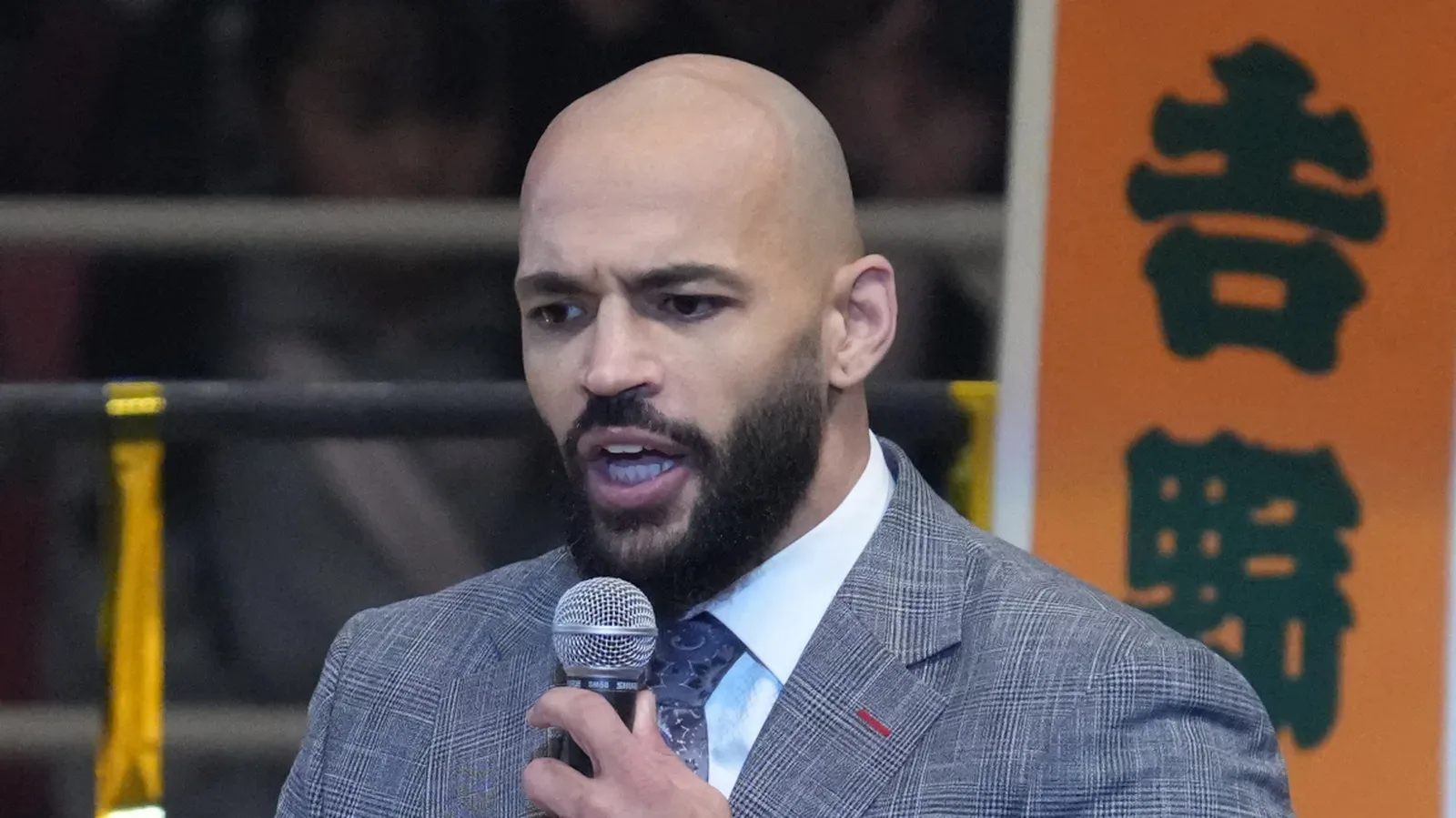
Ricochet’s AEW character has been built around a dramatic change in presentation. Long celebrated as one of wrestling’s most spectacular high-flyers, Ricochet spent much of his career drawing support through remarkable athletic performances and a straightforward babyface identity. In AEW, however, he has leaned into a far different role: an antagonistic, unpredictable figure who seems to take particular satisfaction in disrupting anyone and everyone around him.
That shift has come with an increasingly distinctive set of traits. Ricochet’s high-pitched villainous laugh, his willingness to irritate fans, and his embrace of chaos have made the former aerial standout feel considerably different from the competitor many fans knew for years. Now, Ricochet has explained that there are clear comic-book roots behind that approach.
In a recent interview, Ricochet pointed to several DC Comics villains as key inspirations for the persona he has developed in AEW. The most prominent comparison was the Joker, a character synonymous with disorder and the enjoyment of chaos for its own sake.
“Someone like the Joker, I think, who obviously thrives in chaos, I think is somebody I take a lot of inspiration after, because Ricochet himself in AEW, he just likes to cause chaos,” Ricochet said. “You know, whether that leads to something or not, he just wants to cause chaos. So that’s something that I connect with.”
For more background on this topic, read Speedball Mike Bailey Vows to Fight Back After Continental Classic Opening Loss.
The comparison explains a great deal about the current version of Ricochet. His villainy is not presented solely as an effort to climb the rankings or claim championships, even though he has done both. There is an added sense that creating a problem is itself part of the objective. The character has found ways to make his presence felt through arrogance, agitation and unpredictability, turning reactions that once celebrated his athleticism into reactions driven by frustration.
Ricochet also named Lex Luthor and Reverse-Flash as influences, identifying a more calculating side to his on-screen personality. While the Joker comparison speaks to disorder and provocation, Luthor and Reverse-Flash represent preparation, intelligence and the ability to make damage happen through planning rather than pure impulse.
“And then someone like Lex Luthor, or Reverse Flash, who has the intellect to think of strategy ahead, especially someone like Lex Luthor who uses his strategic mind and his resources around to [inflict] damage onto others as you would say, someone like that.”
That blend of inspirations offers a useful description of Ricochet’s AEW run. The character is chaotic, but not necessarily careless. He can be loud, petty and deliberately obnoxious, yet he also has allies and accomplishments that demonstrate the value of working within a larger strategy. Ricochet’s heel presentation has not been limited to a new attitude; it has translated into a significant collection of achievements since he arrived in AEW.
A Champion With Demand
Ricochet became the first-ever AEW National Champion, adding a defining early milestone to the title’s history. He also captured the AEW World Trios Championships alongside Bishop Kaun and Toa Liona, his partners in Demand. The group has given Ricochet a setting in which the more strategic aspect of his villain persona can operate. Kaun and Liona provide power and physical intimidation, while Ricochet brings speed, experience and the ability to redirect attention in an instant.
Demand’s success has reinforced the idea that Ricochet is no longer functioning as an isolated performer whose main appeal rests entirely on breathtaking moves. He remains capable of delivering the kinds of athletic moments that made him a standout, but his AEW identity has put more focus on his personality, alliances and willingness to exploit circumstances. The trio championship reign, in particular, showed that Ricochet could fit into a unit without abandoning the individual edge that has defined his current work.
His comments about Luthor’s use of resources are especially fitting in that context. Ricochet’s character has people around him who can be deployed as part of a broader plan, and that creates a different threat than an opponent acting alone. Luthor is often associated with using intellect, influence and available tools to overpower adversaries who may be physically stronger. Ricochet’s version of that idea does not need to duplicate the character directly to benefit from the same core principle: find the advantage, then press it.
Reverse-Flash is another telling choice. The character’s association with speed makes the influence a natural fit for Ricochet, but the more important connection is the combination of speed with cruelty and foresight. Ricochet has long had the physical gifts to overwhelm opponents when a match accelerates. As a heel, those gifts can now be framed less as an inspirational display and more as a weapon used to frustrate opponents and audiences alike.
From Athletic Hero to Unpredictable Antagonist
Ricochet’s career reputation was established through extraordinary movement, timing and innovation. That background can make a heel turn challenging, particularly for a wrestler whose appeal has often been tied to fans wanting to see what he can do next in the ring. The AEW version of Ricochet has addressed that challenge by making the audience’s reaction part of the performance.
Rather than trying to hide the qualities that made him popular, Ricochet has repurposed them. The athleticism remains available whenever the moment calls for it, but it is now accompanied by a smugness and volatility designed to create a different emotional response. The villainous laugh has become a memorable element of that change, while the character’s comments and behavior have made clear that he is comfortable being an irritant.
The comic-book comparisons also give the persona a useful internal logic. A Joker-inspired character does not need every action to be noble, fair or even purely practical. Chaos can be the point. At the same time, Luthor and Reverse-Flash provide a counterbalance, allowing Ricochet to be seen as someone who can think ahead and use the right opening to his benefit. Together, those elements help explain how Ricochet can be both reckless-looking and dangerous in a deliberate way.
There is also a broader visual and tonal connection between comic-book supervillains and professional wrestling. Larger-than-life characters, recognizable mannerisms and clear motivations have always had a place in wrestling. Ricochet’s current approach takes advantage of that tradition without requiring a literal costume or direct imitation. The inspiration is visible through the character’s behavior: the pleasure in provoking chaos, the confidence that he can outthink others, and the willingness to use every available advantage.
WrestleDream Marked Ricochet’s Most Recent AEW Match
Ricochet has been away from AEW in-ring competition over the last month. His most recent match came at WrestleDream, where he competed in the first-ever Clockwork Carnage match for the AEW Men’s World Championship. The bout featured eight men and placed Ricochet in one of the promotion’s most high-profile championship settings.
Despite the opportunity, Ricochet did not leave with the title. Will Ospreay retained the AEW Men’s World Championship, ending Ricochet’s bid to add another major singles prize to his AEW résumé. Even in defeat, the match remained a notable appearance because of its historic stipulation and the scale of the championship field.
The WrestleDream result also underscores the distinction between Ricochet’s chaos-driven persona and his championship ambitions. He has already proven capable of collecting gold in AEW, both as the inaugural National Champion and as one-third of the World Trios Champions. But the AEW Men’s World Championship is a different pursuit, one that places him against the company’s leading singles competitors and requires a path through increasingly difficult opposition.
For now, Ricochet’s comments offer the clearest window into the thought process behind his recent evolution. His AEW character is not simply an inversion of the fan favorite he once was. It is a persona built from contrasting villainous traits: the Joker’s appetite for disorder, Lex Luthor’s calculated use of strategy and resources, and Reverse-Flash’s blend of speed, intelligence and menace.
Whether Ricochet’s next AEW appearance resumes his pursuit of the top singles title, refocuses on his championship responsibilities with Demand, or opens another avenue for his disruptive character, the blueprint is now apparent. He wants the audience to expect chaos, but not to mistake chaos for a lack of purpose. In Ricochet’s version of AEW villainy, the laugh may be the loudest signal, but the planning behind it can be just as important.
In pictures

Darryl Polo
Darryl Polo is a passionate wrestling fan covering WWE, AEW, TNA and beyond. He loves great rivalries, breakout stars and the moments that keep fans talking long after the bell. How we work.