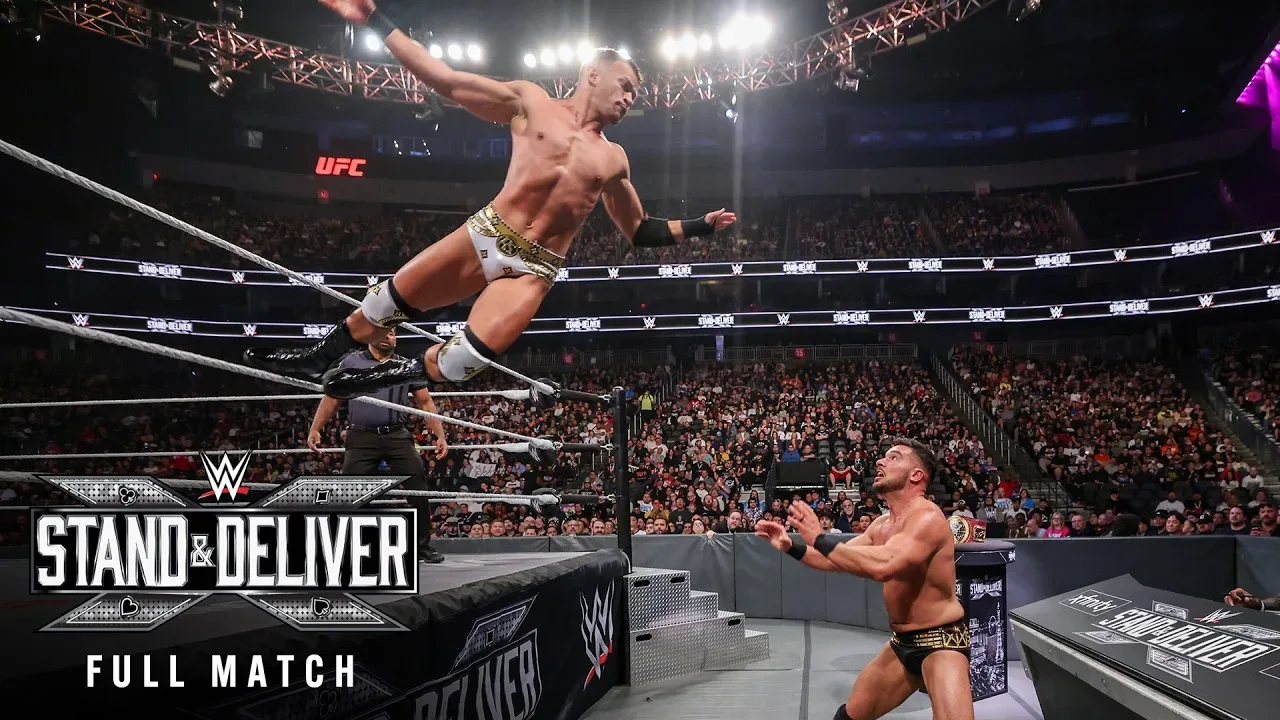
Ricky Saints has built a reputation as one of the more adaptable performers in wrestling, capable of changing the pace of a match, leaning into character work, and drawing from several different approaches once the bell rings. But Saints does not view himself as a natural aerial wrestler, even if his size and occasional rope-walking spots can create that impression.
Speaking on Huge Pop with Donnie DaSilva and Jimmy Korderas, Saints was asked about something he feels he is not especially good at. His initial answer was playful, mentioning guitar playing and politicking before identifying an aspect of in-ring action that does not always come easily to him: leaping from the top rope.
“If you asked the internet, I’m not good at playing guitar [laughs]. I don’t know, politicking? I don’t know what I’m not good at….you know what, actually, I’m not that good at a lot of jumping off the top rope. I get up there and I’m very unathletic in my head. The way that I think I’m jumping and the reality of it are two different things.”
It is a revealing assessment from a wrestler whose broader presentation can sometimes suggest a more acrobatic style. Saints has performed old-school rope walks, a move that requires balance, timing, and confidence while navigating the ropes. That visual can make a wrestler appear entirely at home above the ring, even if taking flight from the turnbuckles is not the part of their craft they trust most.
For more background on this topic, read Ava Says She Hopes Her In-Ring Wrestling Career Is Not Over After WWE Exit.
DaSilva pointed out that Saints looks natural when he comes off the ropes during the old-school spot. Saints acknowledged that his stature can shape the way audiences perceive his in-ring identity, though he said he never truly considered himself a high-flyer.
“Sometimes it feels like an obstacle, but I never really thought of myself as that.”
That distinction is important. Wrestling styles are often reduced to quick descriptions: technical wrestler, powerhouse, brawler, striker, high-flyer, or a blend of two familiar categories. Saints does not seem interested in choosing one of those labels as a permanent definition of who he is in the ring. Rather than framing top-rope offense as a required component of his work, he sees it as one potential tool among many.
Saints explained that there was a period when he attempted to identify exactly what kind of wrestler he was. Looking around at other wrestlers who were coming up at the same time, he saw performers who could identify themselves with a clear specialty. For Saints, the answer became less about adopting a single recognizable lane and more about embracing the variety that already existed within his work.
“There was a time I was trying to figure out what style I am, and I just came to the point where I don’t really have a specific style that I do. These guys that I was coming up with were like, ‘I’m a technical wrestler.’ I can do kind of all of it, but I’m more of a pastiche type guy. Everything is a blend of a blend of a blend. That does sometimes bite you in the butt, but I don’t really let it bother me. I don’t like those type of restraints.”
Saints Rejects the Need for a Single In-Ring Label
Saints’ use of the word “pastiche” gets to the center of his outlook. He is not presenting his style as a pristine version of one tradition. Instead, he sees his approach as a collection of influences and elements that can be adjusted from one situation to the next. That could mean taking a more technical route in one match, becoming more physical in another, or relying more heavily on personality and timing when the moment calls for it.
The approach also helps explain why Saints is comfortable admitting that one particular type of move is not a natural strength. In a wrestling environment where spectacular aerial offense often receives immediate attention, there can be an expectation for performers to add bigger and riskier top-rope maneuvers to their arsenal. Saints’ comments suggest he does not see value in forcing himself into that role simply because the visual fits assumptions tied to his size or athletic presentation.
His point was not that he cannot go to the top rope or that he avoids it completely. He specifically referenced the disconnect between the way he imagines a jump and the reality of executing it. The self-awareness is notable because wrestling requires performers to understand their own limitations as well as their strengths. A move is only useful if it fits the wrestler performing it, the opponent receiving it, and the story of the match.
For Saints, rope-walking can be effective precisely because it brings a different kind of drama than a conventional high-flying sequence. It draws attention to balance and anticipation. The audience sees the wrestler traverse the rope and recognizes the risk before the move reaches its conclusion. That does not necessarily make Saints a high-flyer; it makes the spot another piece of a broader repertoire.
AAA Cruiserweight Title Opportunity in Mexico City
Saints’ comments arrived around a significant championship opportunity. He challenged Rey Fenix for the AAA Cruiserweight Championship on Friday’s SmackDown in Mexico City.
The setting added another layer to the matchup. Rey Fenix is one of the most recognized wrestlers associated with lucha libre’s fast-paced, aerial tradition, and Mexico City is a fitting stage for an AAA championship contest. Saints’ own description of himself as a blended performer created a natural contrast with an opponent whose explosiveness and aerial ability have long been central to his identity.
That contrast does not mean Saints needs to attempt to out-fly Rey Fenix to be competitive. His comments make clear that he would rather draw from the full range of his own game than accept a restriction based on what others expect from him. If a match calls for a technical exchange, Saints believes he can work in that space. If it becomes more physical, he can adapt there as well. If the moment requires movement and risk, he can incorporate those aspects without allowing them to define his entire approach.
It is also the kind of philosophy that can be useful in a championship match. Challenging for a title does not always require a wrestler to prove they are better than the champion at the champion’s preferred style. Often, it requires finding a way to make the match something different. Saints’ comments indicate that he values that flexibility, even while recognizing the occasional downside of not having a single, easily explained identity.
Versatility as Both Strength and Challenge
Saints openly conceded that his refusal to settle into a narrow category can “sometimes bite you in the butt.” There is a practical truth in that. A specialist has a simple calling card. Fans can quickly understand what a technical wrestler, powerhouse, or high-flyer is bringing to a match. A performer who blends several styles may have more to prove in establishing a distinct identity from one opponent or program to the next.
Still, Saints does not appear concerned about that tradeoff. His rejection of “those type of restraints” reflects a desire to keep evolving rather than conform to a preset template. He can acknowledge that top-rope jumping is not his favorite or most instinctive skill without letting that admission become a limitation placed on everything else he does.
That balance may be the clearest takeaway from Saints’ remarks. He is neither claiming mastery of every aspect of professional wrestling nor accepting the notion that a wrestler must be defined by a single specialty. He sees room for technical work, physicality, movement, showmanship, and character-driven moments within the same overall package.
As Saints continues to pursue major opportunities, including his AAA Cruiserweight Championship challenge against Rey Fenix on SmackDown in Mexico City, that versatility remains central to his presentation. The top rope may not be where he feels most naturally athletic, but Saints is comfortable finding other ways to make his matches stand out—and he has no interest in allowing one label to dictate what he can be.
Darryl Polo
Darryl Polo is a passionate wrestling fan covering WWE, AEW, TNA and beyond. He loves great rivalries, breakout stars and the moments that keep fans talking long after the bell. How we work.