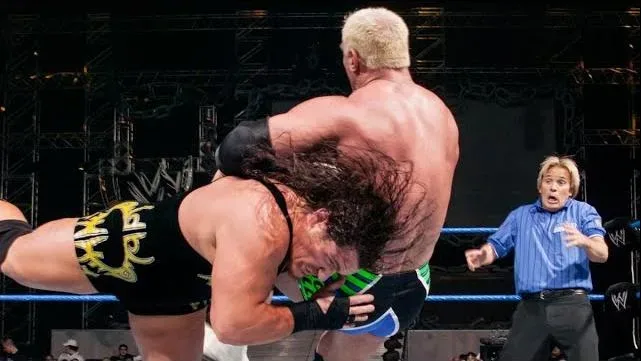
Rhino’s Gore became one of the most recognizable impact moves in modern professional wrestling, a full-speed collision that has long been associated with the former ECW and WWE powerhouse. Yet Rhino says he was not immediately interested in making it part of his offense.
Speaking on the Johnny Pro Show, Rhino looked back on the unexpected path that turned the move into a defining part of his career. His initial reluctance was rooted in the fact that other wrestlers had already used a similar tackle, particularly Goldberg, who had made it an enormously popular part of his own presentation.
Rather than risk being viewed in the locker room as someone copying another wrestler’s signature, Rhino initially preferred not to use it at all. A request from Tracy Smothers, however, put the move in motion. What Rhino viewed as a one-time spot ultimately became a staple, acquired a memorable name through Paul Heyman, and later became a finishing move after advice from Steve Lombardi during Rhino’s WWE run.
Rhino Did Not Expect the Gore to Last
Rhino explained that there was no grand plan for the Gore to become his defining move. It began as a practical question from Smothers about whether Rhino could perform it in a match. Rhino could do it, but he was not enthusiastic about the idea.
For more background on this topic, read Matt Hardy Expects Roman Reigns vs. Penta to Elevate Challenger on WWE Raw in Mexico City.
“I didn’t know I was going to stick with it. It was just one of those things where Tracy Smothers asked me if I could do it,” Rhino said. “I didn’t want to do it because Edge started doing it, Adam, and then Goldberg was the one that got it over.”
Rhino’s concern was not about executing the move. It was about presentation and perception. In wrestling, signature maneuvers often become inseparable from the performers who popularize them. Rhino felt Goldberg had already elevated the tackle to such a level that adding it to his own arsenal could invite accusations that he was taking another wrestler’s idea.
“So then I started doing it because Tracy asked me if I could do it in a match, and I didn’t want to do it. I was hesitant. I didn’t want to be a move stealer or something like that because Goldberg got it so over,” Rhino said.
Smothers’ response cut through those reservations. Rather than engaging the concern about how others might react, Smothers focused on whether Rhino was physically capable of doing the move.
Rhino recalled Smothers telling him, “I didn’t ask you what the guys in the locker room may think. I asked you if you could do it.”
Rhino answered that he could, and that was enough for Smothers. The exchange captures the practical nature of how many in-ring ideas emerge: not always through elaborate long-term planning, but from an immediate need in a match and a wrestler’s willingness to test something new.
An Independent Match in 1996 Changed Everything
Before it became a signature, Rhino said he had used the move once in 1996 on an independent show. Even after performing it, he did not see it as something he would carry forward.
“So I did it one time in 96 on an independent show, a guy asked me to do it,” Rhino said. “The promoter at the time was explaining how to do it, and I’m like, well, ‘I’ll never do that again.’ I literally thought that to myself after I hit that, ‘I’ll never do that again.’”
That reaction makes the eventual outcome especially notable. The maneuver Rhino believed he would abandon became one of the elements most closely tied to his name. It also shows that a move’s future is not always obvious in the moment. A wrestler may be uncertain about its fit, its visual appeal, or the audience response. Sometimes the presentation around a move, the timing of its use, and the performer applying it determine whether it becomes ordinary offense or a career-defining calling card.
For Rhino, the move found a separate identity once it was given a distinct name. He credited Paul Heyman with calling it the Gore, an important development in separating Rhino’s version from other tackles and spears used across wrestling.
A name can matter greatly in wrestling because it gives fans a cue to react before the move even lands. The Gore was not merely described as a tackle or a spear; it became a moment with its own language, rhythm, and expectation. Once the move had that identity, it could be presented as an event within a match rather than simply another piece of offense.
Paul Heyman Supplied the Name
Rhino was direct in crediting Heyman for the name that became synonymous with him.
“Then Paul Heyman gave it the name Gore,” Rhino said.
That concise recollection is a key part of the move’s history. The name gave Rhino’s version a specific character. It suggested something more forceful and violent than a conventional spear, matching the physical style that Rhino brought when he charged forward and drove through an opponent.
There is also a difference between a move existing and a move being understood by an audience. Once fans recognize the setup and know what is coming, the move can generate anticipation. A named signature gives commentators, crowds, and opponents a shared vocabulary. In Rhino’s case, “Gore” became the word that signaled the potential end of a match.
Rhino’s comments do not diminish the impact Goldberg had in getting a similar type of maneuver over. In fact, Rhino openly acknowledged Goldberg’s success as the very reason he hesitated. The important distinction in Rhino’s story is that he eventually developed a version and a presentation that audiences associated with him.
Steve Lombardi Suggested It Become the Finish
The move’s role grew even more during Rhino’s time in WWE. Rhino said he was unable to use a piledriver there, leading to a discussion about how the Gore could serve as his finish.
“Then when I went to WWE, I couldn’t use a pile driver. So Steve Lombardi actually told me I should use it as a finish, and the rest is history,” Rhino said.
That was a major turning point. A signature move can be used to change momentum, set up a finishing sequence, or establish a wrestler’s intensity. A finishing move, however, carries a different responsibility. It needs to look decisive, suit the wrestler’s persona, and provide a clear conclusion when the match calls for it.
By Rhino’s account, the limitation on using the piledriver created an opening for the Gore to take on that role. What started as a move he did not want to use became an answer to a practical WWE restriction and, eventually, the attack most connected to his in-ring identity.
The story also illustrates how wrestlers often adapt when entering a new environment. Moves that may be available in one setting are not always available in another. In that situation, performers must find alternatives that preserve their credibility and still fit the way they work. Rhino found that alternative in something he initially considered a move he would never repeat.
Rhino Draws a Line Between the Gore and a Spear
Rhino also addressed a long-running point of discussion among wrestling fans: whether the Gore is simply another spear. His answer was emphatic. In his view, the two are not the same thing, particularly when it comes to how a match should end.
“Just to clear everything up, there’s a big difference between a gore and a spear,” Rhino said. “Nobody’s ever kicked out of a Gore. So if they kick out, it becomes a spear.”
The line was delivered with the confidence expected from a wrestler defending the legacy of his signature move. Rhino’s point is rooted in the importance of the finish. A spear may be a major offensive weapon for many wrestlers, but Rhino views the Gore as a definitive match-ending attack. Under his own rule, the lack of a successful kickout is what preserves the Gore’s status.
That distinction also reflects the larger way wrestling fans evaluate moves. The mechanics may appear similar at a glance, but execution, momentum, positioning, reaction, and results all shape how a maneuver is perceived. A move becomes more than its basic physical description when a performer consistently presents it with a particular level of force and finality.
Rhino’s career-long association with the Gore did not begin with a decision to copy what had already been successful elsewhere. It began with hesitation, a challenge from Tracy Smothers, and a single use on an independent show that Rhino assumed would be his last. Paul Heyman gave the attack its unforgettable name, while Steve Lombardi recognized its potential as a WWE finishing move.
Years later, Rhino’s story remains a reminder that some of wrestling’s most enduring trademarks emerge from uncertainty. The move he once feared would make him look like a “move stealer” became the one that helped define him. And as Rhino sees it, there is only one standard by which the distinction can be settled: if an opponent kicks out, it was a spear. If not, it was the Gore.

Darryl Polo
Darryl Polo is a passionate wrestling fan covering WWE, AEW, TNA and beyond. He loves great rivalries, breakout stars and the moments that keep fans talking long after the bell. How we work.