
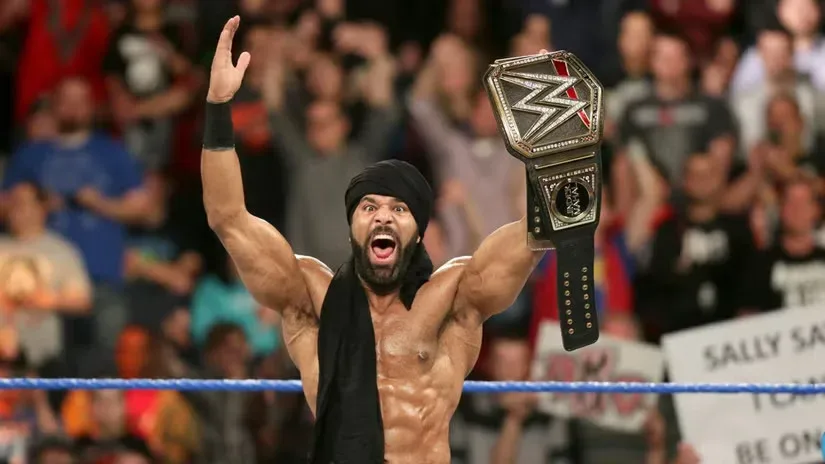
Raj Dhesi has challenged the way some fans evaluate his WWE Championship reign, responding directly after being described online as a “failure” and a “glorified jobber.”
Dhesi, who performed in WWE as Jinder Mahal, won the WWE Championship once during his time with the company. His reign began in 2017 and lasted 170 days before AJ Styles defeated him for the title on an episode of WWE SmackDown.
Rather than simply arguing over opinions of his presentation or the matches that took place during that stretch, Dhesi questioned what concrete standard is being applied when people call the run unsuccessful. His response focused on the business measurements that can potentially be used to assess a championship program, including television viewership, ratings and revenue.
View the referenced post on X
“Genuinely curious, what tangible measure are people using to determine that it was a failure? Viewership? Ratings? Revenue? Something else?”
For more background on this topic, read Spike Dudley Revisits the Undertaker Spot He Pushed to Make Happen on WWE Raw.
Dhesi asks for a measurable standard
The exchange highlights a familiar divide in wrestling discourse. A title reign can be judged in very different ways depending on the person making the assessment. Some fans prioritize match quality, weekly booking, crowd reactions, major-event performances or the champion’s overall momentum. Others look more closely at business indicators, media attention, sponsorship opportunities, ticket demand or whether a particular act helped a promotion reach audiences it may not otherwise have reached.
Dhesi’s question does not offer a specific statistical claim about his reign. Instead, it asks critics to identify the evidence behind the word “failure.” That distinction is central to his response. Calling a championship run disappointing, unmemorable or creatively ineffective is ultimately a matter of personal interpretation. Calling it a business failure suggests that there is a measurable outcome available to support that conclusion.
The former WWE champion specifically raised viewership, ratings and revenue as possible benchmarks. Those are all terms commonly invoked in modern wrestling debates, although fans do not always have access to the full internal information needed to make definitive judgments about any individual performer or title program. Television numbers may be publicly discussed in some form, but revenue and broader company strategy involve many moving parts beyond a single champion.
By framing the issue in those terms, Dhesi pushed the conversation away from a simple insult and toward a broader question: what should a WWE Championship reign actually be expected to accomplish before it is labeled successful or unsuccessful?
A 170-day WWE Championship tenure
Dhesi’s sole WWE Championship run remains one of the defining chapters of his WWE career. Working under the Jinder Mahal name, he captured the title in 2017 and held it for 170 days. The reign ended when AJ Styles won the championship on an episode of SmackDown.
That basic record is not in dispute. What remains debated among fans is how the run should be remembered. WWE title reigns are often revisited years later through a range of lenses: the champion’s place on the roster at the time, the stories surrounding the title, the level of competition, the reaction from audiences and the company’s creative direction.
In Dhesi’s case, the discussion is also shaped by the contrast between how audiences had seen him at earlier points in his WWE tenure and where he was positioned after becoming champion. That kind of rapid rise is frequently met with strong reactions in wrestling, particularly when the performer involved is placed at the center of WWE’s most prominent championship picture.
Supporters and critics can reasonably come away from the same reign with different impressions. One viewer may see a significant championship opportunity and a lengthy title tenure. Another may focus on the storytelling and presentation that surrounded it. Dhesi’s response does not demand that everyone regard the run as a creative success. It challenges the certainty of declaring it an objective failure without identifying the metric used to reach that judgment.
The difference between creative opinion and business assessment
Wrestling fans regularly blend creative criticism with business language. A disliked storyline may be called bad for business. A polarizing champion may be described as a ratings problem. A title change can be framed as proof that a particular act did not work. Those conclusions can sometimes reflect real trends, but they can also be based primarily on audience taste.
Dhesi’s wording draws a line between those two forms of analysis. He did not say that every fan had to enjoy his WWE Championship run. He asked what tangible evidence people are using when they go beyond opinion and make a claim about failure.
That is a useful distinction in evaluating any performer’s run at the top of a promotion. A championship reign is rarely responsible for a company’s performance by itself. Weekly television is influenced by the full card, competing programming, time slots, promotion, major stories, broader audience habits and many other factors. Financial performance is broader still. Revenue does not rest solely on the shoulders of one wrestler, regardless of how prominent that wrestler may be on television.
At the same time, championships are designed to place a performer in a highly visible role. It is understandable that fans scrutinize a champion’s matches, promos, opponents and ability to carry a weekly program. The debate becomes more complicated when subjective criticism is presented as settled business fact.
Dhesi’s post addresses that complication directly. His questions about viewership, ratings and revenue indicate that he is looking for something more substantial than the longstanding online tendency to repeat a label until it is treated as accepted history.
Why the conversation continues
The WWE Championship carries enormous symbolic weight. Wrestlers who hold it are not only evaluated on what they do in the ring, but also on what their reign represents within a particular era. As a result, former champions are often discussed long after they have lost the title, and those discussions can become especially intense when a reign was divisive in real time.
Dhesi’s tenure is a clear example of that dynamic. The fact that it is still being debated shows how strongly fans remember the period, even if they disagree on its quality or impact. For some, longevity is an important part of the story: he held WWE’s top championship for 170 days. For others, the more important questions concern how the reign was received and how it compares with other title programs.
Neither approach is automatically invalid. The point Dhesi raised is that the standard should be clear. If the criticism is aesthetic or creative, it can be expressed that way. If the claim is that the reign failed in business terms, then it is reasonable to ask what business evidence supports it.
That conversation has only become more relevant as wrestling discussion increasingly overlaps with data-driven debate. Ratings, viewership figures and revenue discussions now feature prominently in arguments about promotions and performers. Yet those numbers are often used selectively, and they do not always reveal the full story behind a creative decision or a company’s priorities.
Dhesi remains active in the discussion
The response is the latest example of Dhesi engaging with wrestling-related discussion on social media. He has also recently addressed WWE’s often-discussed 90-day non-compete clause in another social media post, explaining his view that it is not a real thing.
For now, his latest comments are likely to keep attention on his WWE Championship tenure and the larger question he presented to critics. Dhesi has not attempted to dictate how fans should feel about the reign. Instead, he has asked them to separate personal assessment from a claim that can supposedly be proven through tangible results.
His 2017 title run ended with AJ Styles taking the WWE Championship on SmackDown, but the arguments surrounding that 170-day stretch have clearly not ended. Dhesi’s challenge is straightforward: if the reign is to be called a failure, what exactly is the measurable case for saying so?

Darryl Polo
Darryl Polo is a passionate wrestling fan covering WWE, AEW, TNA and beyond. He loves great rivalries, breakout stars and the moments that keep fans talking long after the bell. How we work.