
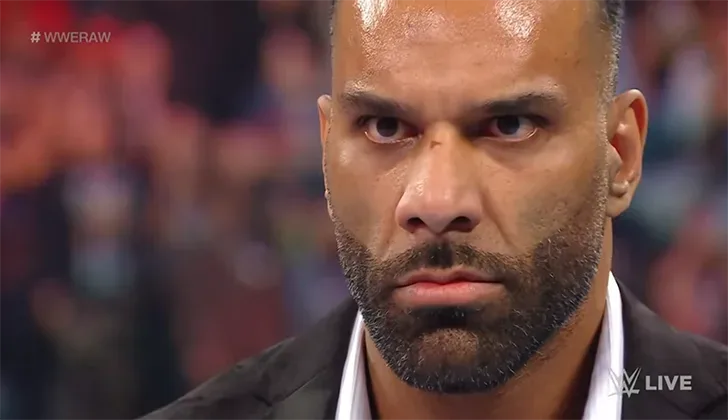
Raj Dhesi has taken another major step in his career beyond the wrestling ring, making his feature-film debut in Strong Son, which premiered at the Toronto International Film Festival on September 11. The former WWE Superstar, known to wrestling audiences as Jinder Mahal, co-stars in the Ian Bawa-directed film and has discussed why the opportunity represents an exciting new chapter.
Dhesi’s path from WWE television to an independent film premiering at one of North America’s most prominent film festivals is not something he views as a sudden departure from performance. Instead, he sees acting as a natural continuation of work that has always been central to professional wrestling, while also recognizing that the two disciplines demand very different skills.
Speaking with Popternative, Dhesi reflected on first becoming aware of TIFF years before he ever had a film of his own entering the event. He recalled attending a WWE show in Toronto during the festival in 2011, a period before his better-known WWE runs as Jinder Mahal and as part of 3MB.
“Bro, I’m inspired. I’m actually inspired,” Dhesi said. “So, the first time I even heard about TIFF was in 2011. WWE had a show during TIFF. And in those days — this is pre-Rockstar days, pre-3MB days — I went out and partied, and like every place was bumping. And I asked, ‘What’s going on?’ They’re like, ‘It’s TIFF, it’s a film festival.’”
For more background on this topic, read John Cena Praises Nattie and TJ Wilson’s Investment in The Dungeon 2.0.
At the time, Dhesi was focused entirely on building his wrestling career. Over a decade later, he has arrived at the festival as a member of a film’s cast, an accomplishment that has offered a new perspective on the possibilities available after a lengthy run in WWE.
From WWE Performance to a Film Set
Dhesi’s WWE tenure included several distinct phases. He initially appeared on the main roster before becoming part of 3MB, later returned to the company after time away, and ultimately reached the top of the card when he captured the WWE Championship in 2017. Those experiences placed him in front of live crowds of vastly different sizes and made him accustomed to delivering character-driven performances under pressure.
That background has carried over to his work in Strong Son, though Dhesi is clear that professional wrestling does not automatically translate into screen acting. He described acting as a “natural progression” after wrestling, but emphasized that he had to adapt his instincts for the camera.
“At that time, I was just focused on wrestling,” Dhesi said. “But then post-wrestling obviously, I want to do acting, right? It’s a kind of a natural progression. So, as you mentioned, Strong Son is my debut film, directed by Ian Bawa. I’m excited to do more, brother. It’s like wrestling, but it’s very different. But the performance, it’s acting at the end of the day.”
The comparison is understandable. Wrestling requires performers to portray emotion, establish relationships with an audience, react in real time, and remain committed to a character even when plans change. Dhesi said his ability to make adjustments proved useful on the set of Strong Son, particularly because Bawa allowed performers room to bring their own voice to certain moments.
In the film, Dhesi plays a professional wrestler, an overlap that allowed him to draw directly from his experience. He has a monologue centered on pro wrestling and its terminology, including references to concepts such as babyfaces and heels. Rather than forcing him to adhere rigidly to every word on the page, Dhesi said the director gave him flexibility to shape the material.
Improvisation Was a Key Wrestling Skill
For Dhesi, the freedom to adjust dialogue was an area where years in wrestling offered a distinct advantage. WWE performers must often respond to changing audience reactions, timing issues, live television constraints, and the unpredictability of an in-ring environment. The ability to think quickly is essential, particularly for talents who have spent significant time speaking live in front of arenas full of fans.
“Being flexible on set,” Dhesi said when asked what he took from wrestling into the film. “Ian gave us creativity to do things our way. In this film I have essentially a monologue where I’m talking about pro wrestling — I’m a professional wrestler also in this film, coincidentally — where I’m talking about wrestling.”
“And the words that I’m using, babyface and heel, and he gave me flexibility. And I wasn’t tied to like the script as it was written, he gave me a little bit of wiggle room. Which, wrestling prepared me for the ability to improvise and think on the spot and adjust on the spot.”
That adaptability is a valuable asset for any performer, but Dhesi did not present wrestling as a substitute for learning the specifics of screen acting. Instead, he addressed a misconception that can follow wrestlers who seek opportunities in movies or television: the assumption that cutting WWE-style promos and playing to an arena means someone is already prepared for the demands of a film set.
Wrestling presentation is intentionally broad. A performer may need to communicate an emotion to fans seated far from the ring, project a voice over a loud crowd, and make physical mannerisms unmistakable on a large stage. Film acting, by comparison, can rely on the smallest facial change, a restrained vocal delivery, or a brief reaction captured in close-up.
A Different Scale of Acting
Dhesi explained that he had to learn how to operate at that smaller scale. He also revealed that he began taking acting lessons during the last year and a half of his WWE time, providing him with a foundation before his feature-film debut.
“But the acting style is so different in WWE,” Dhesi said. “It’s over the top; you’re projecting in a big stadium. Acting on film or television is very subtle. It’s very small. And oftentimes, WWE wrestlers think they know how to act because of the WWE style, but it’s completely different. I luckily started acting lessons the last year and a half of my time in WWE.”
His comments underline the increasingly visible route from wrestling into other entertainment fields. Wrestlers bring unusual experience with live pressure, physical storytelling, character work, and media appearances. Yet the move into scripted film and television also requires a willingness to be coached, to understand technical production demands, and to recalibrate a performance for an audience watching through a camera rather than from the upper levels of an arena.
Dhesi’s openness about the difference is notable because it frames Strong Son not simply as a celebrity appearance, but as the result of preparation and a deliberate effort to study a new craft. His stated desire to pursue more acting work suggests the TIFF premiere is a starting point rather than a one-off experiment.
Strong Son and the Conversation Around Masculinity
Beyond the personal milestone of a debut film, Dhesi hopes audiences engage with the themes at the center of Strong Son. He said he wants the project to encourage conversation about masculinity, emotional vulnerability, and mental health.
Professional wrestling has historically been associated with displays of toughness and physical dominance, making Dhesi’s emphasis on vulnerability particularly relevant to both the subject matter of the film and the public image he carried during his career. His message is not that strength and vulnerability are opposites. Rather, he argues that asking for help and speaking honestly can be part of taking care of oneself.
“I just want people to open up the dialogue for the idea of masculinity,” Dhesi said. “Men oftentimes, we have this facade of masculinity, and always proving that we have to be tough. It’s okay to be vulnerable. It’s okay to lean on other people. It’s okay to open up the discussion, seek therapy, anything to help your own mental health.”
That objective gives Strong Son a purpose beyond Dhesi’s transition from wrestling to acting. The film’s TIFF premiere introduced his work to a festival audience, while its underlying themes invite a broader discussion about the pressures men can face to conceal their emotions or avoid seeking support.
For Dhesi, the journey has come full circle in an unexpected way. He first encountered the energy surrounding TIFF while traveling with WWE in 2011. Fifteen years later, his own debut feature has premiered at the festival, and he is looking ahead to further acting opportunities with a clearer understanding of both what wrestling taught him and what he still wants to learn.

Darryl Polo
Darryl Polo is a passionate wrestling fan covering WWE, AEW, TNA and beyond. He loves great rivalries, breakout stars and the moments that keep fans talking long after the bell. How we work.