
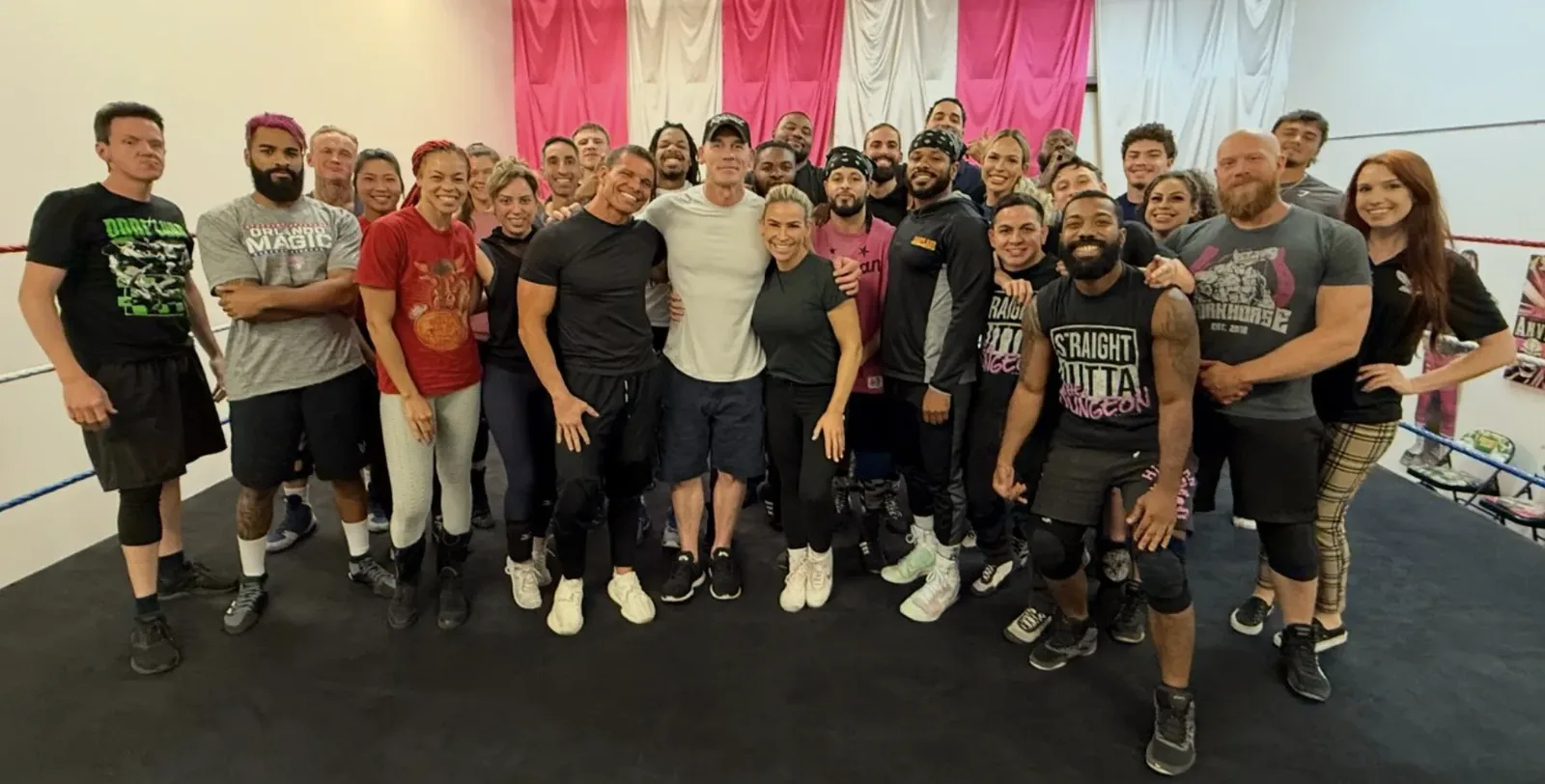
John Cena has offered high praise for Nattie and TJ Wilson, describing the pair’s work at The Dungeon 2.0 as an unusually selfless investment in the next generation of professional wrestling talent.
Speaking during Edmonton Fan Expo, Cena discussed his visits to the training space operated by Nattie and Wilson. The former WWE Champion has previously spent time at The Dungeon 2.0, observing wrestlers and offering feedback to a group that has included WWE names such as Angelo Dawkins, Liv Morgan and Maxxine Dupri, along with Brodie Lee Jr., Marcus Mathers, Avery Styles and others.
For Cena, the defining element of the program is not simply the quality of instruction. It is the fact that the operation is invite-only and does not charge its trainees. He viewed that approach as a reflection of the people running it and their desire to help performers improve without making the training process a financial transaction.
“TJ and Nattie are awesome,” Cena said. “They’re awesome folks. They move through space with kindness.”
For more background on this topic, read CM Punk Set To Guest Star On September 22 Episode Of ‘RJ Decker’.
Cena characterized Wilson as a “kind curmudgeon,” noting that he has a dry, sarcastic side while still carrying a genuine desire to bring the best out of the people around him. It is a description that fits Wilson’s long-standing reputation as both a respected in-ring veteran and a trusted wrestling mind. Since injuries ended his active career, Wilson has continued to make an impact through coaching and producing, while Nattie remains one of WWE’s most experienced and respected performers.
Their work with The Dungeon 2.0 also continues the legacy attached to the Hart family’s original Dungeon in Calgary. The name carries enormous historical weight in wrestling, with the Hart family training environment becoming synonymous with discipline, technical skill and an uncompromising commitment to the craft. Nattie and Wilson’s version has its own identity, but it maintains a central principle of passing knowledge along to people with the drive to use it.
Cena Appreciates the No-Fee Model
Cena said the absence of fees stood out to him immediately. Rather than operating as a conventional school in which students pay for access to ring time and instruction, The Dungeon 2.0 is built around invitations and mentorship. Cena said Nattie and Wilson are effectively putting their own resources into helping wrestlers develop, with no direct financial return required.
“They wouldn’t be doing what they’re doing — keep in mind, there’s no fees at the Dungeon,” Cena said. “It’s invite only. You don’t pay, and they make you better.”
He connected strongly with that philosophy, explaining that it echoed the influence of mentors from earlier in his own life. Cena framed the couple’s approach as a personal bet on people they believe can grow, rather than a business arrangement based on immediate profit.
“They just bet on folks they believed in,” Cena said. “I think that speaks volumes about them as people, to be able to invest their own money with no return on investment rather than just the joy they get from watching people passionate about the business.”
That kind of environment can be particularly meaningful in wrestling, a business where aspiring performers often face significant costs before they have a realistic path to earning money. Training fees, travel, equipment, medical needs and time away from regular employment can all become barriers. A program that removes at least some of those burdens gives selected trainees a chance to concentrate on learning the art form and absorbing lessons from people who have lived it at the highest level.
It also places added significance on the invitation itself. Cena’s comments make clear that The Dungeon 2.0 is not presented as an open enrollment operation. The people who enter are being trusted with an opportunity, and the coaches are choosing to devote time and resources because they see something worth developing.
The Value of Active Feedback
When asked about what he taught during his time at The Dungeon 2.0, Cena resisted portraying himself as a hands-on in-ring instructor. He retired from wrestling in December 2025 after facing Gunther in his final match, and he was direct about the physical toll accumulated across a career that spanned more than two decades.
“What did I teach? I’m retired, and I’m retired for a reason. I’m scuffed up,” Cena said. “If I had any life left, I wouldn’t be teaching in a ring. I’d be trying to fall down in front of an audience, because that’s what I love the most.”
Instead, Cena described his role as one of observation and active feedback. That distinction is important. A performer with Cena’s experience can spot choices that may not register to someone who is focused on executing a sequence, hitting a move or proving athletic ability. The feedback does not necessarily need to involve demonstrating a hold or physically directing a drill. Sometimes it comes from identifying what is missing from a performance and explaining why it matters.
Cena said the issue he sees most often, including during his visit to The Dungeon 2.0, is the lack of attention paid to the smallest elements of a match or segment.
“The little things,” Cena said. “People don’t stress the little things. The little things can make what we do beautiful.”
That philosophy has been central to Cena’s own evolution as a WWE performer. While his career included spectacular matches, major championship reigns and some of the company’s biggest events, his strongest work was often built around timing, facial expressions, crowd interaction, escalation and the ability to make a simple reaction feel consequential. Those are the skills that turn athletic action into emotional storytelling.
The Small Details That Make Wrestling Work
Cena pointed to several prominent WWE stars as examples of performers who understand how much can be gained from seemingly minor choices. He named CM Punk, Sami Zayn, Roman Reigns, Cody Rhodes, Randy Orton and Shawn Michaels while discussing the value of detail-oriented work.
“I think CM Punk is doing some of his best work with the little things,” Cena said. “I think Sami Zayn, Roman Reigns, Cody Rhodes — Randy is the king of the little things. A performer like Shawn Michaels is the king of the little things.”
Each name represents a different style and generation, but Cena’s point was not about copying any one performer. It was about understanding the power of a pause, a glance, a change in body language, a well-timed reaction or a moment of hesitation before a major move. Such details can make an audience feel that a match is unfolding in real time rather than as a series of planned athletic exchanges.
Orton has long been praised for his patience and precision, while Michaels is widely regarded as one of wrestling’s most complete storytellers. Reigns’ character work, Rhodes’ emotional connection with audiences, Zayn’s underdog credibility and Punk’s ability to create tension through expression and pacing all illustrate different ways that subtle choices can deepen a performance.
Cena said those small pieces are what pull viewers to the edge of their seats and keep them invested. The goal is not merely to show that an athlete can perform difficult maneuvers. The goal is to give those maneuvers a reason to matter.
He acknowledged that young wrestlers commonly fall into the trap of trying to prove their physical capabilities at every opportunity. It is an understandable instinct, particularly in training environments where performers want to demonstrate progress and stand out. But Cena argued that athleticism alone is not the final destination.
“As a young performer, you just want to show what you can do,” Cena said. “All these kids are trying to get better, just trying to show that they can do stunts, and that they’re athletes. You need to have the little things. The little things make the magic.”
That message does not diminish the value of conditioning, technique or innovation. Rather, it places them within the wider objective of wrestling: making people care. A dramatic near fall means more when the audience understands the desperation behind it. A basic strike can draw a louder reaction than a complicated sequence if the moment has been properly built. A look toward the crowd, an opponent’s wounded expression or a deliberate delay can change the temperature of an entire match.
A Meaningful Endorsement for The Dungeon 2.0
Cena’s comments amount to a significant endorsement of Nattie and Wilson’s work. He praised not only their character and commitment, but also the mentorship model they have created. Their willingness to offer an invite-only, no-fee opportunity aligns with Cena’s belief in giving passionate performers a real chance to improve.
His feedback also provides a useful mission statement for anyone entering that room. The next generation can train to become stronger, faster and more spectacular, but Cena’s message is that lasting connection comes from the choices between the big moments. Wrestling’s magic is often found in the details that are easiest to overlook.
For The Dungeon 2.0, that is an especially fitting lesson. The facility is rooted in a lineage built on teaching, discipline and trust. With Nattie and TJ Wilson continuing to invest in selected wrestlers, and with veterans such as Cena willing to share their perspective, the program remains focused on helping performers develop more than just a move set. It is helping them learn how to make an audience feel something.
In pictures

Darryl Polo
Darryl Polo is a passionate wrestling fan covering WWE, AEW, TNA and beyond. He loves great rivalries, breakout stars and the moments that keep fans talking long after the bell. How we work.