
Raj Dhesi has offered a candid reassessment of WWE’s NIL recruiting initiative, admitting that he initially viewed the company’s push to sign college athletes as a questionable use of resources. Years later, after seeing talent emerge from that system, the former WWE Champion says he has changed his mind.
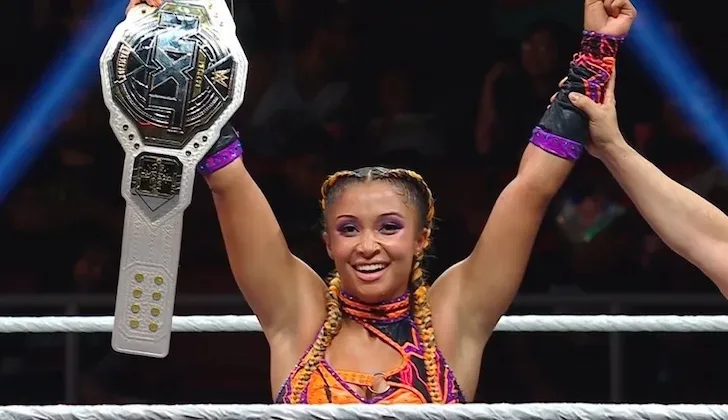
Dhesi, known to WWE fans as Jinder Mahal, discussed the program while appearing on Busted Open Radio. His comments arrived in the wake of NXT Heatwave, where Kendal Grey and Kelani Jordan competed in a widely praised championship match. Both Grey and Jordan entered WWE through the NIL pathway, giving their bout added significance in the broader discussion of how WWE develops new talent.
For Dhesi, the match was an example of why the initiative deserves credit. While he stressed that athletic credentials alone do not guarantee success in professional wrestling, he believes Grey and Jordan showed the rare combination of physical ability, timing, and storytelling instincts needed to thrive in WWE.
Dhesi Was Not Sold on WWE’s College-Athlete Strategy
WWE’s NIL program was created to identify and recruit athletes from collegiate sports backgrounds, offering performers an entry point into the company’s developmental structure. The philosophy differs from the more traditional path of spending years working independent promotions before being signed by WWE. Instead, the program seeks athletes who may have limited or no prior wrestling experience but possess the physical traits, competitive background, and coachability to transition into sports-entertainment.
For more background on this topic, read Lex Luger Says He Is ‘Feeling Great’ as Rehabilitation Progress Continues.
Dhesi was around when WWE began pursuing that approach, and he did not immediately see the upside.
“I was there when WWE started this initiative of signing athletes, the NIL, the college athletes,” Dhesi said. “I’ll admit, at the time, I didn’t agree with it. I was skeptical of it. I thought this was a waste of time.”
That is a notable perspective from someone who understands the demands of WWE performance from the inside. Dhesi’s career included multiple stints with the company, a WWE Championship reign, and extensive experience performing in front of global audiences. His concern was not necessarily about whether athletes could execute physically impressive moves. The greater question was whether someone arriving from another sport could grasp the creative and emotional elements that separate professional wrestling from conventional athletic competition.
Wrestling requires performers to work safely with an opponent while maintaining a believable competitive framework. At the same time, they must understand crowd reactions, pacing, character work, television production, and the narrative purpose behind every sequence. A prospect can be an exceptional athlete and still struggle to become a complete WWE performer.
Dhesi acknowledged that reality in explaining why he has revised his initial judgment. He remains clear that succeeding after an athletic background takes more than raw talent, but he sees evidence that WWE’s recruitment approach can find the special individuals who make that leap.
“Now, fast forward a couple of years, I can admit I was wrong,” Dhesi said. “And it takes a very, very special type of performer to come from an athletics background and make it in the world of WWE and entertainment and truly get it and tell a beautiful story in your match.”
Grey vs. Jordan Provided a Major Showcase at NXT Heatwave
Dhesi pointed directly to Kendal Grey and Kelani Jordan’s championship encounter at NXT Heatwave as proof of the potential within the NIL system. The bout gave the two performers 22 minutes on television, a substantial amount of time and a meaningful platform for a match built around both athletic execution and competitive drama.
Grey emerged with the championship, and Dhesi specifically highlighted the finish. Rather than offering only general praise, he focused on the precision required during the closing sequence, in which Grey stepped and pulled off the cover over an exposed turnbuckle.
“I haven’t seen a finish like that in a very long time,” Dhesi said. “The precision of Kendal Grey stepping and pulling off the cover over the exposed turnbuckle. Amazing. What a display of athleticism. What a display of storytelling. 22 minutes these women had on television. Amazing match.”
The comments place equal importance on the two elements Dhesi identified: athleticism and storytelling. The exposed-turnbuckle element created a potentially dangerous variable within the contest, while Grey’s movement and cover transformed that situation into the decisive moment. A finish like that asks the wrestlers to be exact in their positioning and timing, but it also has to make sense to viewers watching the action unfold. That is where Dhesi sees the difference between merely executing a sequence and effectively telling a story.
For Grey and Jordan, the Heatwave contest represented more than a showcase of their individual skills. It also served as a high-profile reflection of a development model that has sometimes prompted skepticism among longtime wrestling observers. There is a natural concern whenever a major company emphasizes athletes with backgrounds outside wrestling, particularly when countless wrestlers build their careers through the independent scene and traditional training routes.
However, WWE’s NIL initiative does not eliminate the need for development. If anything, it places an even greater premium on the performance center environment, coaching, repetition, and television experience needed to turn an athlete into a credible in-ring personality. Dhesi’s remarks recognize that not every recruit will make that transition. His praise was specifically for those who can absorb the unique language of wrestling and apply it under the spotlight.
A Changing View of WWE Development
Dhesi’s willingness to say he was wrong is particularly striking because the NIL strategy represented a major shift in the way WWE identifies prospects. Traditional wrestling experience remains valuable, and performers who have developed their craft across independent promotions bring their own strengths to WWE. Yet the NIL model broadens the search, opening doors for competitors from sports backgrounds that may include amateur wrestling, gymnastics, football, track and field, cheerleading, basketball, and other disciplines.
Those recruits often arrive with experience in structured training systems, high-pressure competition, travel, coaching, and the discipline required to perform physically at an elite level. What they must then learn is the art of professional wrestling itself: how to make an audience care, how to create momentum in a match, and how to convey a character through movement and expression as much as dialogue.
Dhesi’s assessment suggests that Grey and Jordan have demonstrated meaningful growth in those areas. His use of the phrase “tell a beautiful story in your match” is especially revealing. Wrestling storytelling is not simply a matter of having a dramatic finish. It involves establishing stakes, responding to an opponent’s offense, building escalation, and ensuring that the conclusion feels connected to everything that happened before it.
By praising the 22-minute length of the Heatwave match, Dhesi also emphasized the trust placed in both women. Longer matches require conditioning, concentration, and a greater command of structure. They provide room for momentum shifts and deeper character expression, but they also increase the opportunity for mistakes if performers are not prepared. In Dhesi’s view, Grey and Jordan made the most of that opportunity.
Grey Prepares for Her First Title Defense
Grey’s momentum will be tested quickly. She is scheduled to appear on tonight’s episode of NXT for her first defense of the championship she won at NXT Heatwave. Her challenger will be Jaida Parker, setting up an immediate test for the new titleholder.
A first title defense can establish the tone of a champion’s reign, particularly in NXT, where the division consistently presents emerging names alongside performers looking to make a statement. Grey now enters that position with the attention that comes after a major Heatwave victory and with a veteran former WWE Champion publicly commending her work.
Jordan, meanwhile, remains an important part of the conversation surrounding WWE’s NIL success. Even in defeat at Heatwave, Dhesi’s remarks made clear that he saw both competitors as contributors to an “amazing match.” The performance was not framed solely as a victory for Grey, but as a showcase made possible by the abilities of both wrestlers.
As WWE continues to invest in athletes entering through the NIL system, matches such as Grey vs. Jordan will likely be closely watched as measuring sticks for the program’s effectiveness. Dhesi’s opinion has shifted from skepticism to praise, but his reasoning remains grounded in a central point: the recruiting model only works when an athlete develops into a wrestler capable of connecting their physical gifts to compelling in-ring storytelling.
At NXT Heatwave, Dhesi believes Kendal Grey and Kelani Jordan did exactly that.

Darryl Polo
Darryl Polo is a passionate wrestling fan covering WWE, AEW, TNA and beyond. He loves great rivalries, breakout stars and the moments that keep fans talking long after the bell. How we work.